Triumph TR6 Interior
A wooden facia with two big dials in front of the driver, bucket seats in leathercloth, and changes year by year: reclining seats for 1970, new instruments and a battery meter for 1973, and American seats with head restraints from the start.
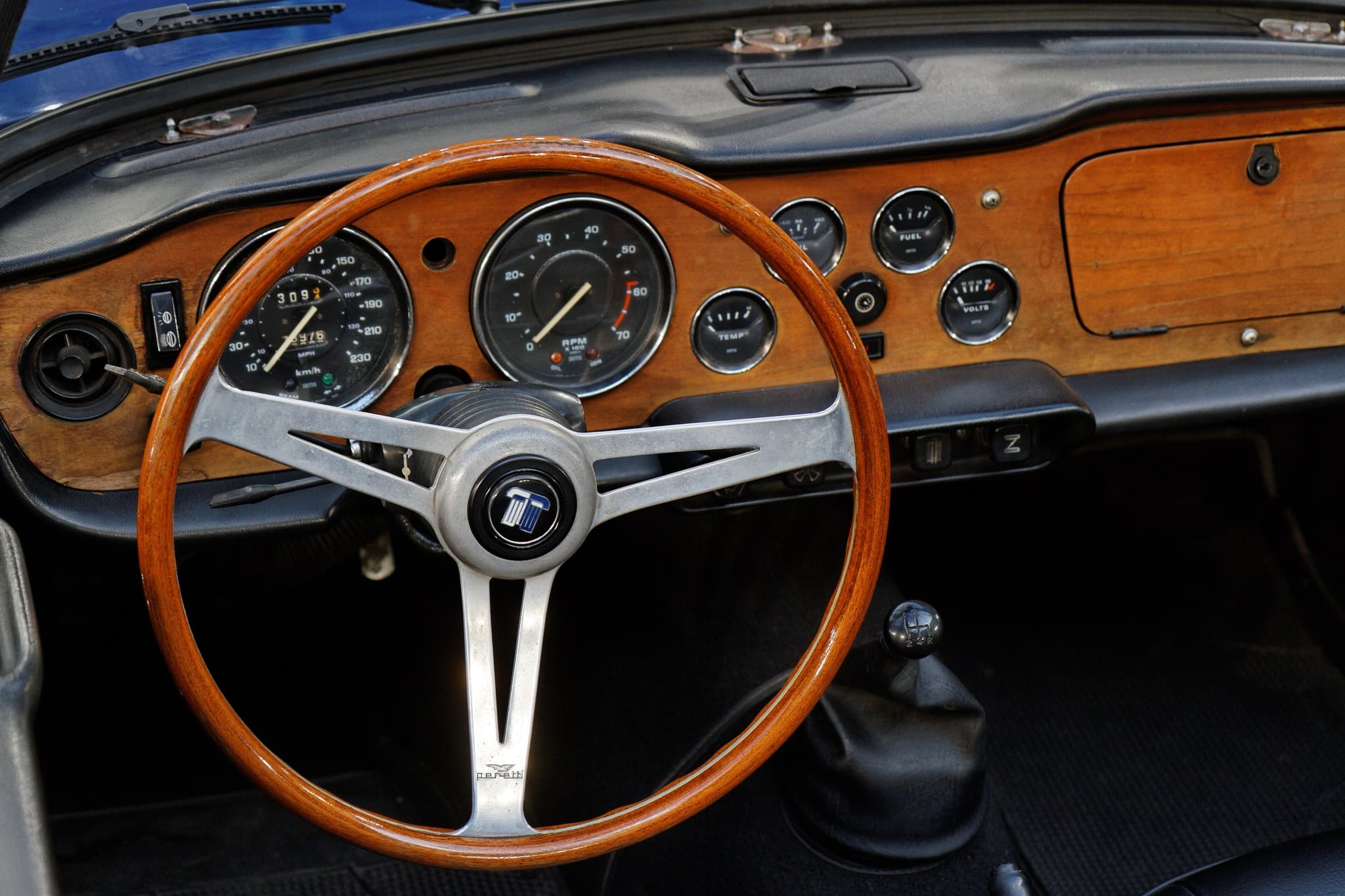
The TR6's cockpit is very nearly the TR5's. Classic & Sports Car calls the two interiors near-identical, and Aaron Severson writes that the facia came from the TR5 and the TR250, whose switchgear had been changed for the American safety rules of 1 January 1968. The facia is wood: "Non-glare wood finish", the British brochure called it, and the American importer a walnut finish. In front of the driver are two large dials, the rev counter and the speedometer, with smaller dials for fuel, water temperature, oil pressure and, on the early cars, an ammeter, their lighting dimmed by a rheostat. The seats were faced in leathercloth, perforated so that it breathed, and the floor had full carpet over thick felt. The brochure gives each seat 483 mm (19 in) of width, 1,232 mm (48½ in) between the doors and 915 mm (36 in) of headroom above the cushion. Clive Richardson liked what he saw:
The interior trim is typically Triumph and typically attractive, if one likes wood facia, which I do.
Year by year
| Year | What changed inside |
|---|---|
| 1969 | A dished steering wheel with black spokes pierced with holes; seats that do not recline; on American cars, high-backed seats with folding head restraints and a leather-rimmed wheel |
| 1970 | Reclining seats; a flat wheel with silver anodised spokes; the ignition switch on the column of American cars, with the steering lock |
| 1971 | Black spokes again on the wheel of American cars |
| 1973 | Restyled instruments, the small dials' needles pointing upwards, with a battery-condition meter where the ammeter had been; the dip switch moved to the column; a slightly smaller steering wheel; lamps beneath the facia; trim that resists fire; mountings for head restraints |
| 1974 | New door trims with pulls in the middle; Chestnut and Beige trims in fire-resistant material, by the Vintage Triumph Register's list, though the importer called Beige new for the 1975 model year; on American cars, an aerial and two speakers built in, and interlocked seat belts |
The years are model years on American cars, which began the autumn before; Severson dates the reclining seats from late 1969. The instrument lighting may have changed too: the importer's description of 1969 and the British brochure of 1970 give it as blue, while Richardson's car of 1973 had green, and no source read dates the change. A trim code beginning with H on the commission plate means leather, Rimmer notes; the colours page gives the trims by name.source 6source 3source 7source 2source 5source 1source 8source 9source 10
Cockpits 4
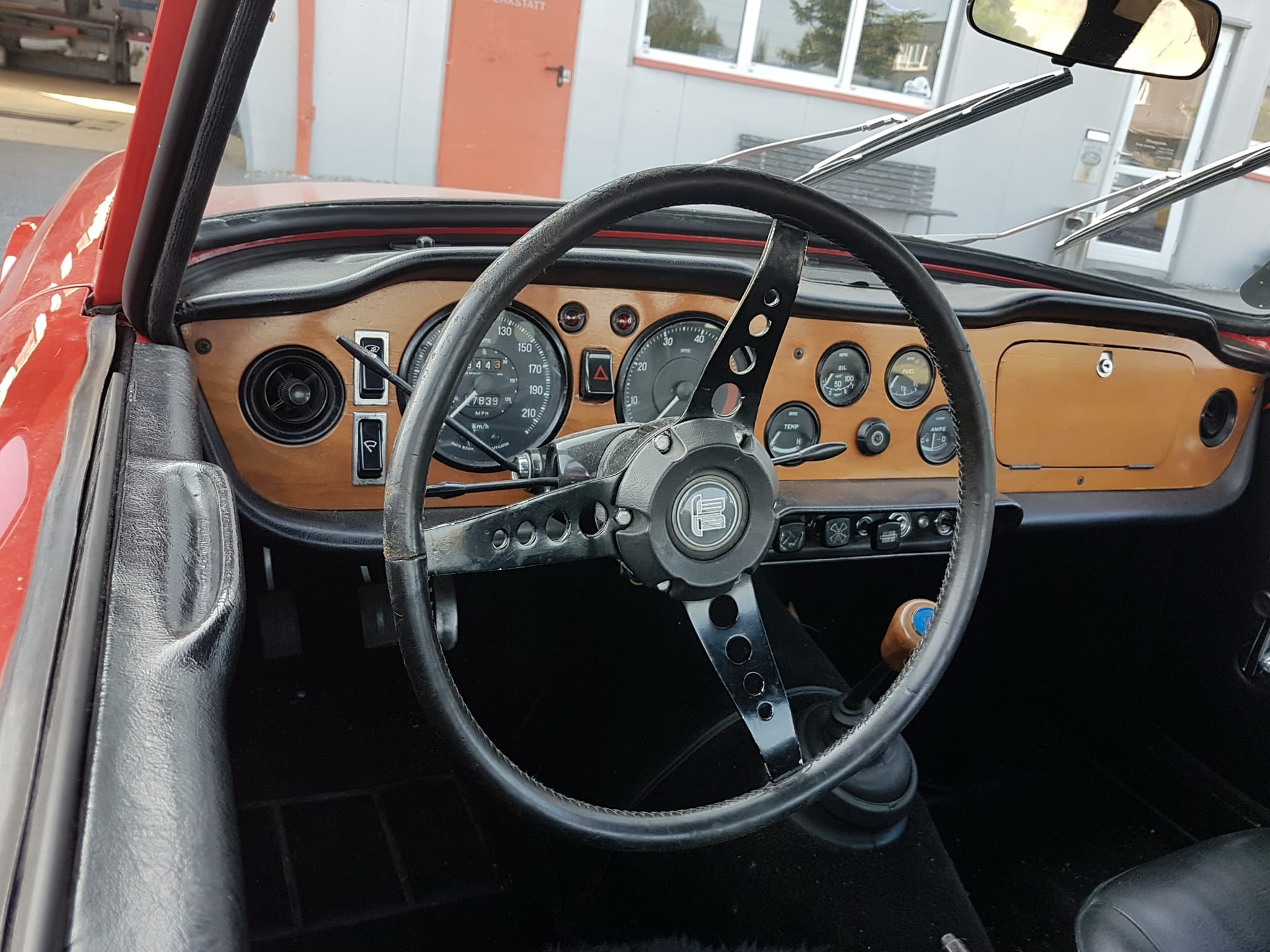
1 The early instruments, their needles pointing down, and a dished wheel with black drilled spokes, in a left-hand-drive TR6 with a speedometer in km/h, in Austria in August 2019.
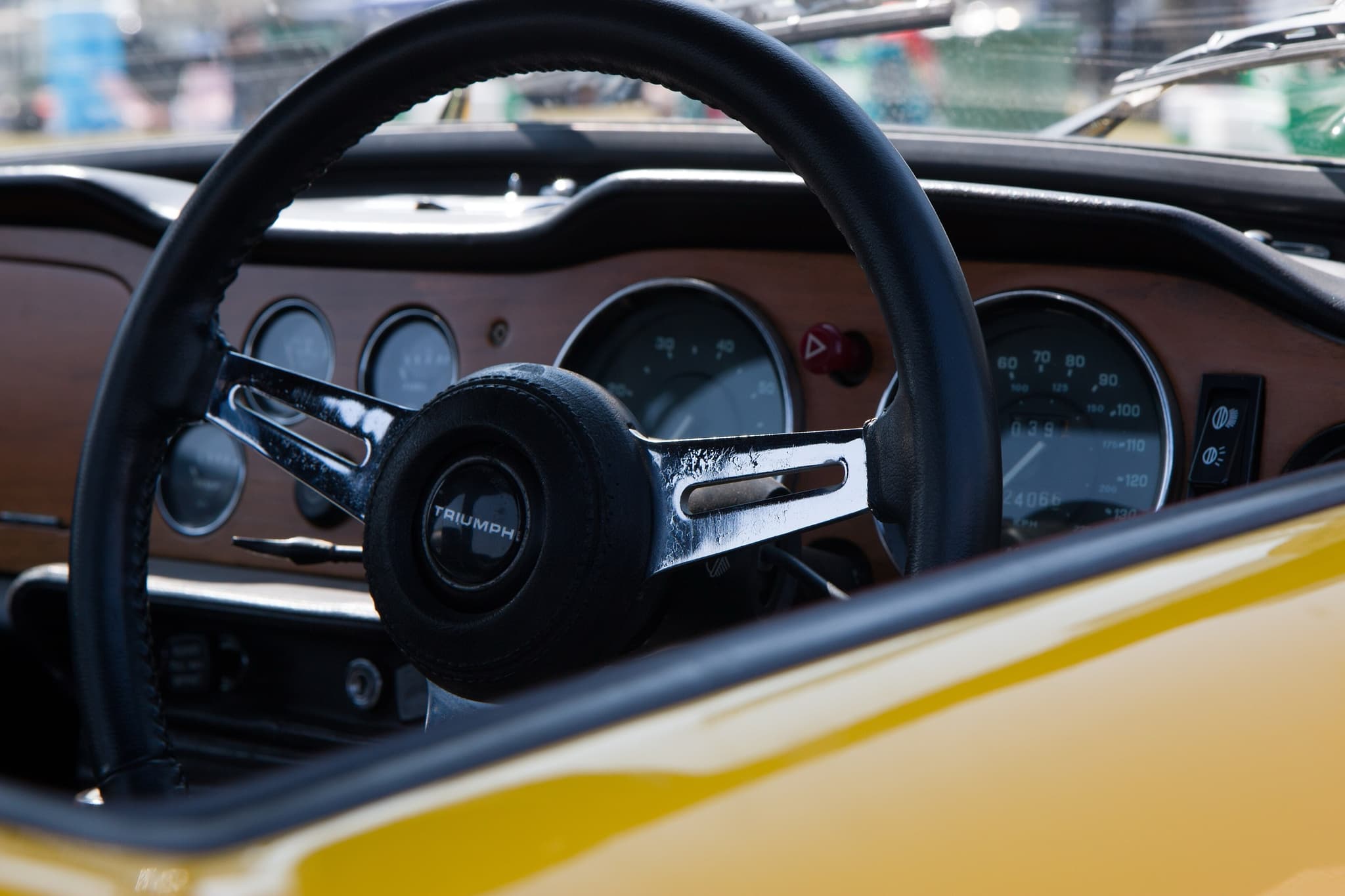
2 Slotted chrome spokes in front of the early instruments of a yellow TR6, in Hong Kong in November 2014.
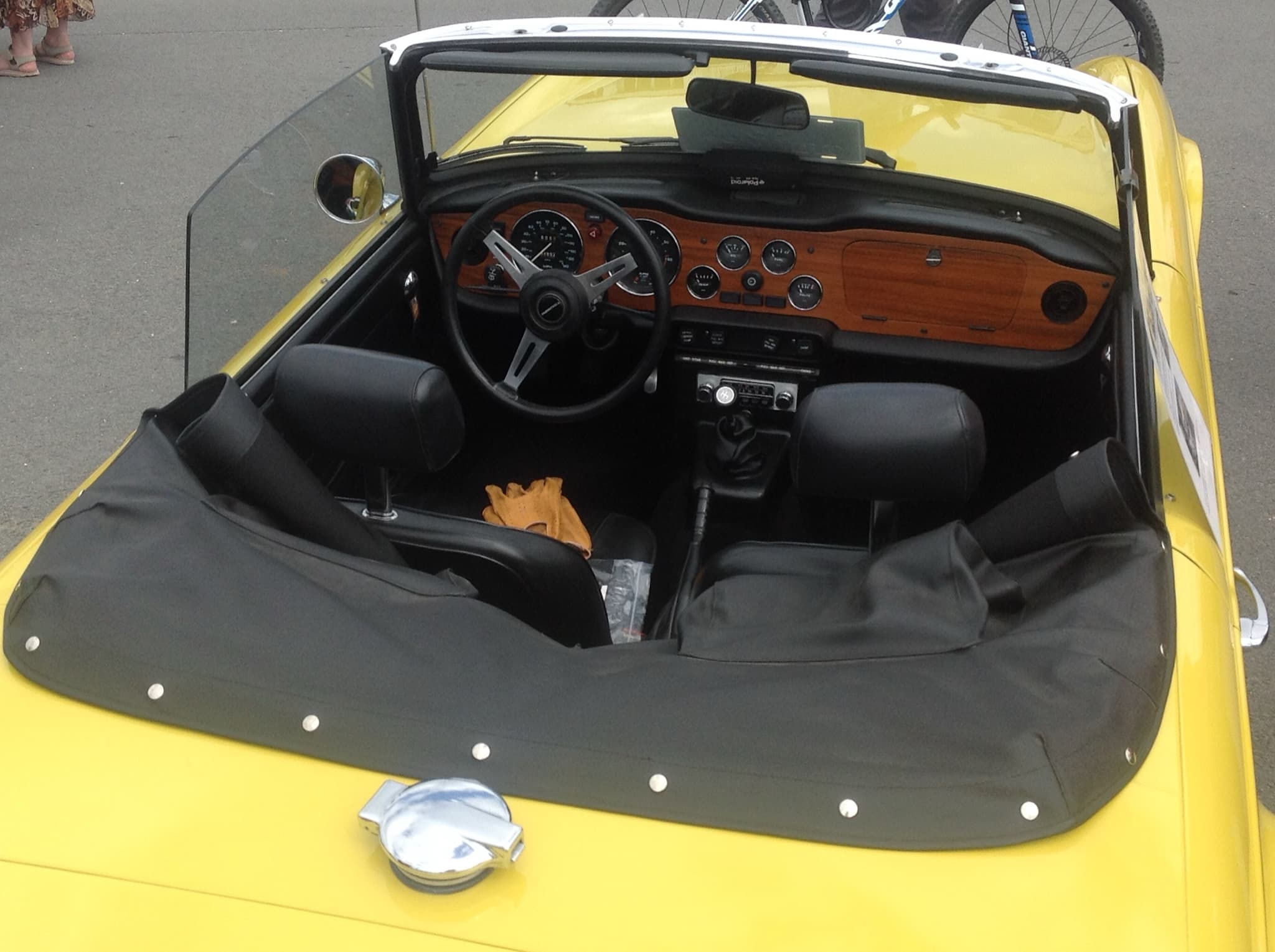
3 Seats with head restraints on stalks, in a left-hand-drive TR6 its photographer records as a 1975 American car, at West Bay, Dorset, in August 2016.
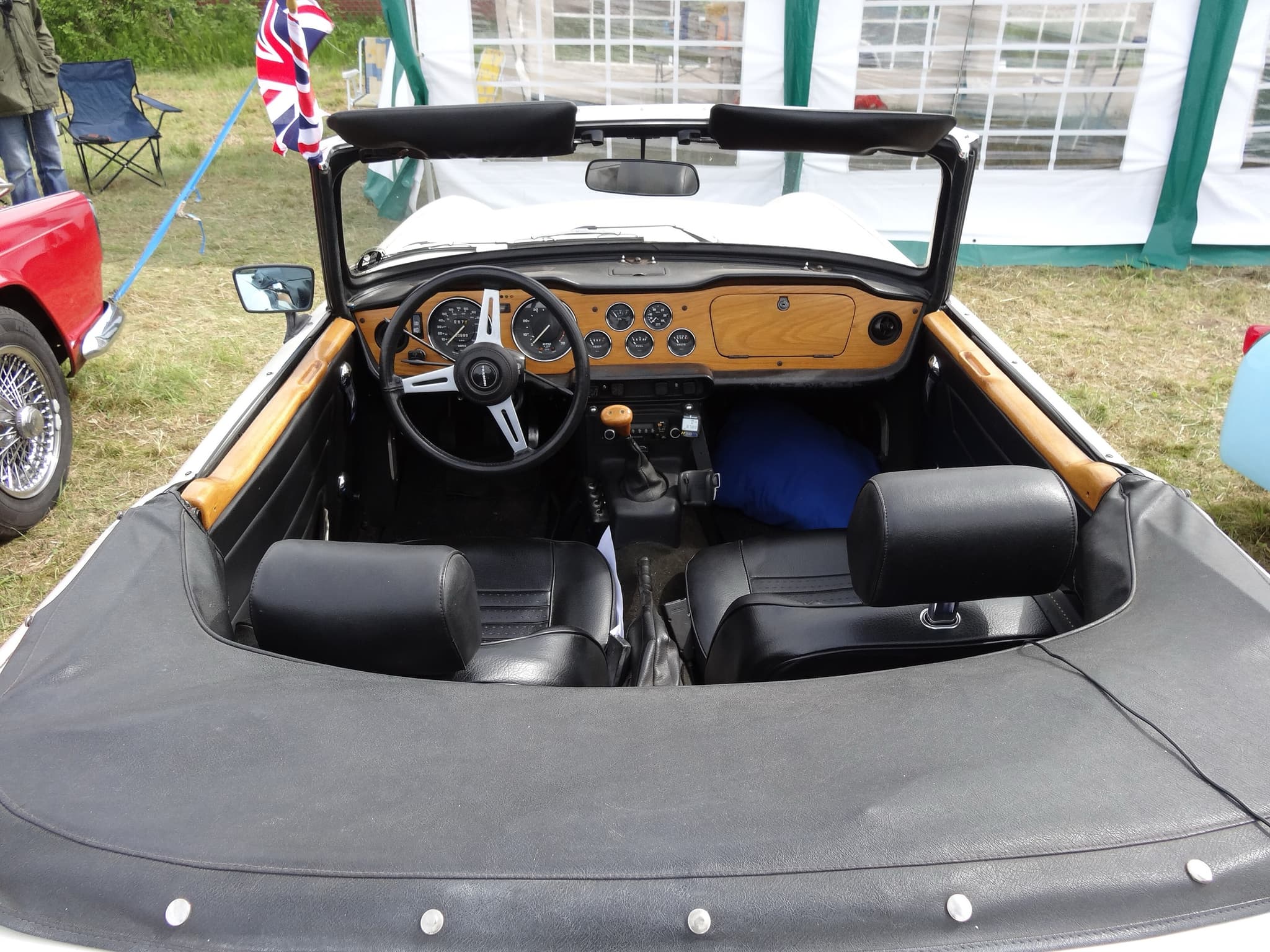
4 High-backed seats with head restraints on stalks, left-hand drive and a speedometer in mph: an American-specification cockpit, at Hohenlockstedt, Germany, in June 2013.
Picture credits (4)
- 1 Asurnipal, CC BY-SA 4.0
- 2 km30192002, CC BY 2.0
- 3 Andrew Bone from Weymouth, England, CC BY 2.0
- 4 Nightflyer, CC BY 3.0
Details from the tests
Motor Sport's tester in 1971 found comfortable bucket seats that lifted for access to a shelf behind them, a lockable cubby in the facia, an anti-dazzle mirror and a vanity mirror, a lidded ashtray, swivelling fresh-air vents, and the ignition key in the facia where he could reach it, not "buried … down below" as on other Triumphs; the heater needed the flap ahead of the windscreen (windshield) open to do much. Two years later Richardson found the seat backs too short for long journeys, the ashtray awkwardly placed on top of the facia, no cigarette lighter, and plastic blanks in the head-restraint holes that kept falling out; his car's heater, by contrast, was all or nothing: "at full blast you could just about bake a cake".
The facia pleased the Vintage Triumph Register too:
The facia is neat and uncluttered, an endearing feature of most 1960s Triumphs. The wooden facia gives an air of quality.
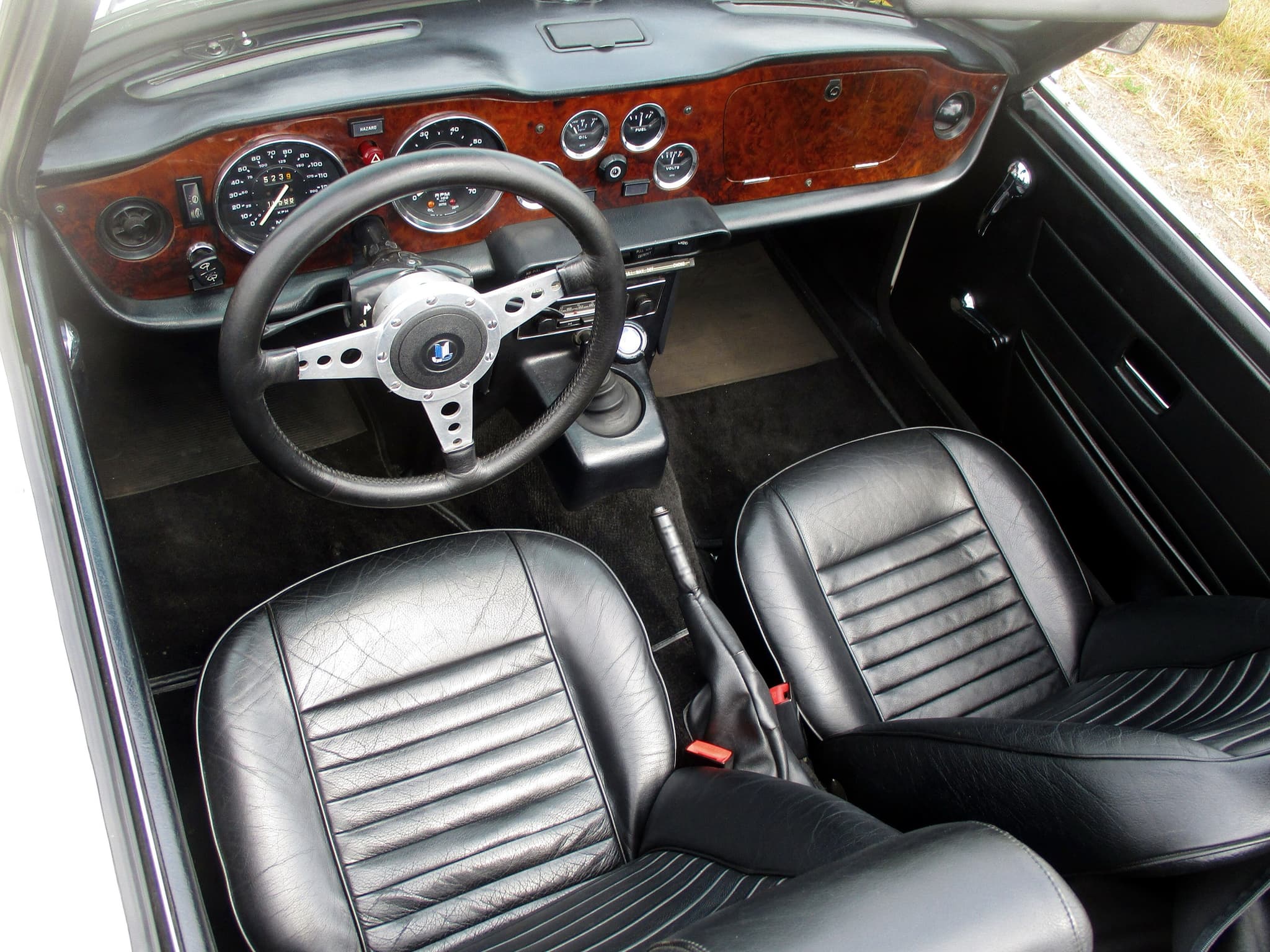
Driving one in 2023, Classic & Sports Car found the cockpit "tight inside – especially for the elbows", and called its classic Smiths dials "far prettier than the blocky gauges Triumph later adopted in a cost-saving move". Plenty of cockpits have been retrimmed since, like the one in the picture, and Hagerty wrote in 2014 that door cards and other trim were all available.source 11source 5source 7source 4source 12
Sources
Sources are given as plain text; their addresses are on the sources page.
- Primarymade at the time, by the maker or by people who were there
- Referenceserious later work: clubs, specialists, magazines, books
- Standard-Triumph, Triumph TR6 P.I. (sales brochure), UK, Dec 1970, publication 426/1270/ENG, the interior: "Non-glare wood finish"; instruments; leathercloth; carpet; interior dimensions; blue instrument lighting. Primary
- Triumph Sports Owners Association, Triumph Sports Owners Association Newsletter, January 1969, Jan 1969 (vol. 15 no. 1), p. 3, walnut-finish facia; Ambla seats; p. 3, the 1969 US cockpit. Primary
- Aaron Severson, "Grandfather's Ax: The Many Evolutions of the Triumph TR4, Part 2: TR5, TR250, and TR6", Ate Up With Motor, 7 Nov 2012, the dashboard from the TR5 and TR250, revised for the US rules of 1968; A new bottle: reclining seats from late 1969. Reference
- Charlie Calderwood, "Datsun 240Z vs Triumph TR6: the battle for America", Classic & Sports Car, 1 Feb 2023, the interior near-identical to the TR5's; tight for the elbows; the Smiths dials. Reference
- Clive Richardson, "The Tale of a TR6", Motor Sport, Nov 1973, p. 54, p. 54, "The interior trim is typically Triumph …"; p. 54, the 1973 changes; green instrument lighting; p. 54, the seat backs, the ashtray, the headrest blanks, the heater. Primary
- TR Register, "Buyer Beware: TR6" (2 pp. PDF leaflet), p. 1, the 1969 and 1970 details; the US steering wheel from 1971; the 1973 changes. Reference
- Vintage Triumph Register, "TR6" (history, year-by-year changes, US production table, buyer's guide), change list, '69 to '74; history: "The facia is neat and uncluttered …". Reference
- Triumph Sports Owners Association, Triumph Sports Owners Association Newsletter, December 1973, Dec 1973, p. 2, the 1974 door panels, aerial and speakers, belts. Primary
- Triumph Sports Owners Association, Triumph Sports Owners Association Newsletter, December 1974, Dec 1974, the 1975 trims: Beige new. Primary
- Graham Robson (foreword), Triumph TR6 1969–1976 Parts & Accessories Catalogue, Rimmer Bros, edn 2.2 (source code TR600313), p. 207, trims; the H prefix. Reference
- Bill Boddy, "Rumblings" (TR6 PI and 2.5 PI Mk II), Motor Sport, Mar 1971, p. 34, p. 34, the seats, the cubby, the mirrors, the lighting, the key in the facia, the heater. Primary
- Rob Sass, "Buyers Guide: Triumph TR6", Hagerty UK, 12 Nov 2014, interiors: door cards and trim available. Reference