Triumph TR6 Review
What the testers made of the TR6, from its launch in 1969 to its last years beside the TR7, in Britain and America, and what a modern drive finds: a car praised for its muscle and its value, and faulted, more each year, for its age.
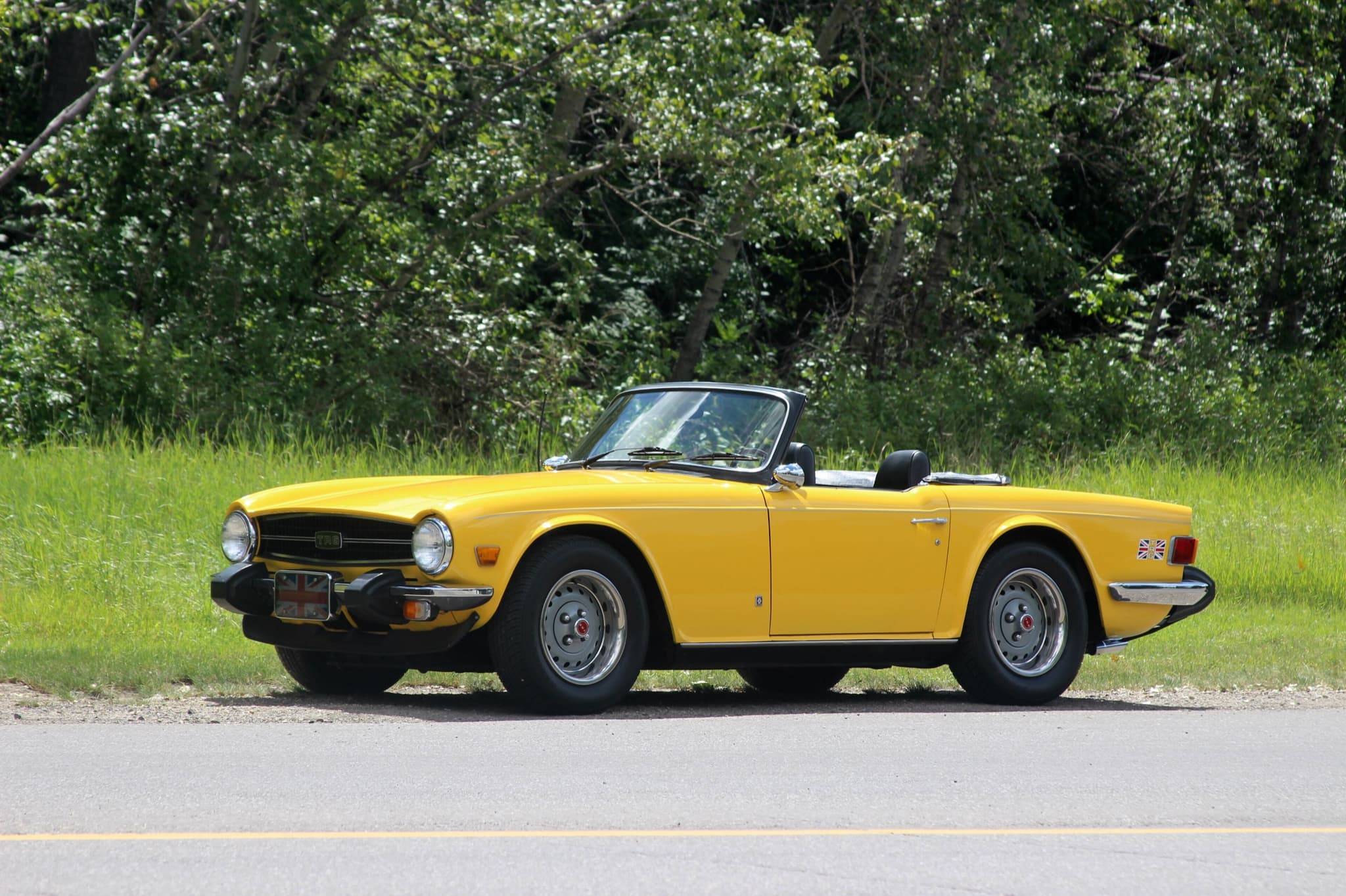
Autocar's test of 1969 found the TR6 a "masculine machine", and the critics of its last years an anachronism. Britain had it with petrol (fuel) injection and America with carburettors, so the two countries' magazines tested different engines, and each country's verdict is its own. The figures the testers measured are in the specifications, each with its test; this page gives what they wrote.source 1source 2source 3
At launch, 1969
The earliest account read is the American importer's own. Its owners' newsletter introduced the car in January 1969 with its new body, its wider wheels, its front anti-roll bar and its redesigned cockpit, and the newsletter's editor, after a short drive, found the ride "firm but not harsh" and the engine responsive; "The TR-6 corners much flatter than the 250," he wrote. It was a house magazine, not an independent test.
Autocar tested a TR6 PI in its issue of 17 April 1969. No source read reprints it in full, but the TR Register prints its figures and its verdict:
It is very much a masculine machine, calling for beefy muscles, bold decisions, and even ruthlessness on occasion. It could be dubbed the last real sports car...
In America, Road & Track found the carburetted US TR6 almost exactly as quick as the TR250 it replaced, Aaron Severson writes; reviewers, he adds, found the ride and handling more composed than the TR250's, though the anti-roll bar made for pronounced understeer, "where the early TR4 would hang out its tail at will". Car and Driver tested the car in February 1969, a test no source read reprints, and in August Popular Science timed an American TR6 in its group test of "The $3,000 Roadsters", a time that is among the specifications' readings.source 4source 1source 3source 5
The British view, 1971–74
For its issue of March 1971 Motor Sport collected a TR6 PI from Standard-Triumph's press depot at Acton, and found that the British sports car had grown up:
These days there is no drama about crossing the Metropolis in a 150 b.h.p. two-seater. Oiled-up plugs, teeth-jarring suspension, "impossible" crash gearboxes and intractability due to lack of torque are of the past.
It was very quick on the open road, with "previously undiscovered bends appearing on familiar roads and journey times shrinking impressively", its steering was light, and its seats and hood (soft top) were good. Its cornering was "less 'scientific' than in cars like Lotus, Alfa Romeo, etc., but it clings on excellently". The faults were a fierce clutch, pinking on the half-tank of fuel it came with, a whining fuel pump, a heater that did little unless the flap in front of the windscreen (windshield) was opened, and headlamps "trying to burn a hole in the road". The magazine thought it good value, and a worthy successor to the Austin-Healey 3000.
Two years later the magazine's assistant editor, Clive Richardson, put his own money into a new TR6, despite his colleagues' jibes ("What on earth do you want one of those lorries for?"). It had stood two months in a dealer's open compound, and it arrived, he wrote, "very second-hand". Its handling was "nowhere near as bad as those who have never driven TR6s try to make out", with safe understeer, and the hardtop cut the scuttle shake of the open car. In November he admitted that "over the last 5,000 miles I have grown to love it. It has character". A year later, after a specialist's service, it was "utterly reliable", and, if Triumph's quality control and finish could be relied on, he called the TR6 good value for anyone who wanted a relatively powerful open two-seater: "after all it is one of the few remaining examples of a dying breed of car".
The magazine's readers were divided. When one complained in 1973 of a car whose injection had never worked properly, the editor added that a member of staff could tell a similar tale, "A pity, for hairy British sports cars are few and far between"; another reader that year called the TR6 "one of the rare delights of modern motoring", and in 1974 a third, who disliked its injection, still thought that "a TR6 in good form is a great machine and good value for money".source 2source 6source 7source 8
The US view, 1972–76
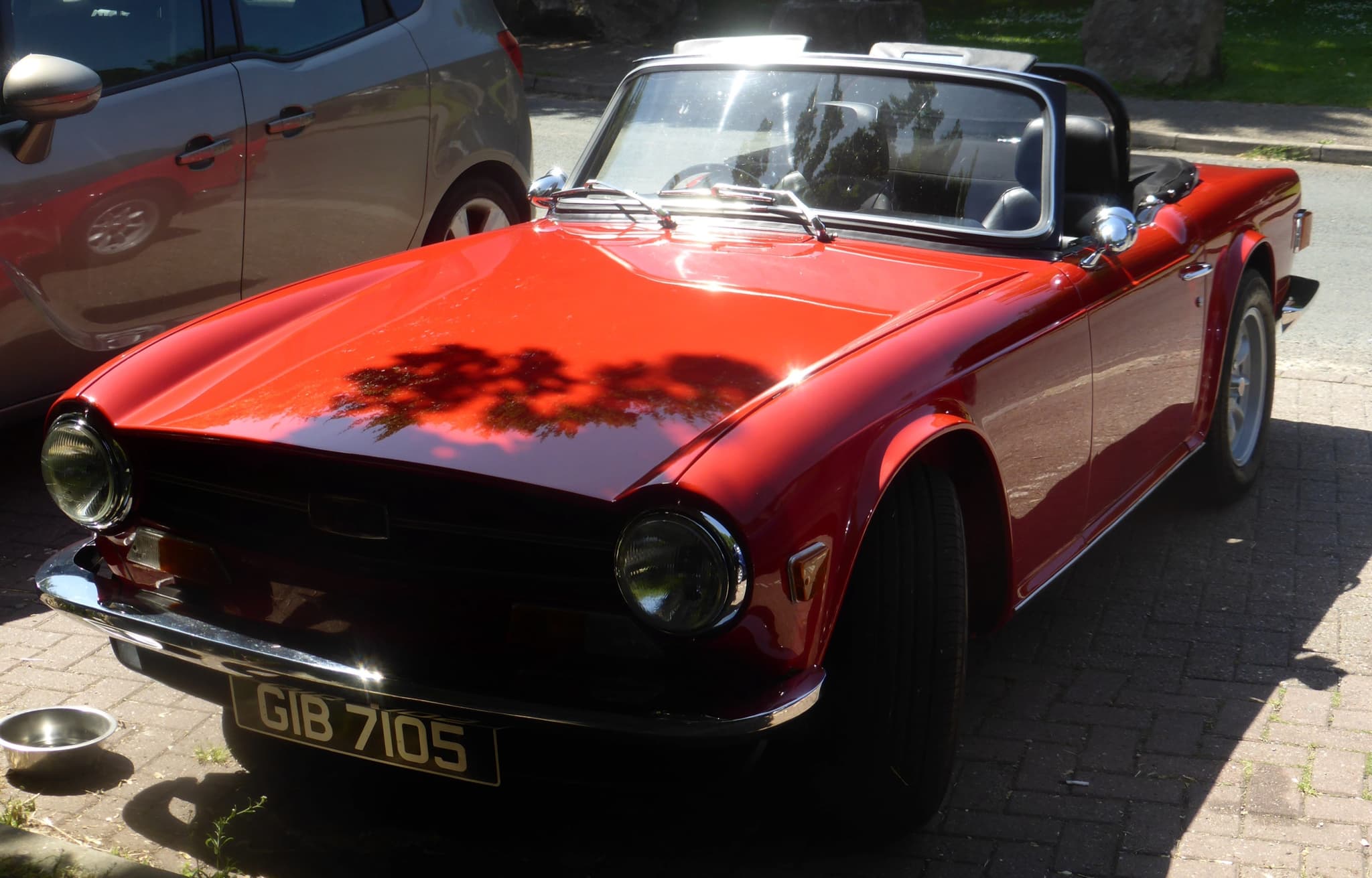
In America the TR6 aged faster. Road & Track, introducing a comparison of sports cars and sports saloons (sedans) in June 1974, set its own figures for 11 cars tested in 1972 and 1973, the TR-6 among them, in approximate order of price, and the magazine concluded that, in the low and middle price ranges, saloons and sporty coupés were giving sports cars a hard time. When the TR7 arrived, Car and Driver compared it with the old car:
The old TR6, never mind its six-cylinder engine with an extra half liter of displacement, would be the loser in any kind of speed contest, be it drag strip or road course
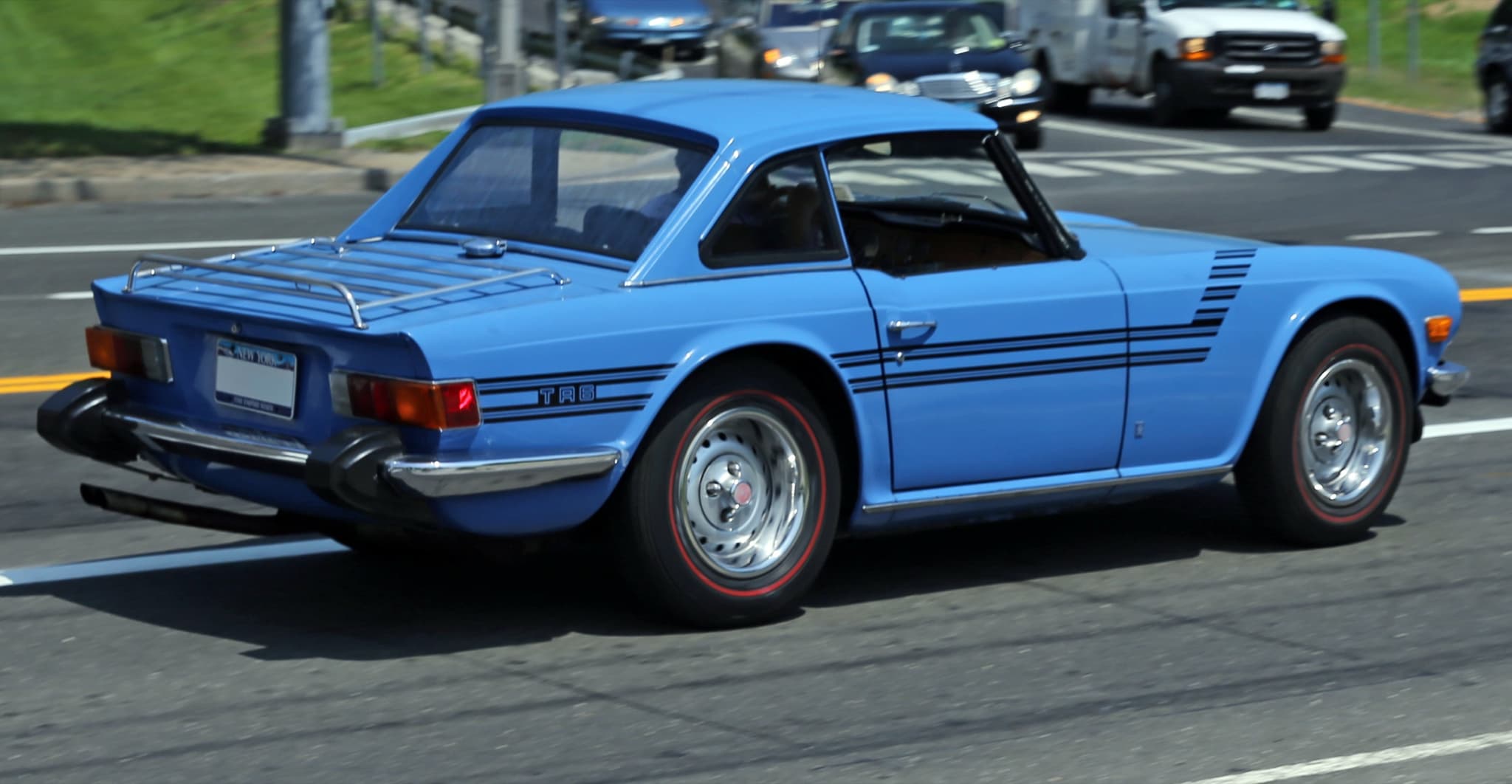
Aaron Severson sums up the critics who tested the late TR6: they conceded its "rugged good looks and an entertaining basso profundo exhaust note, but in other respects, the Triumph seemed increasingly anachronistic", above all beside the Datsun 240Z, and the federal fuel-economy test for the 1974 model year gave it what he calls "a dismal 16.4 mpg", in US gallons. In 1976 an owner wrote to the importer's newsletter to complain that the magazines, Car and Driver among them in a test that October, kept calling the TR6 antiquated, draughty and hard-riding. Owners bought it all the same, and the US TR6 page has what they found.source 9source 10source 11source 3source 12
The modern view
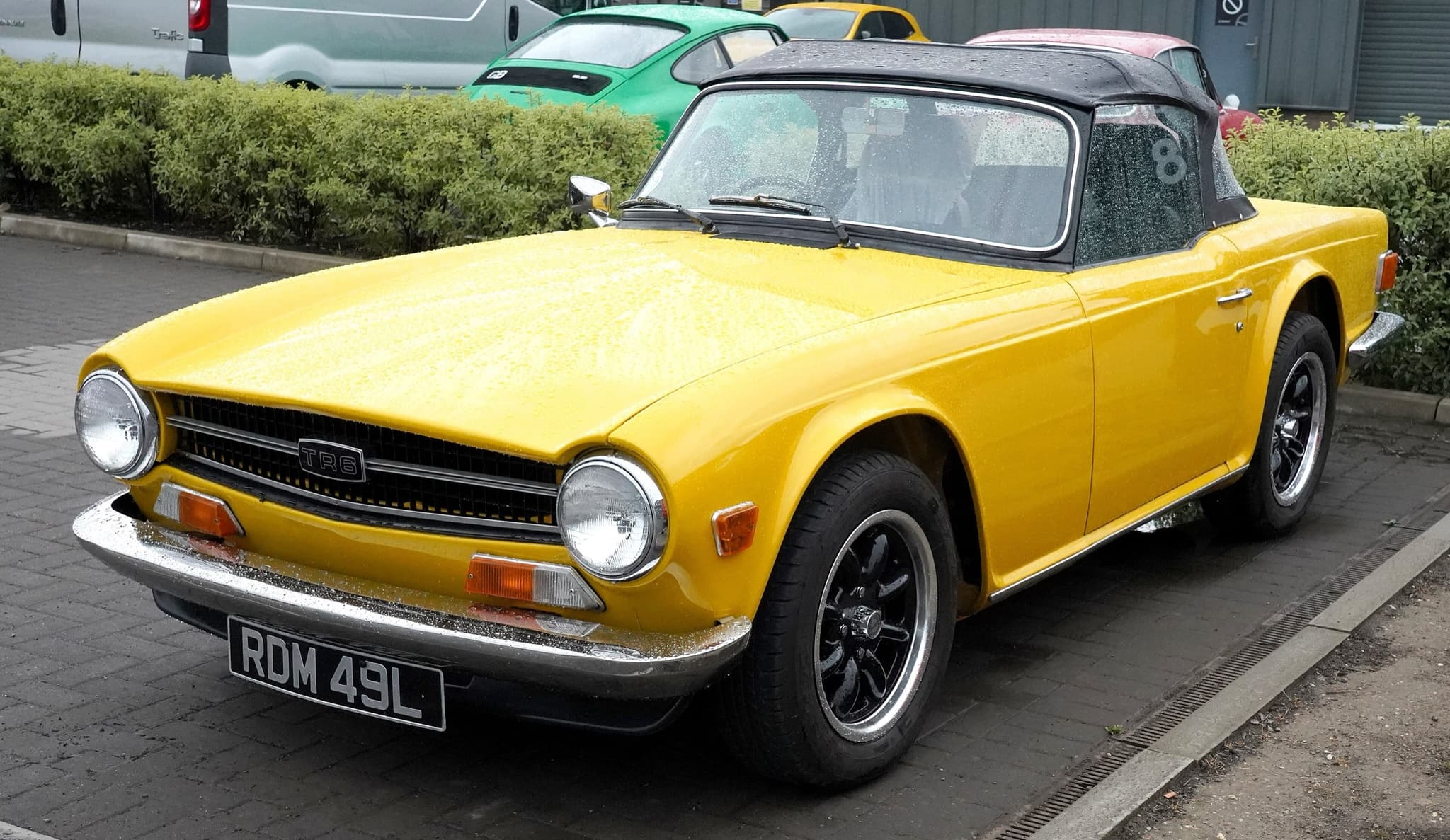
Half a century on, Classic & Sports Car drove a TR6 against a Datsun 240Z and found the Triumph the wilder of the two:
On a smooth road the Triumph TR6 is a noisy riot to drive
Driving it hard, the magazine wrote, was "like being strapped to the back of a rocket over which you only loosely have control"; and, set beside the Datsun, "the Triumph only does white-knuckle rides".source 13
Sources
Sources are given as plain text; their addresses are on the sources page.
- Primarymade at the time, by the maker or by people who were there
- Referenceserious later work: clubs, specialists, magazines, books
- TR Register, "Triumph TR6 Buyers Guide" (facts sheet), the Autocar verdict and performance table; the Autocar quotation (17 April 1969); the performance table. Reference
- Bill Boddy, "Rumblings" (TR6 PI and 2.5 PI Mk II), Motor Sport, Mar 1971, p. 34, p. 34; p. 34, the test of a TR6 PI. Primary
- Aaron Severson, "Grandfather's Ax: The Many Evolutions of the Triumph TR4, Part 2: TR5, TR250, and TR6", Ate Up With Motor, 7 Nov 2012, TR in twilight: the late critics; A new bottle: Road & Track's 1969 test; Car and Driver, February 1969, in the notes on sources; TR in twilight: "basso profundo"; the 240Z; the EPA figure. Reference
- Triumph Sports Owners Association, Triumph Sports Owners Association Newsletter, January 1969, Jan 1969 (vol. 15 no. 1), p. 1, the new car described; the editor's drive. Primary
- Jan P. Norbye and Jim Dunne, "The $3,000 Roadsters", Popular Science, vol. 195 no. 2, Aug 1969, pp. 96–101, pp. 96–101, a US TR6 in the group test. Primary
- Clive Richardson, "The Tale of a TR6", Motor Sport, Nov 1973, p. 54, p. 54, the staff car. Primary
- Clive Richardson, "The continuing tale of a TR6", Motor Sport, Dec 1974, p. 53, p. 53, a year on. Primary
- Motor Sport, Readers' letters on the TR6 (group), Feb 1970, p. 54; Jun 1973, p. 94; Aug 1973, p. 77; Jan 1974, p. 57, Jun 1973 p. 94 (the editor's note); Aug 1973 p. 77; Jan 1974 p. 57. Primary
- Road & Track, Road & Track, June 1974, Jun 1974, "Sports cars vs sports sedans": the introduction and the table of 1972–73 test figures, in ascending order of price. Primary
- Triumph Sports Owners Association, Triumph Sports Owners Association Newsletter, February–March 1975, Feb–Mar 1975 (vol. 21 no. 2), Car and Driver's TR7 test, as reprinted. Primary
- Triumph Sports Owners Association, Triumph Sports Owners Association Newsletter, November–December 1976, Nov–Dec 1976, a reader's letter; Car and Driver, October 1976. Primary
- Triumph Sports Owners Association, Triumph Sports Owners Association Newsletter, December 1973, Dec 1973, p. 3, the EPA figure. Primary
- Charlie Calderwood, "Datsun 240Z vs Triumph TR6: the battle for America", Classic & Sports Car, 1 Feb 2023, the drive: "a noisy riot"; the rocket; "white-knuckle rides". Reference