Triumph TR6 Engine Numbers
A TR6 has no VIN: it has a commission number, whose prefix names its series, and an engine number whose prefix should match it. How to read both, where to find them, how the numbers run year by year, and how they tell an original car from a converted one.
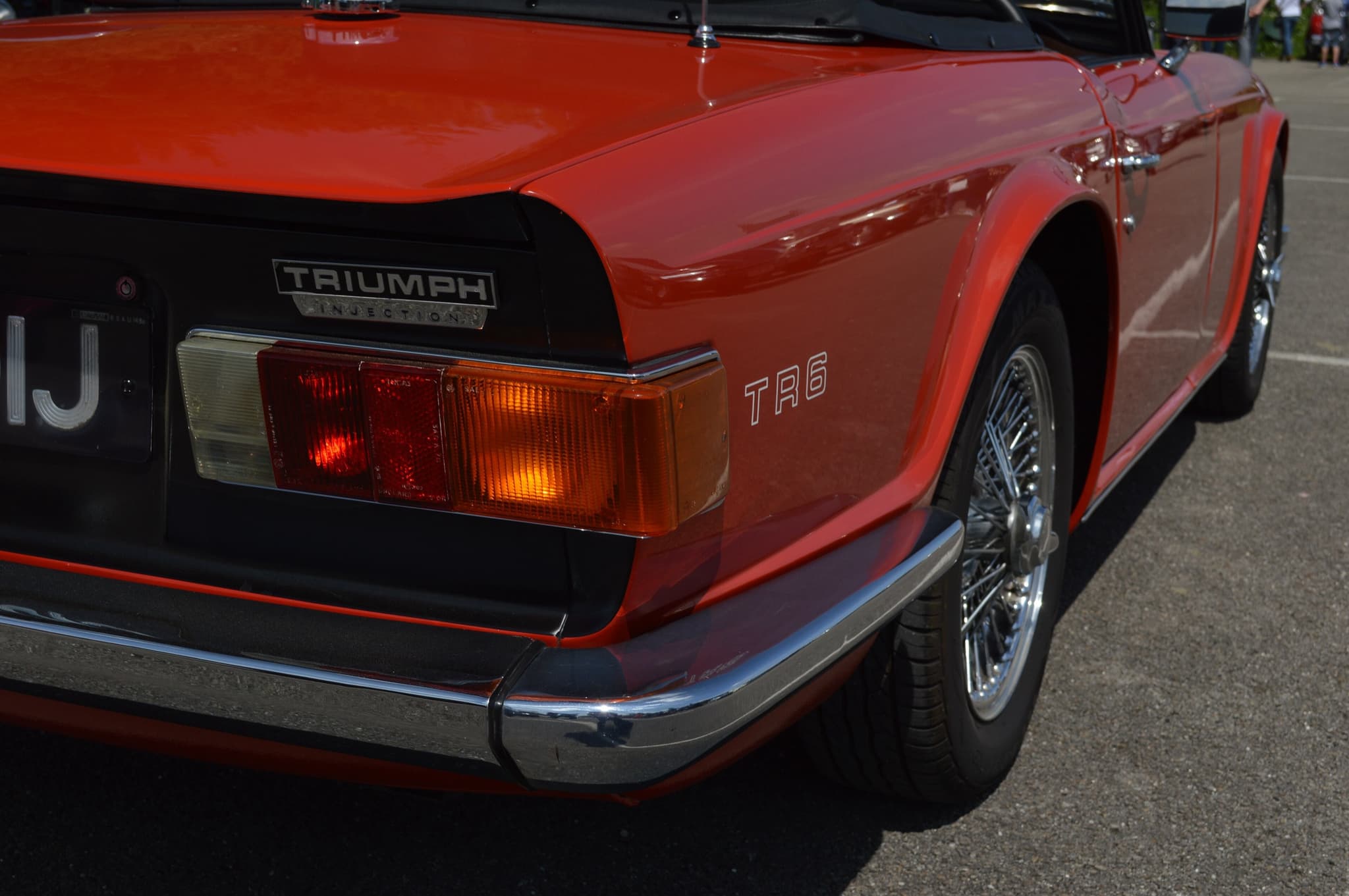
Triumph called a car's chassis number its commission number, and on a TR6 it is the number that matters. The TR Register puts it plainly:
TR's originate from an era prior to VIN's (Vehicle Identification Numbers) and used a number identified as the Commission Number.
It is stamped on an aluminium plate, and on British papers it appears as the car's VIN. Check it against the papers first, then against the engine number, whose prefix should match it. The British Motor Museum holds Triumph's build records from 1946 to 1981 and issues Heritage Certificates from them, and the TR Register's leaflet sends buyers to its TR6 registrar to authenticate a car from its registration, engine and body numbers.source 1source 2
Reading the numbers
The prefix names the series, CP or CR for the TR6 PI and CC or CF for the US TR6, and the letters after the serial say how the car left the factory:
| Mark | Where | Meaning |
|---|---|---|
| CP | Prefix | A TR6 PI, from 1968 to September 1972 |
| CR | Prefix | A TR6 PI, from late 1972 to February 1975 |
| CC | Prefix | A carburetted TR6 of the 1969 to 1972 model years |
| CF | Prefix | A carburetted TR6 of the 1973 to 1976 model years |
| L | Suffix | Left-hand drive; on carburetted cars up to CC78520 |
| U | Suffix | A left-hand-drive car for North America, from CC78521 and on every CF |
| O | Suffix | Overdrive fitted at the factory |
| 1 and P | Before the prefix, and at the end | A car assembled from a kit in Belgium |
Rimmer's catalogue dates the U to 1971 on. On Belgian cars TR-Register Deutschland prints the extra figure as a letter I, as in "ICP500-LP"; whether a plate reads 1 or I, no source read settles.
Where to look. On early cars the commission plate is on top of the left inner front wing (fender), under the bonnet (hood); on late carburetted CC cars and on every CR and CF it is on the left door post, below the striker. CP cars for Germany have it on the right-hand wing, and Belgian cars on the bulkhead, and American cars carry a second plate at the left of the windscreen (windshield). The plate also gives the paint and trim codes. The engine number is stamped on a lip at the rear of the block's left side, just below the spark plugs. Two body-number plates sit on the bulkhead, one fitted by the body maker and one by Triumph; the gearbox (transmission) number is behind the clutch cross-shaft, or above the starter's bulge on the right on later American cars, and the axle number is at the base of its housing.
CF58328U
- CFThe prefix: a carburetted TR6 of the 1973 to 1976 model years
- 58328The serial: the last number Canley gave a TR6
- UThe suffix: a left-hand-drive car for North America
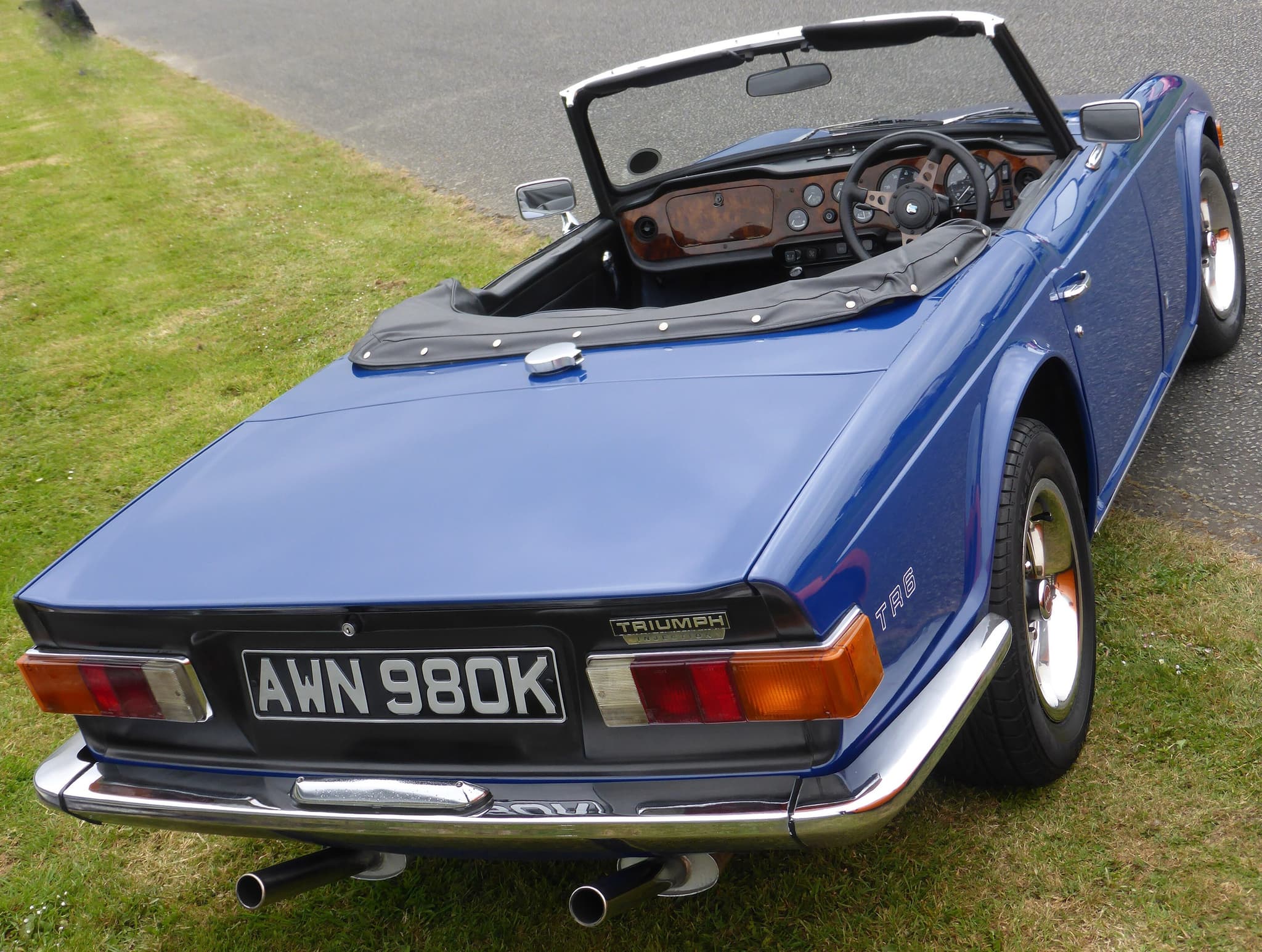
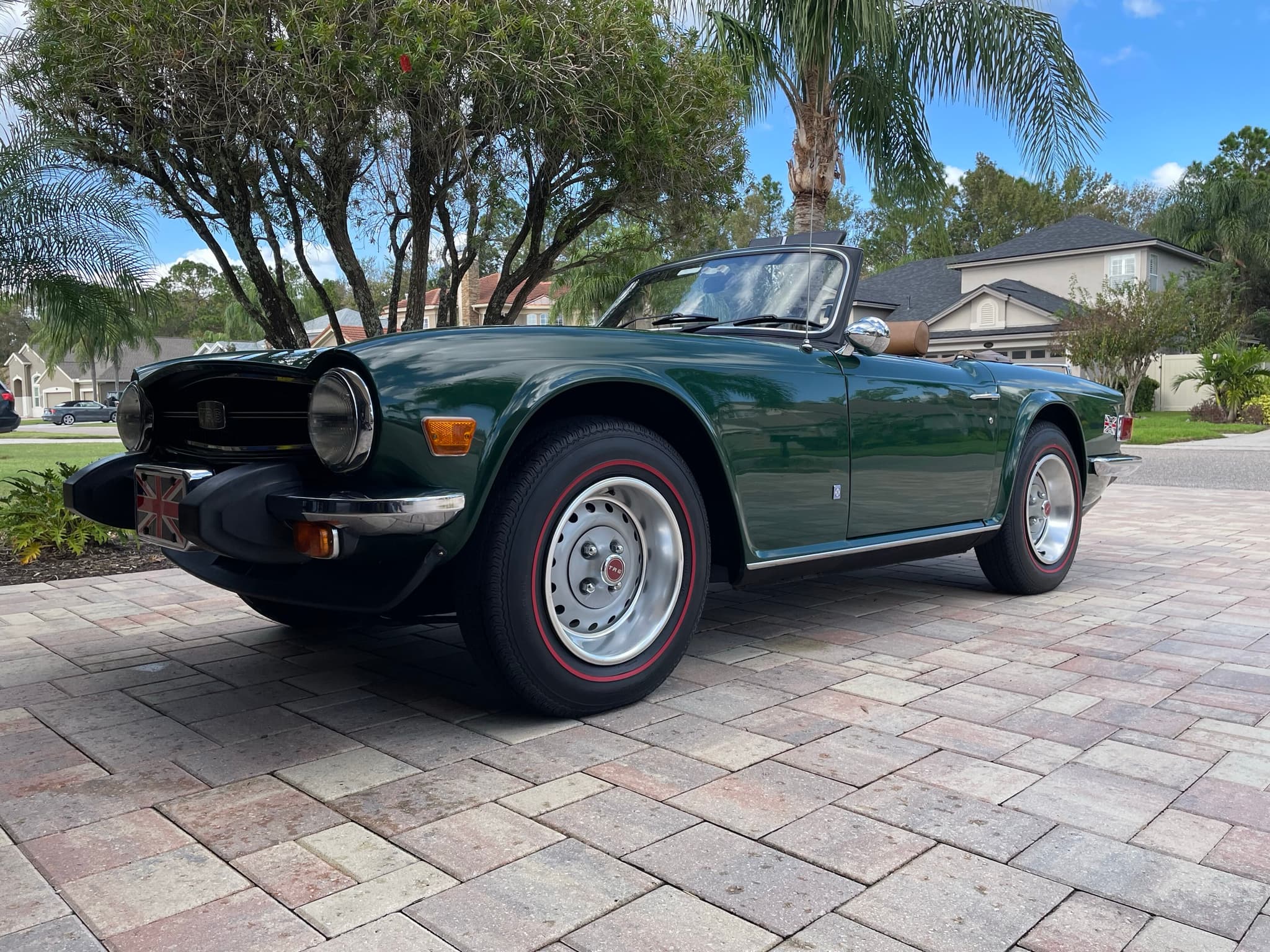
The numbers year by year
Rimmer's parts catalogue lists the first and last commission number of each year with its build date, taken from the factory's records. Its years are calendar years, each filed under a model year; for injected cars the model year is Rimmer's own label, not an American one. A few of its entries are misprints, noted below.
| Calendar year | Injected cars, first to last | Built |
|---|---|---|
| 1968 | CP25156 to CP25158 | From 28 November; CP25001 most likely a prototype, CP25002 to CP25145 kits |
| 1969 | CP25159 to CP26998; CP50001 to CP50464 | From 2 January; CP26998's date is printed "10th Sept 68", for 1969; the 1970 model year from 1 September |
| 1970 | CP50465 to CP52785 | From 1 January |
| 1971 | CP52786 to CP54572; CP75001 to CP75454 | To 7 September, then from 27 September (printed "CP7544") |
| 1972 | CP75455 to CP77718; CR169 to CR664 | CP77718 on 21 September; CR169 on 15 November, CR1 to CR168 kits |
| 1973 | CR665 to CR2911; CR5049 to CR5612 | CR2911 on 17 October; CR5049 on 14 September, CR5001 to CR5048 kits |
| 1974 | CR5613 to CR6630 | From 1 January |
| 1975 | CR6631 to CR6701 | CR6701, the last PI, on 7 February |
| Calendar year | Carburetted cars, first to last | Built |
|---|---|---|
| 1968 | CC25003L to CC27383L | From 19 September; CC25001 and CC25002 not in the build records |
| 1969 | CC27384L to CC32142L; CC50001L to CC51032L | CC32142L on 19 December; CC50001L on 22 November |
| 1970 | CC51033L to CC60902L | From 1 January |
| 1971 | CC60903L to CC67893L; CC75001L to CC78812 | CC67893L on 20 August; CC75001L the same day (printed "CC7881") |
| 1972 | CC78813U to CC85737U; CF1U to CF4028U | CC85737U on 5 October; CF1U on 11 September |
| 1973 | CF4029U to CF17002U | From 2 January |
| 1974 | CF17002U to CF25777U; CF27001U to CF29580U | CF25777U on 18 September; CF27001U on 22 August (CF17002U is printed twice) |
| 1975 | CF29581U to CF39991U; CF50001U to CF52314U | CF39991U on 23 August; CF50001U on 29 August |
| 1976 | CF52315U to CF58328U | CF58328U, the last TR6, on 15 July |
The TR Register's leaflet groups the same numbers by model year instead, and its ranges are the ones the US TR6 page uses for the carburetted cars. It dates the last CC car to August 1972, where Rimmer's build record gives 5 October. The Vintage Triumph Register and TR-Register Deutschland each draw some of the breaks at other numbers, especially around the 1974½ model year. None of these lists counts cars. TR-Register Deutschland notes that Triumph skipped whole series of numbers and took cars from the line for experiments, so a range says how many numbers were issued, not how many cars were built; the versions page explains why the totals differ.source 3source 1source 5source 4
The Belgian kits
The cars assembled in Belgium were all injected and left-hand drive, and their commission numbers gain a 1 in front and a P at the end, the TR Register says; their plate is on the bulkhead. Rimmer and TR-Register Deutschland, which takes its ranges from Bill Piggott, list the kits' numbers:
| Rimmer | TR-Register Deutschland |
|---|---|
| CP25002 to CP25145 | CP25004 to CP25145, 1968 |
| CP50002 to CP50436, "believed to be CKD" | CP50002 to CP50436, 1969 |
| CP54573 to CP54584 | CP54573 to CP54584, 1971 |
| CR1 to CR168 | CR1 to CR168, 1972 |
| CR5001 to CR5048 | CR5001 to CR5048, 1973 |
Was the first TR6 a CC or a CP?
Fact check
CC25003L
Rimmer's catalogue, from the factory's build records: "First production car (built 19th Sept 68)"
CP25003
the Vintage Triumph Register: "first carb TR6 on record", built the same day
Our reading. Both give the same serial and the same day, 19 September 1968, and both make it a carburetted car, so only the Vintage Triumph Register's prefix is wrong: carburetted TR6s carry CC. Rimmer adds that CP25001, which the Vintage Triumph Register calls the first prototype TR6, was most likely a prototype, and TR-Register Deutschland, after Piggott, gives CP25003 as the first injected number on record, a different reading of the same number.source 3source 5source 4
Production
Production: how far the sources agree
- 13703, TR6 PI, 'Produced for the Home Market - 8370', 'Produced for the Export Market - 5333'
- Disputed.
- 13702, TR6 PI, '13702 of the total were petrol injection models'
- Disputed.
- just under 14,000, TR6 PI, sold outside the US
- Disputed.
- 13912, TR6 PI, Roger Williams (2014); equals the CP + CR commission-number spans exactly
- Not yet confirmed.
- 8370, TR6 PI, home market (all PI): 'Produced for the Home Market - 8370'
- Good sources agree.
- 5333, TR6 PI, export PI: 'Produced for the Export Market - 5333'
- One good source.
- 78147, US TR6, TR6 Carb, 'Produced for the Export Market - 78147'
- Disputed.
- 78142, US TR6, '78142 were carburettor US market models'
- Disputed.
- almost 78,000, US TR6, sold in the US as carburetted cars
- Disputed.
- 77398, US TR6, Roger Williams (2014)
- Not yet confirmed.
- 91850, all TR6s, 1968-76 ('91850 cars built 1968 to 1976'); counting rule not stated
- Disputed.
- 94619, TR6, '94,619 TRs were built, of which 86,249 found homes overseas, only 8,370 being sold in the UK'
- Disputed.
- 91310, TR6, Roger Williams (2014): 77,398 carburetted + 13,912 PI
- Not yet confirmed.
13703TR6 PI, 'Produced for the Home Market - 8370', 'Produced for the Export Market - 5333'
TR Register, "Triumph TR6 Buyers Guide" (facts sheet)source 6
13702TR6 PI, '13702 of the total were petrol injection models'
TR Register, "Buyer Beware: TR6" (2 pp. PDF leaflet)source 1
just under 14,000TR6 PI, sold outside the US
Bruno Dwinger, "Geschichte, Typenkunde und Kaufberatung: British Leyland Triumph TR 6PI und TR 6 (Vergaser) – Die Karmann Autos", TR-Register Deutschland, c. 2010, 13 pp. (PDF)source 4
13912TR6 PI, Roger Williams (2014); equals the CP + CR commission-number spans exactly
Wikipedia (DE), "Triumph TR6", 2026source 7
8370TR6 PI, home market (all PI): 'Produced for the Home Market - 8370'
TR Register, "Triumph TR6 Buyers Guide" (facts sheet)source 6; TR Register, "Buyer Beware: TR6" (2 pp. PDF leaflet)source 1; Moss Motoring, "Twenty-Five years of the TR6: A Nostalgic Profile", Oct 1994source 8
5333TR6 PI, export PI: 'Produced for the Export Market - 5333'
TR Register, "Triumph TR6 Buyers Guide" (facts sheet)source 6
78147US TR6, TR6 Carb, 'Produced for the Export Market - 78147'
TR Register, "Triumph TR6 Buyers Guide" (facts sheet)source 6
78142US TR6, '78142 were carburettor US market models'
TR Register, "Buyer Beware: TR6" (2 pp. PDF leaflet)source 1
almost 78,000US TR6, sold in the US as carburetted cars
Bruno Dwinger, "Geschichte, Typenkunde und Kaufberatung: British Leyland Triumph TR 6PI und TR 6 (Vergaser) – Die Karmann Autos", TR-Register Deutschland, c. 2010, 13 pp. (PDF)source 4
77398US TR6, Roger Williams (2014)
Wikipedia (DE), "Triumph TR6", 2026source 7
91850all TR6s, 1968-76 ('91850 cars built 1968 to 1976'); counting rule not stated
TR Register, "Triumph TR6 Buyers Guide" (facts sheet)source 6; TR Register, "Buyer Beware: TR6" (2 pp. PDF leaflet)source 1; Vintage Triumph Register, "TR6" (history, year-by-year changes, US production table, buyer's guide)source 5; Bruno Dwinger, "Geschichte, Typenkunde und Kaufberatung: British Leyland Triumph TR 6PI und TR 6 (Vergaser) – Die Karmann Autos", TR-Register Deutschland, c. 2010, 13 pp. (PDF)source 4
94619TR6, '94,619 TRs were built, of which 86,249 found homes overseas, only 8,370 being sold in the UK'
Vintage Triumph Register, "TR6" (history, year-by-year changes, US production table, buyer's guide)source 5; Aaron Severson, "Grandfather's Ax: The Many Evolutions of the Triumph TR4, Part 2: TR5, TR250, and TR6", Ate Up With Motor, 7 Nov 2012source 9; Charlie Calderwood, "Datsun 240Z vs Triumph TR6: the battle for America", Classic & Sports Car, 1 Feb 2023source 10; Moss Motoring, "Twenty-Five years of the TR6: A Nostalgic Profile", Oct 1994source 8; Fred M. H. Gregory, "TR8 V-8: A mighty Triumph" (road test), with the sidebar "A String of Triumphs", Motor Trend, Jun 1980source 11
91310TR6, Roger Williams (2014): 77,398 carburetted + 13,912 PI
Wikipedia (DE), "Triumph TR6", 2026source 7
Sources
Sources are given as plain text; their addresses are on the sources page.
- Primarymade at the time, by the maker or by people who were there
- Referenceserious later work: clubs, specialists, magazines, books
- Uncheckedencyclopaedias and enthusiast sites: cited beside a good source, named in the sentence, or marked Unchecked
- TR Register, "Buyer Beware: TR6" (2 pp. PDF leaflet), p. 2, "TR's originate from an era prior to VIN's …"; p. 1, the V5 and the registrar; p. 1, prefixes, suffixes, L to U at CC78521, the Belgian marks, the plate positions, converted cars; p. 1, the ranges by model year; the last CC, August 1972; p. 1, the Belgian cars: PI, left-hand drive, "1" and "P", the plate on the bulkhead; p. 1. Reference
- British Motor Museum (BMIHT), "Heritage Certificates", the service: build records, 1946–81. Primary
- Graham Robson (foreword), Triumph TR6 1969–1976 Parts & Accessories Catalogue, Rimmer Bros, edn 2.2 (source code TR600313), p. 5, "'L' or 'U' (1971 on) for left hand drive … and 'O' for overdrive"; Location of serial numbers; p. 5, Vehicle identification: first and last car of each year, with build dates; p. 5, the five CKD ranges; "believed to be CKD"; p. 5: "First production car (built 19th Sept 68)"; CP25001 most likely a prototype; CC25001–02 not in the build records. Reference
- Bruno Dwinger, "Geschichte, Typenkunde und Kaufberatung: British Leyland Triumph TR 6PI und TR 6 (Vergaser) – Die Karmann Autos", TR-Register Deutschland, c. 2010, 13 pp. (PDF), p. 2, "ICP500-LP"; p. 2, its own breaks; skipped numbers and experimental cars; p. 2, the CKD ranges after Piggott; not claimed to be complete; p. 2, CP25003 as the first recorded PI number, after Piggott; p. 1; p. 2. Reference
- Vintage Triumph Register, "TR6" (history, year-by-year changes, US production table, buyer's guide), change list, '73: the plate on the door post; Spotter's Guide: its own year breaks; Spotter's Guide, '68: "CP25003, first carb TR6 on record"; CP25001 "first prototype TR6"; TR6 page, 'Production Dates and Numbers'; TR6 page, history text. Reference
- TR Register, "Triumph TR6 Buyers Guide" (facts sheet), all US cars left-hand drive; Facts & Figures, 'Production Figures TR6 PI'; Facts & Figures, 'Production Figures TR6 Carb'; Facts & Figures, introduction. Reference
- Wikipedia (DE), "Triumph TR6", 2026, lead section. Unchecked
- Moss Motoring, "Twenty-Five years of the TR6: A Nostalgic Profile", Oct 1994, text. Reference
- Aaron Severson, "Grandfather's Ax: The Many Evolutions of the Triumph TR4, Part 2: TR5, TR250, and TR6", Ate Up With Motor, 7 Nov 2012, 'TR in Twilight'. Reference
- Charlie Calderwood, "Datsun 240Z vs Triumph TR6: the battle for America", Classic & Sports Car, 1 Feb 2023, factfile, 'Triumph TR6'. Reference
- Fred M. H. Gregory, "TR8 V-8: A mighty Triumph" (road test), with the sidebar "A String of Triumphs", Motor Trend, Jun 1980, sidebar 'A String of Triumphs' (read by the TR8 agent, notes-tr8.md). Primary