Triumph TR6 Images
Photographs of TR6s taken long after they were new, grouped to help tell the cars apart: the years one by one, the injected PI, the colours, the cockpit, the engine bay, the hardtop, and TR6s racing and rallying today.
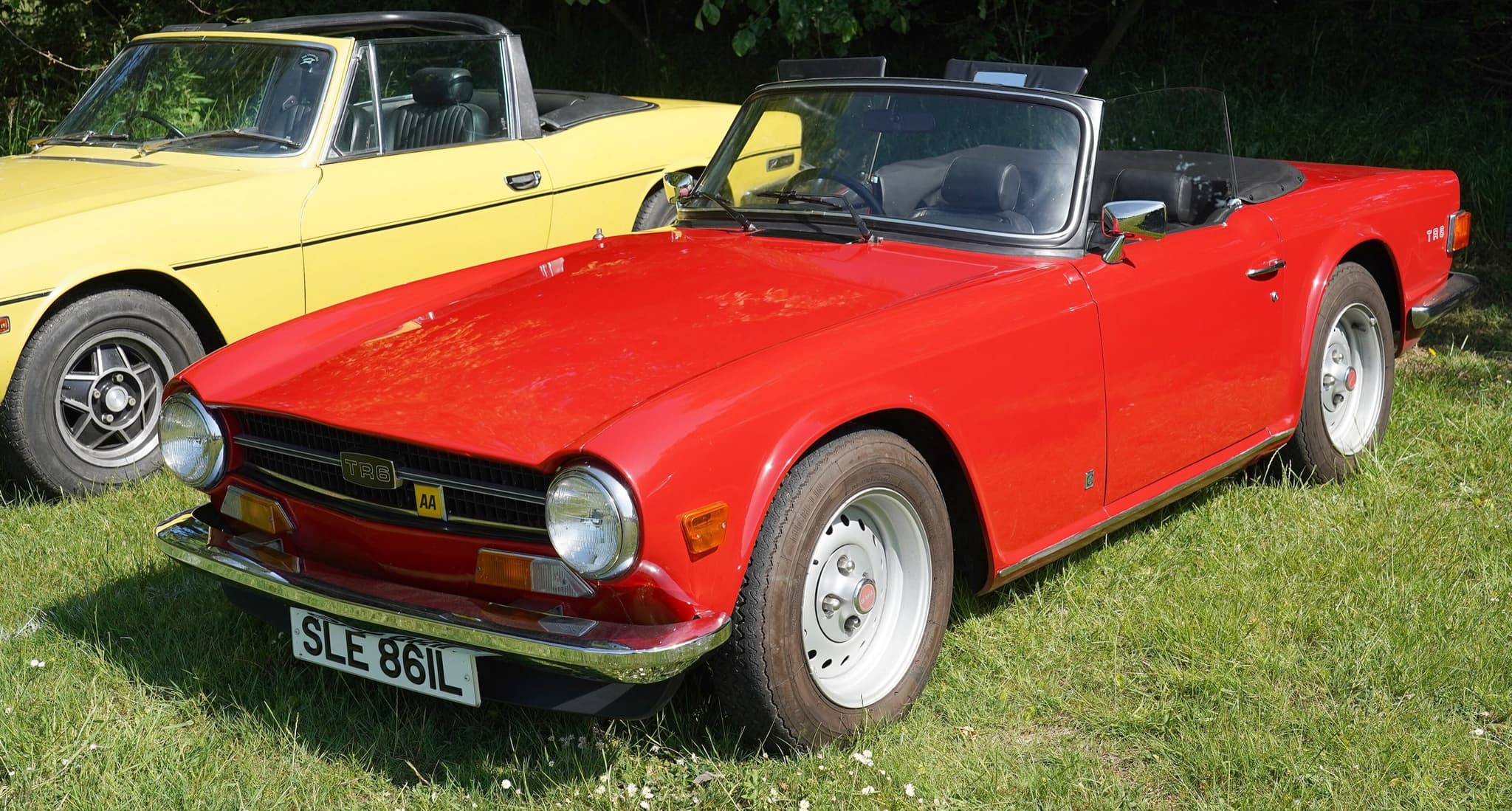
Every car here is pictured as it was on the day of the photograph, and many wear later wheels, lamps or trim, as the captions point out. A date in a caption is the photograph's. A car's year comes from what it shows or from the letter of its British registration, and where only the photographer gives a year, the caption says so. Each picture opens a larger view.source 1
By year
Most of the TR6's changes, which production years sets out one year at a time, can be seen. Cars of the 1969 model year had Rostyle-type wheel trims and a windscreen (windshield) surround in the body's colour; for the 1970 model year the surround was black and the trims new. From late 1972 every car had a black spoiler beneath the front bumper and beading along the grille's edges, and the American ones carried Union flag decals for the 1973 model year. Rubber overriders (bumper guards) followed on American cars for the 1974 model year, and a front bumper raised higher, with the indicators set below it, for the 1975 model year. The pictures run in that order.source 1source 2source 3source 4source 5
By year 7
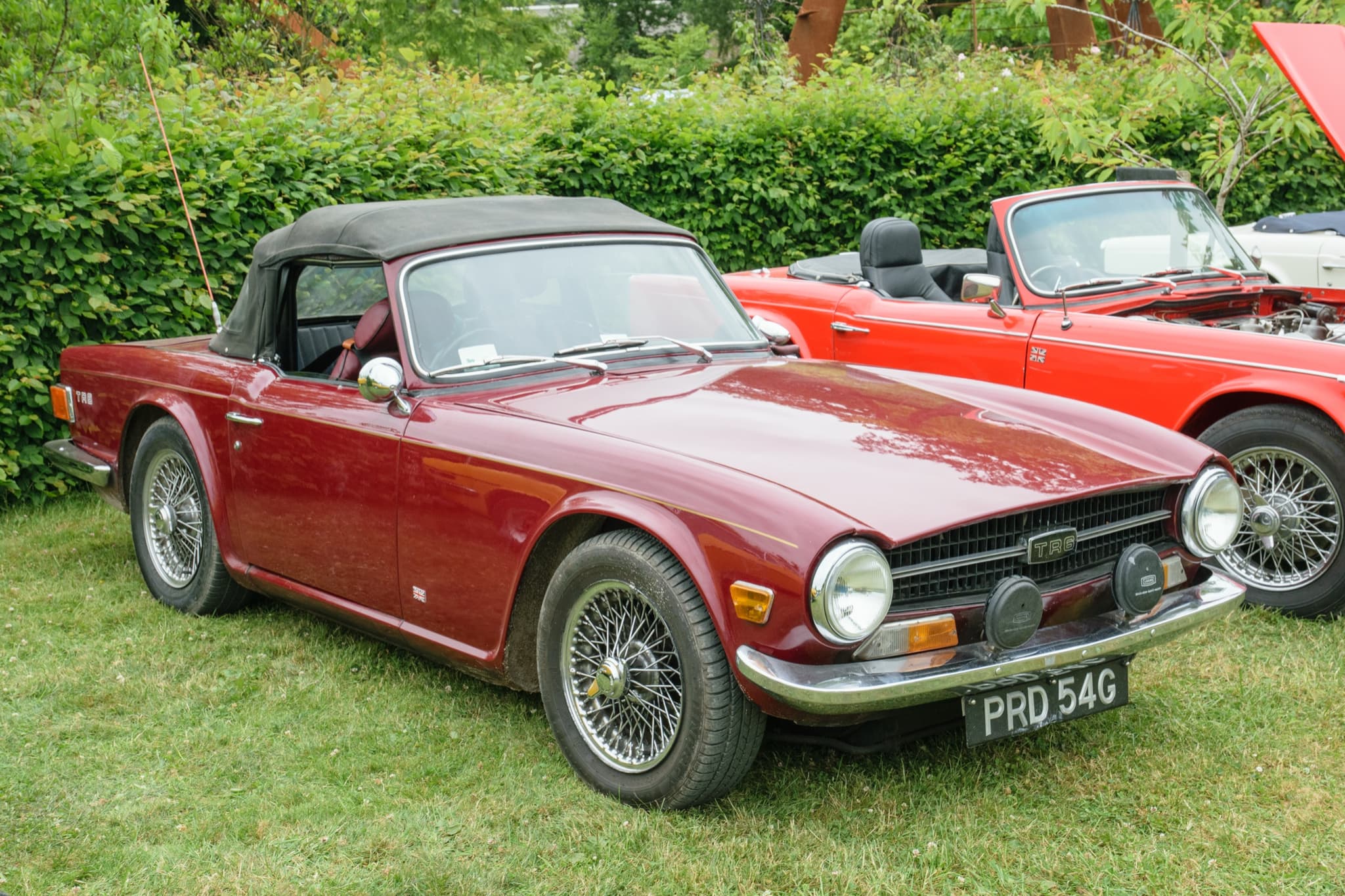
1 An early TR6 in maroon, its hood up and its wire wheels the factory's option, dated 1969 by its photographer, in June 2018; the covered spot lamps are additions.
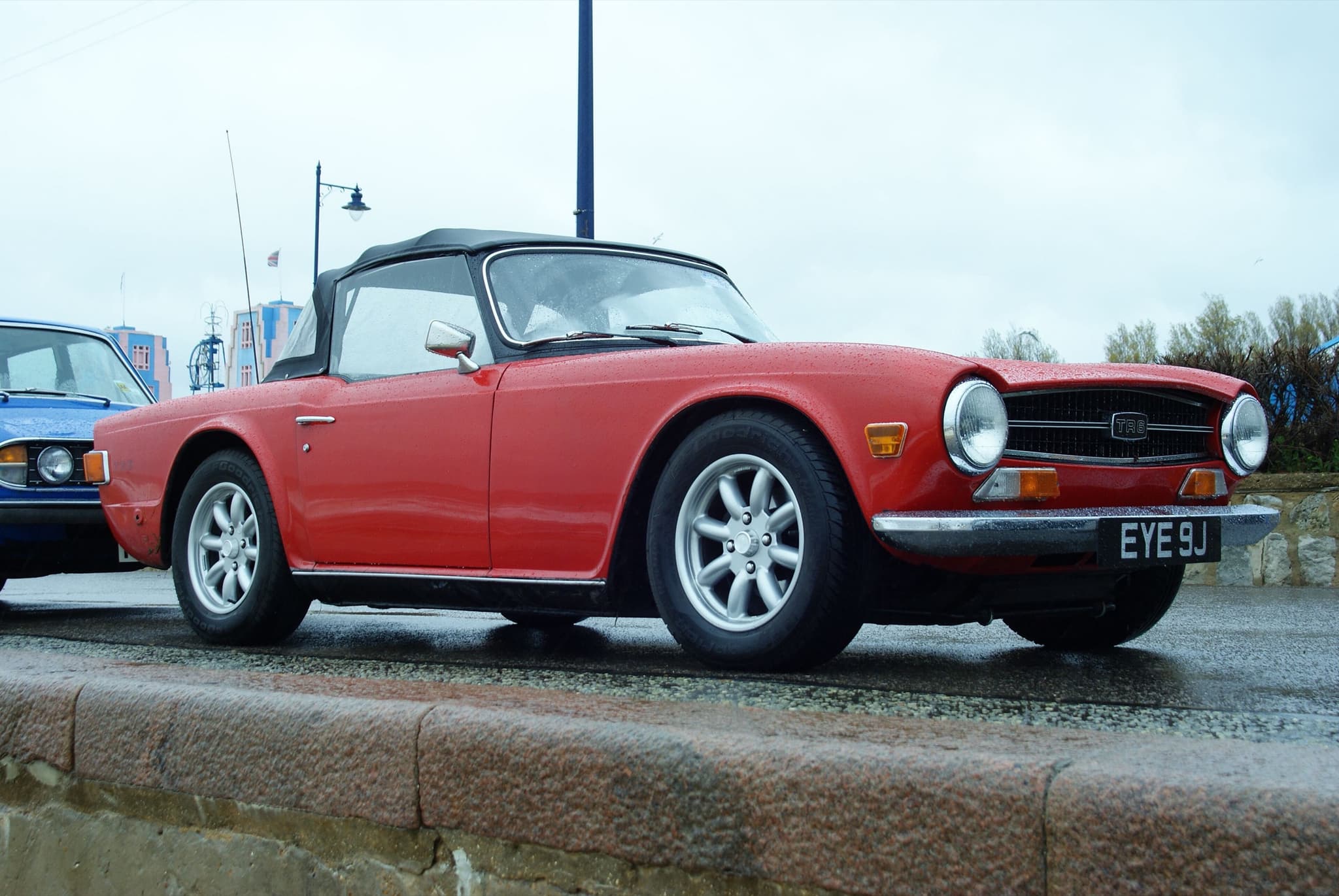
2 Hood up on a wet promenade: a red TR6 of the early type, registered in Britain in 1970 or 1971; its eight-spoke alloy wheels are not factory.
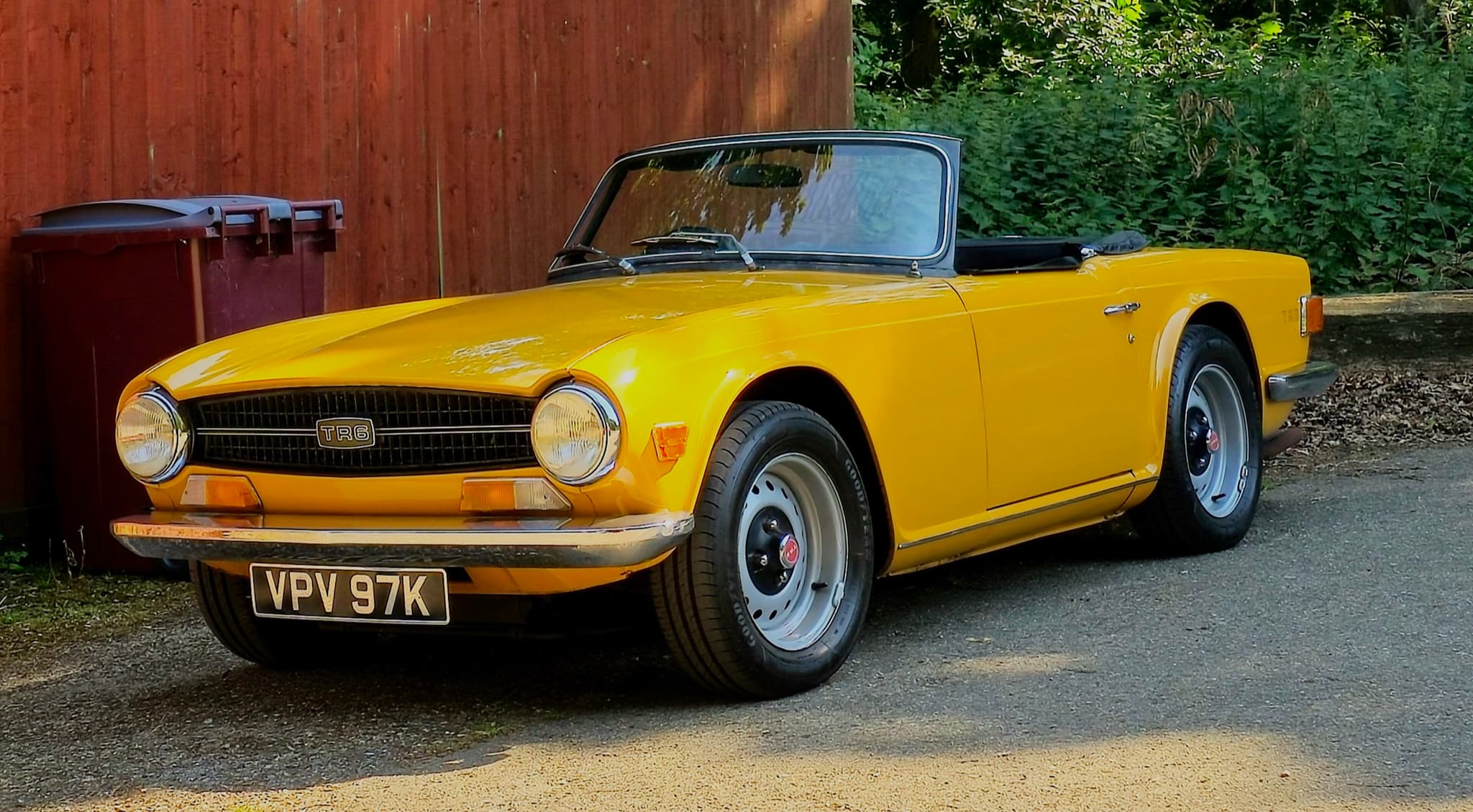
3 A yellow TR6 registered in 1971 or 1972, hood folded, a chrome bumper and nothing beneath it, as the early cars were built.
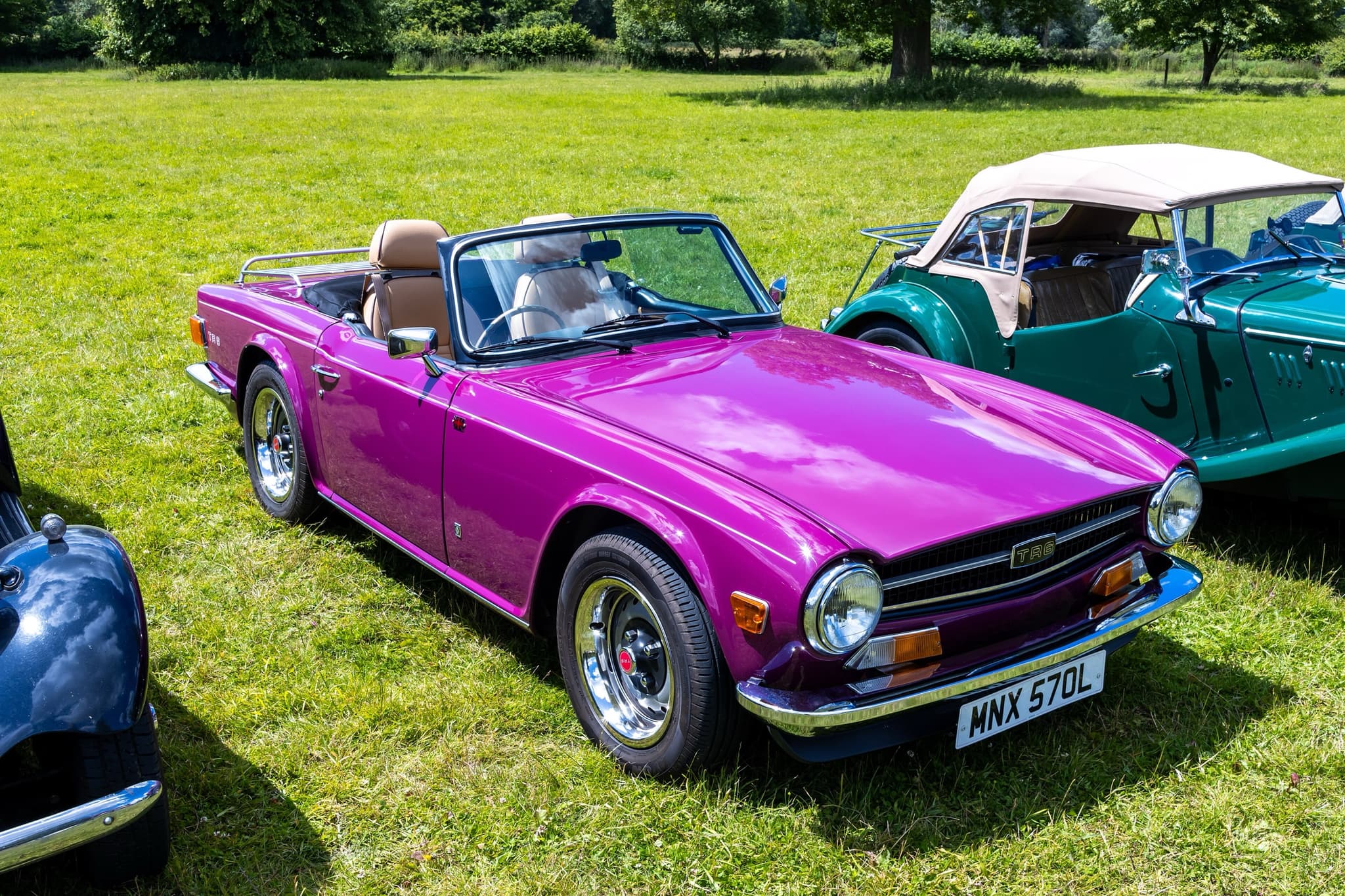
4 The late face, a spoiler under the bumper, on a magenta TR6 registered in 1972 or 1973, beside a green Morgan in Buckinghamshire in June 2024.
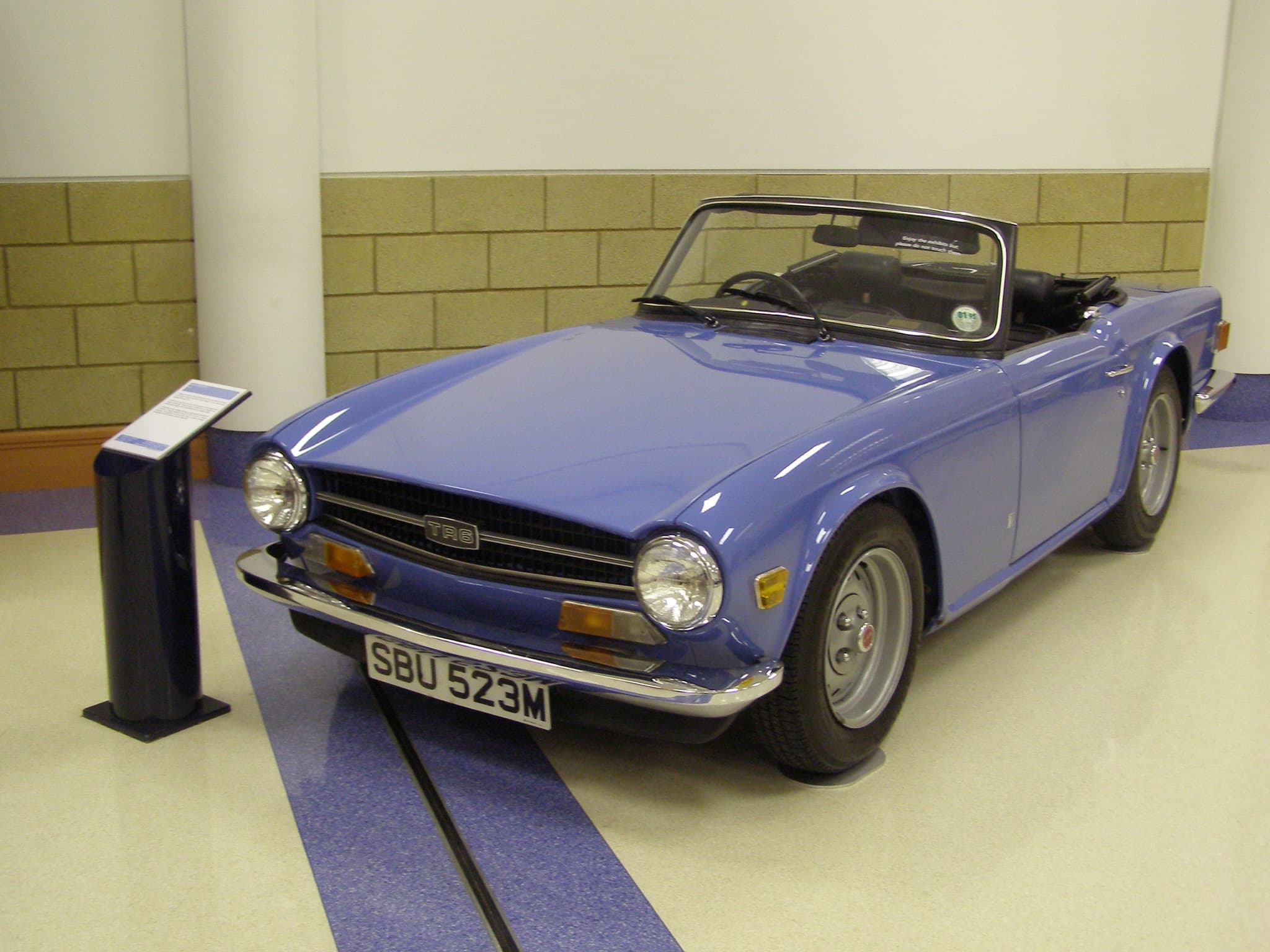
5 Indoors at Gaydon in December 2007, at what was then the Heritage Motor Centre: the museum's mid-blue TR6, a late car with its spoiler and without American overriders.
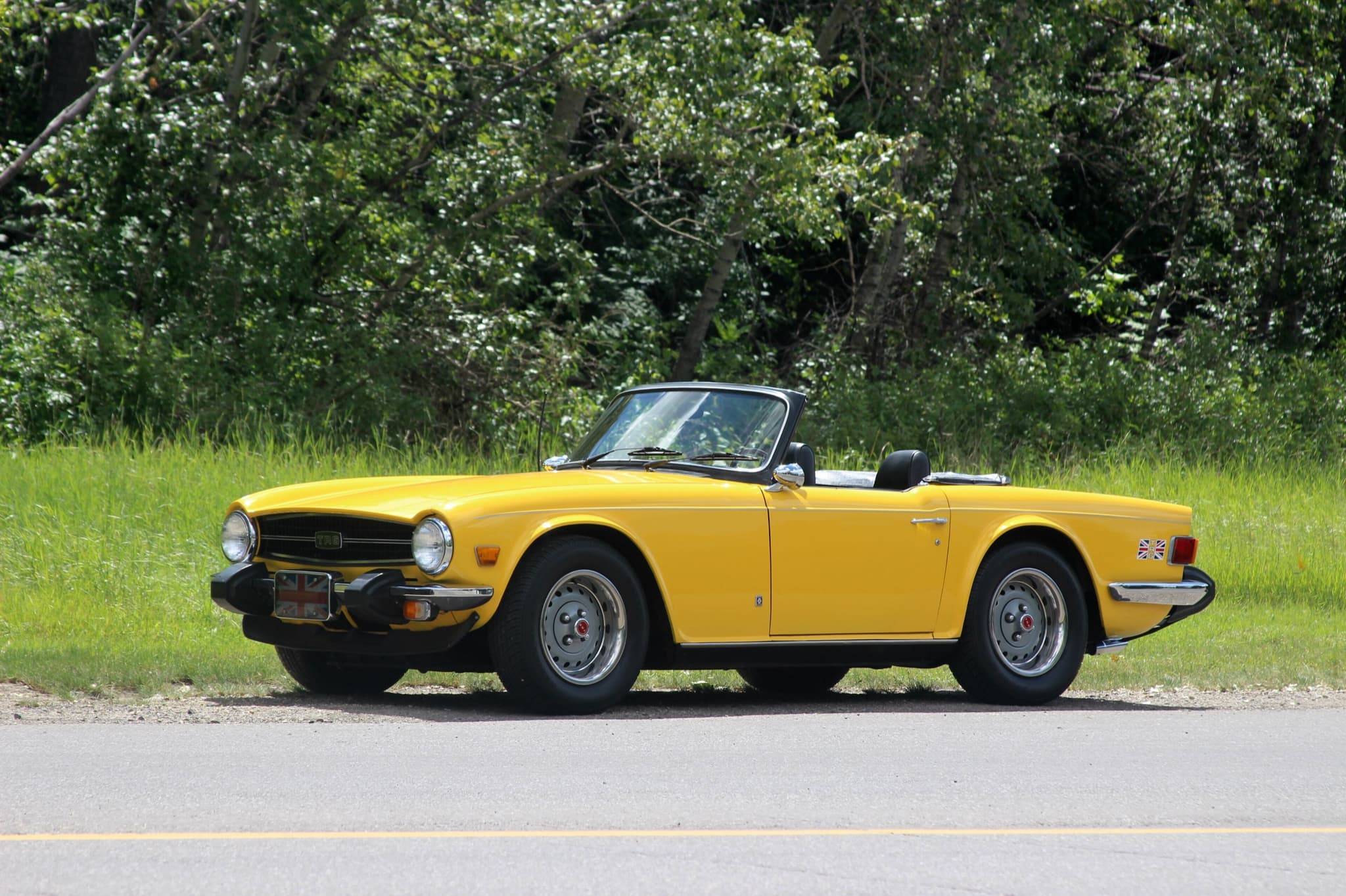
6 Yellow, with the rubber overriders and higher front bumper of the last two American model years, 1975 and 1976: a TR6 parked by a road through woods in Alberta, Canada, in 2016.
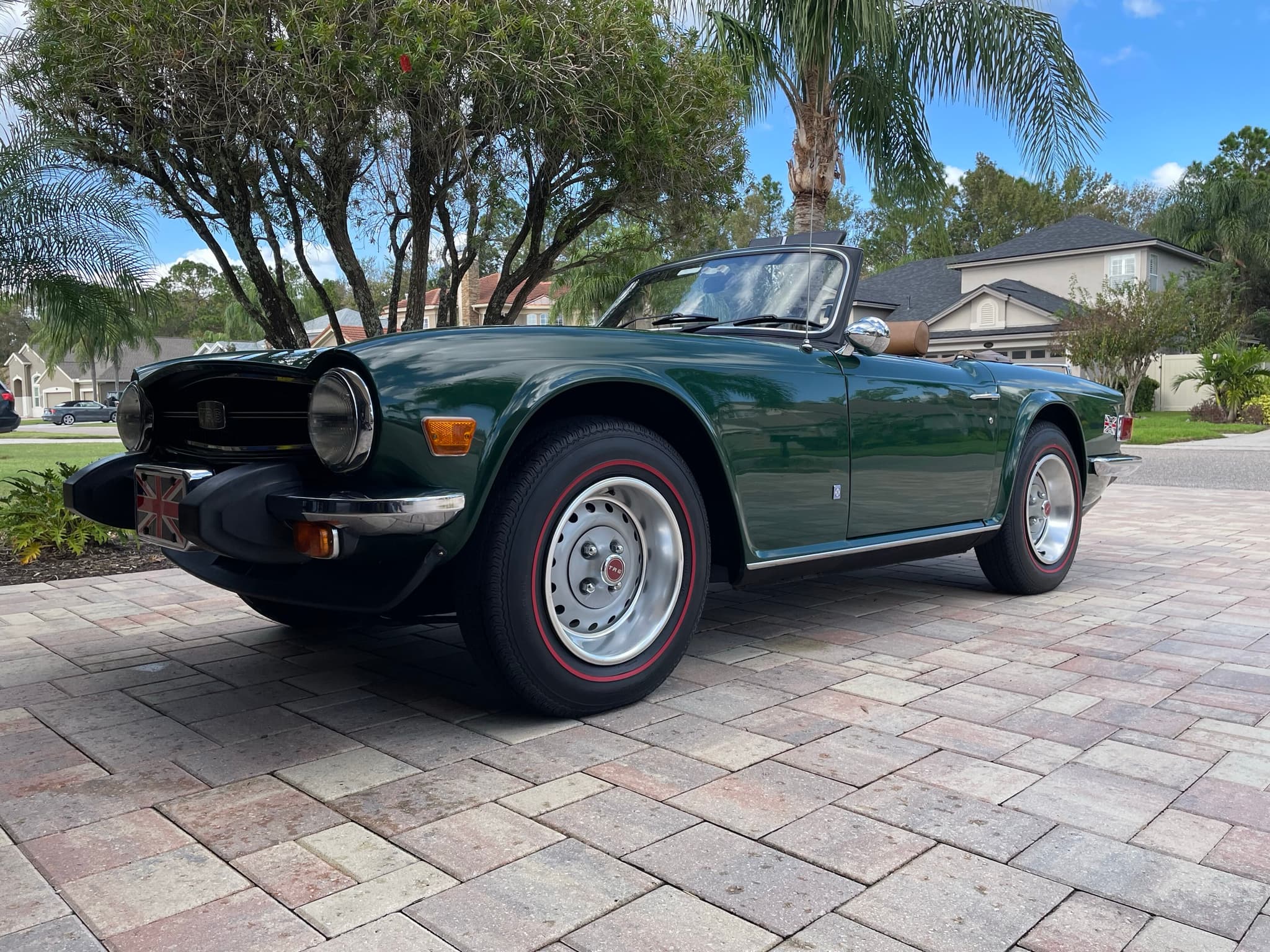
7 Dark green, on red-band tyres, in Florida in October 2024: another American TR6 of those last two model years, which its owner calls a 1976 car.
Picture credits (7)
- 1 Steve Glover, CC BY 2.0
- 2 HHA124L, CC BY-SA 2.0
- 3 Calreyn88, CC BY-SA 4.0
- 4 Mike Peel, CC BY-SA 4.0
- 5 MilborneOne, CC BY-SA 4.0
- 6 dave_7 from Canada, CC BY 2.0
- 7 Transpoecon, CC BY-SA 4.0
The TR6 PI
The injected TR6 was never sold in North America: every TR6 PI was built for Britain or for other markets. On the tail, the word INJECTION beneath TRIUMPH marks one, as on the cars in Triumph's brochure, and under the bonnet (hood) the injection is plain to see. A badge can be fitted to any TR6, though, and right-hand drive proves nothing, since many American cars have been converted, so the commission number, beginning CP or CR, is what settles it.source 6source 7source 8source 1
PI cars 5
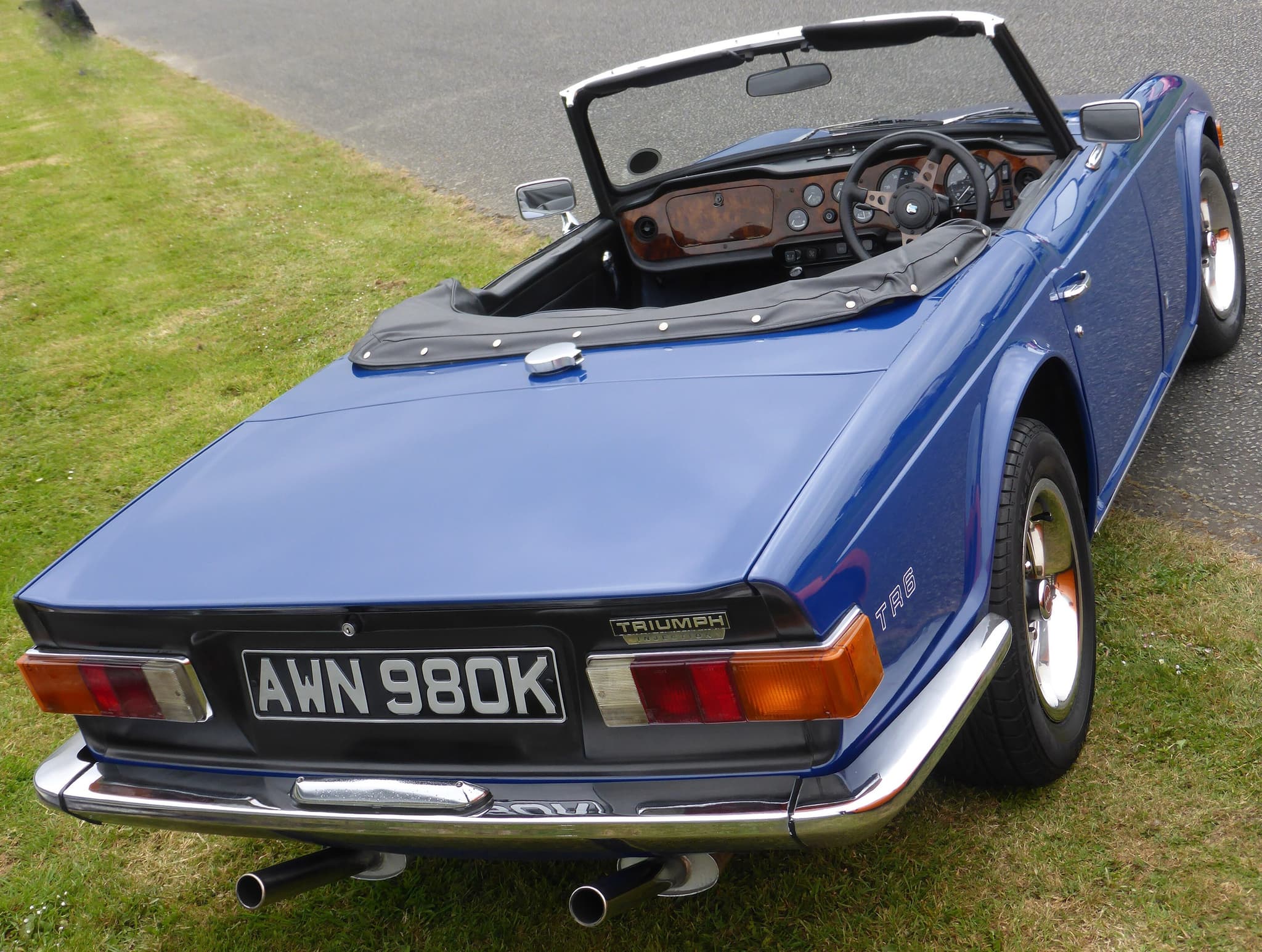
8 Seen from above: a right-hand-drive TR6 PI registered in the CP years, the INJECTION badge on its black tail panel, at a museum breakfast meeting in Somerset in 2017.
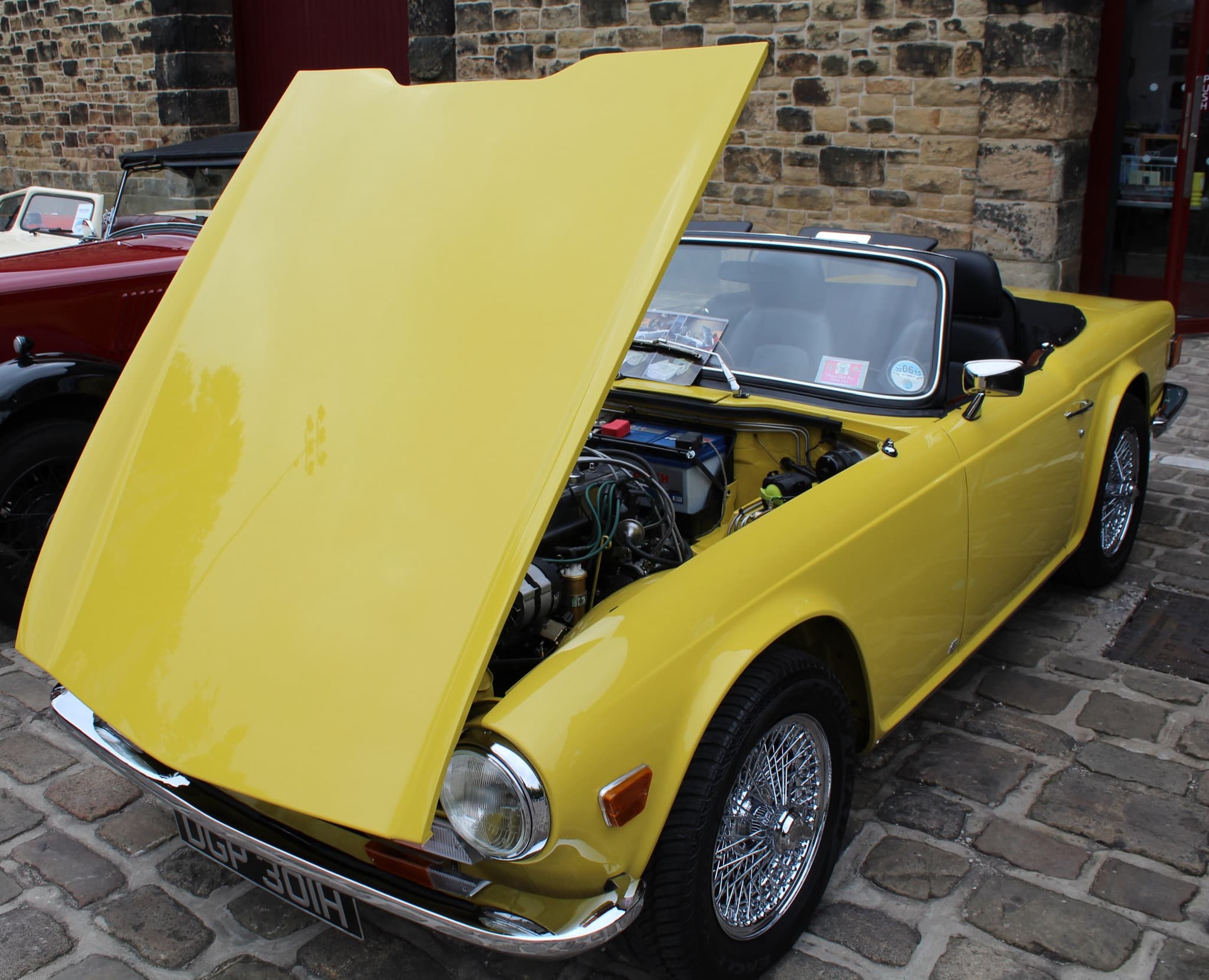
9 Yellow, on wire wheels and registered in 1969 or 1970: a TR6 PI with its front-hinged bonnet up, beside the East Lancashire Railway in 2014.
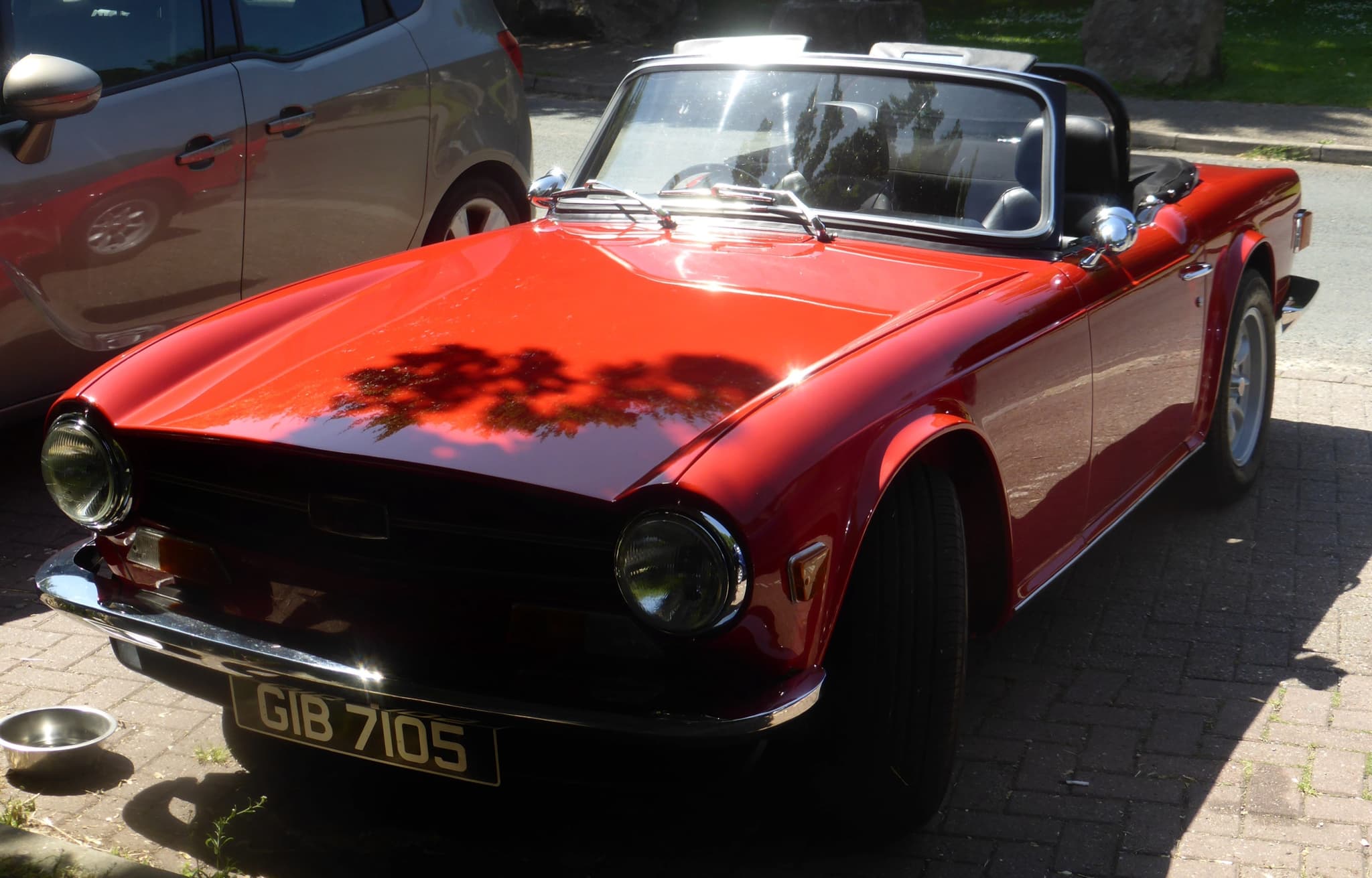
10 A red TR6 PI with right-hand drive, in hard sun on block paving in July 2019; the roll bar and alloy wheels are later additions, and the next picture shows its badge.
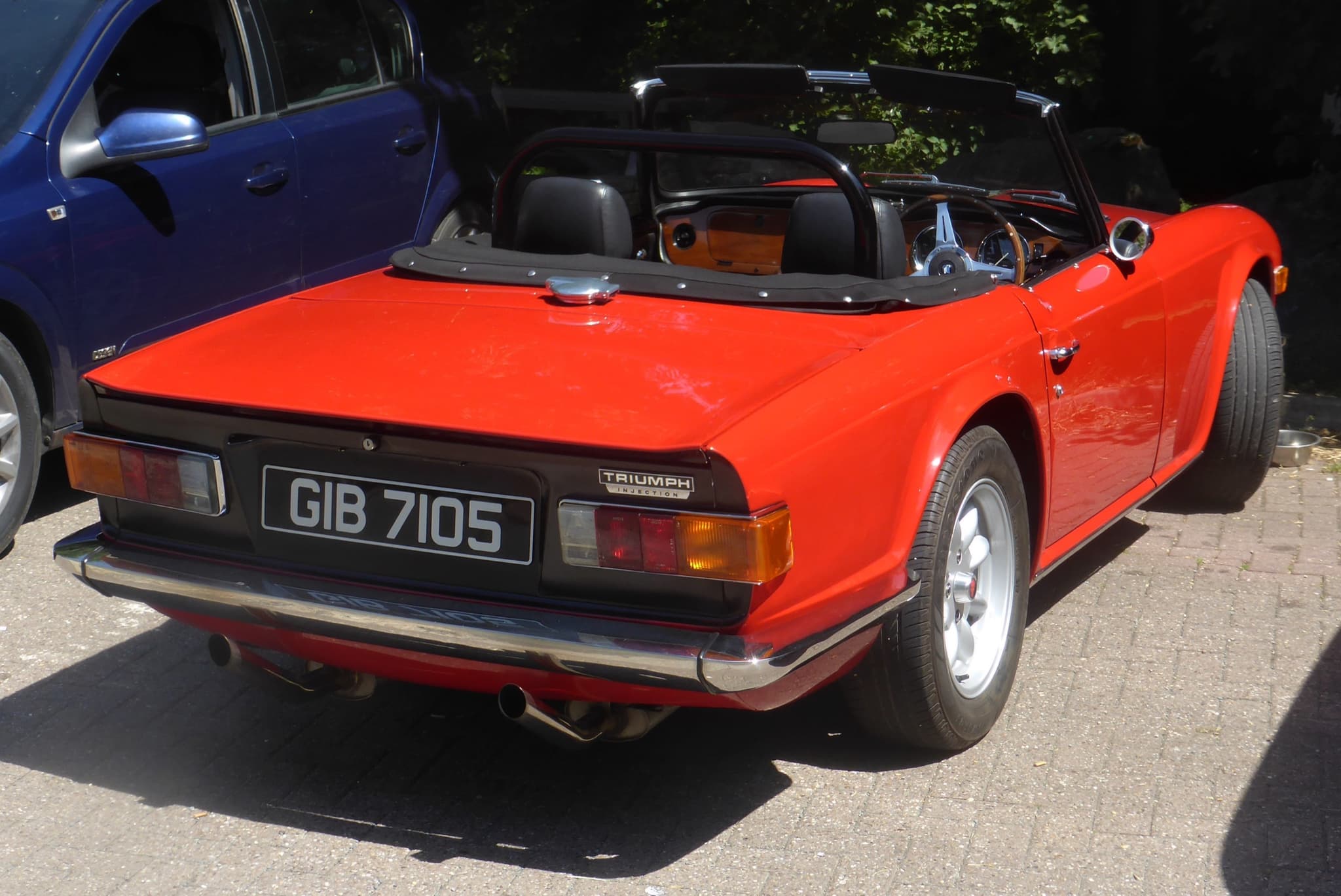
11 The same car from behind, TRIUMPH over INJECTION on its black panel, in July 2019.
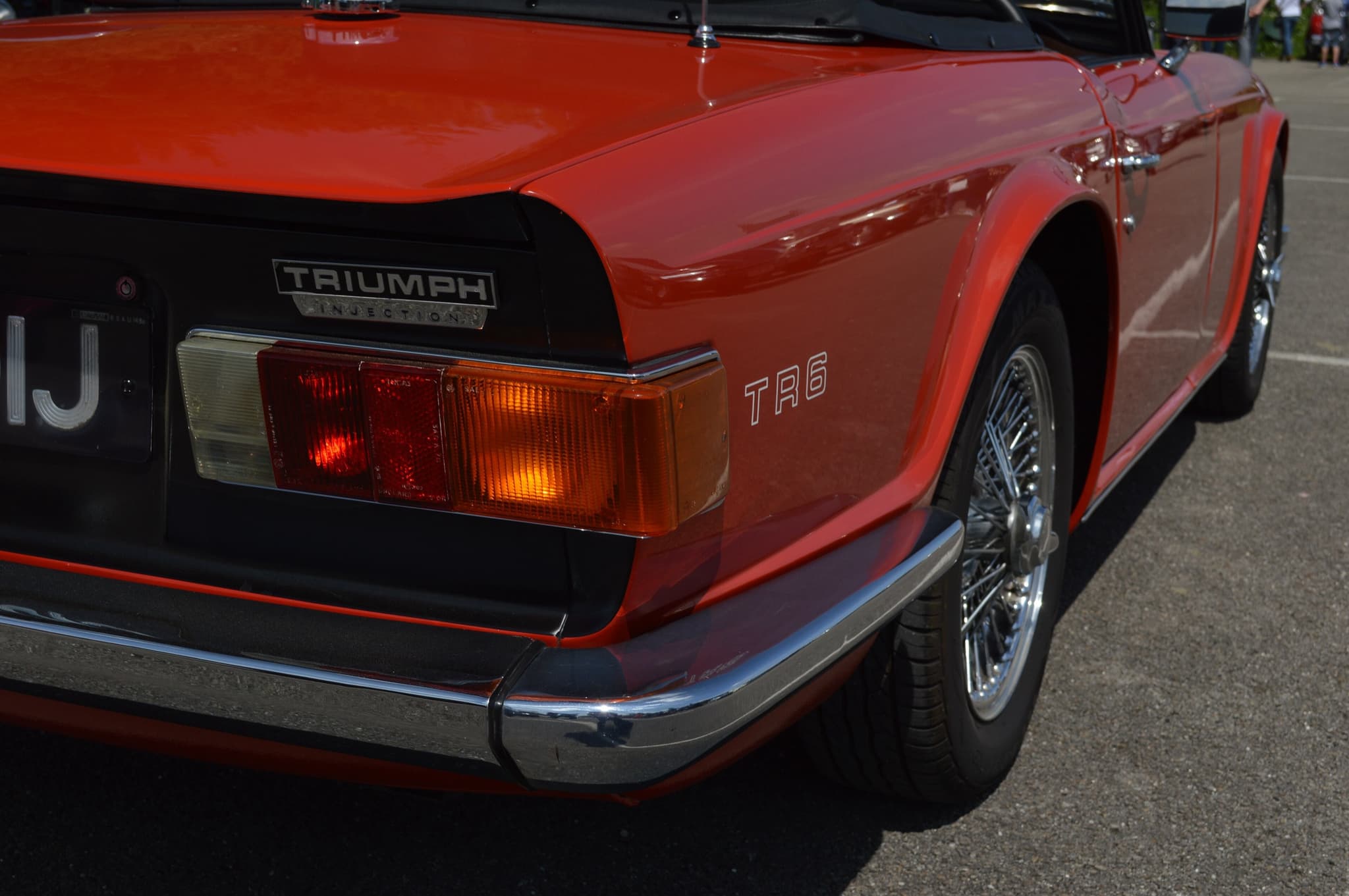
12 The INJECTION badge close up, on another red TR6 PI, one with wire wheels.
Picture credits (5)
- 8 Andrew Bone from Weymouth, England, CC BY 2.0
- 9 Thomas's Pics, CC BY 2.0
- 10 Andrew Bone, CC BY 2.0
- 11 Andrew Bone, CC BY 2.0
- 12 Draco2008 from UK, CC BY 2.0
Colours
Colours 6
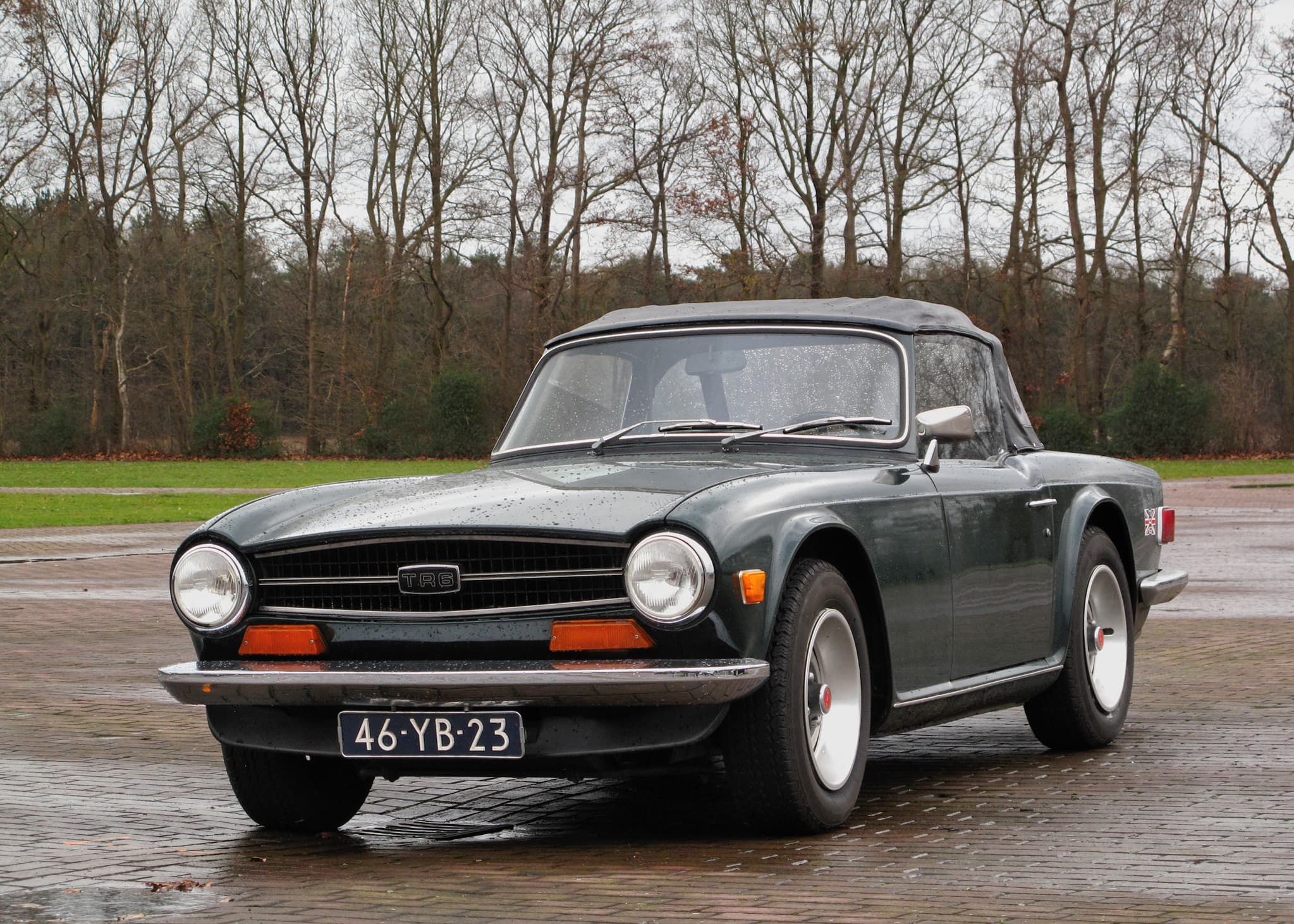
13 Dark green under bare trees: an early, left-hand-drive TR6 with a grey hood, in the Netherlands in March 2019.
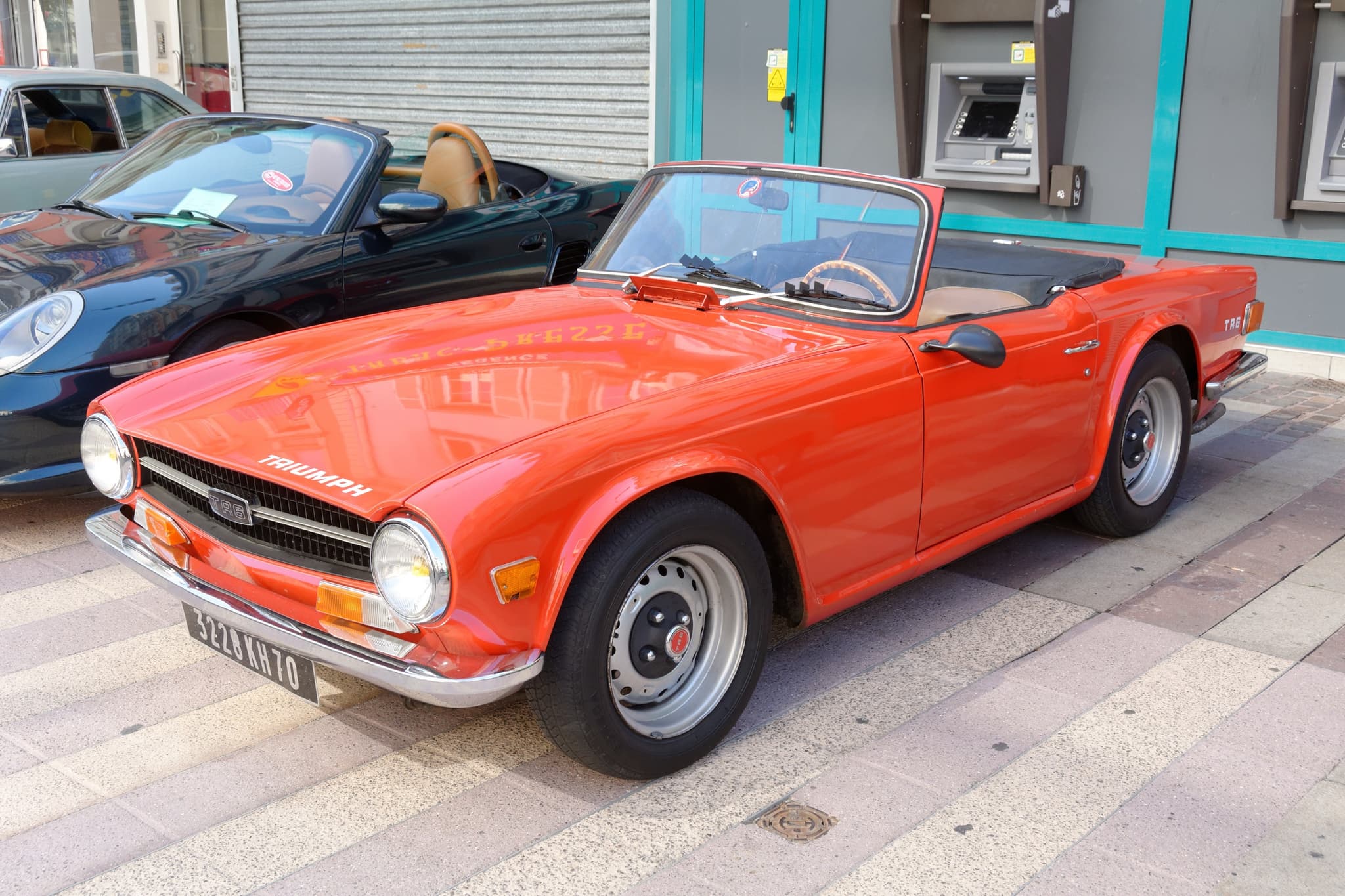
14 Orange with tan seats, at a convertibles' festival in Belfort, France, in 2015; the TRIUMPH decal on the bonnet is not factory.
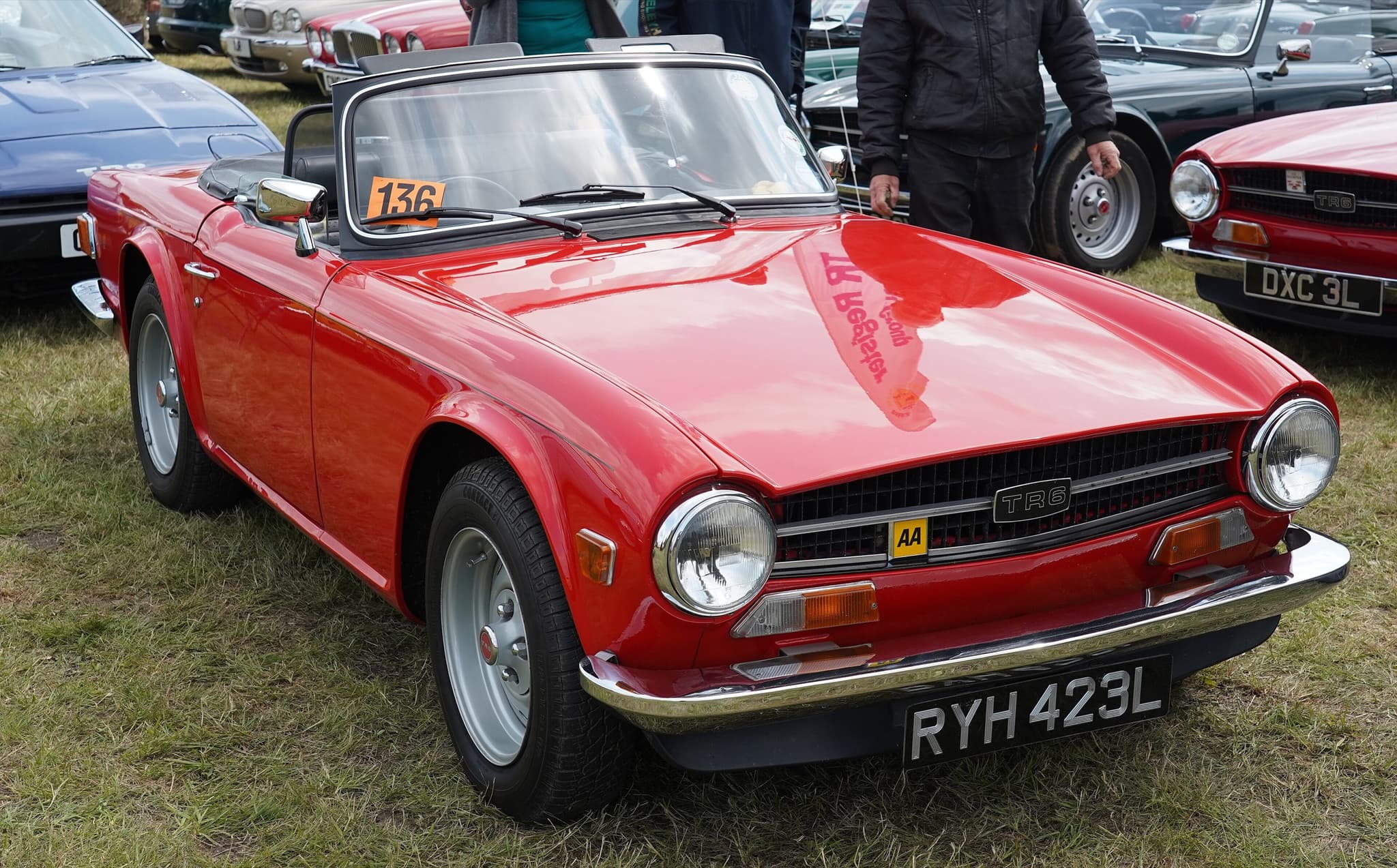
15 Red, hood folded, among other Triumphs at a rally of old cars at Marks Tey, Essex, in June 2025: an early TR6 registered in 1972 or 1973.
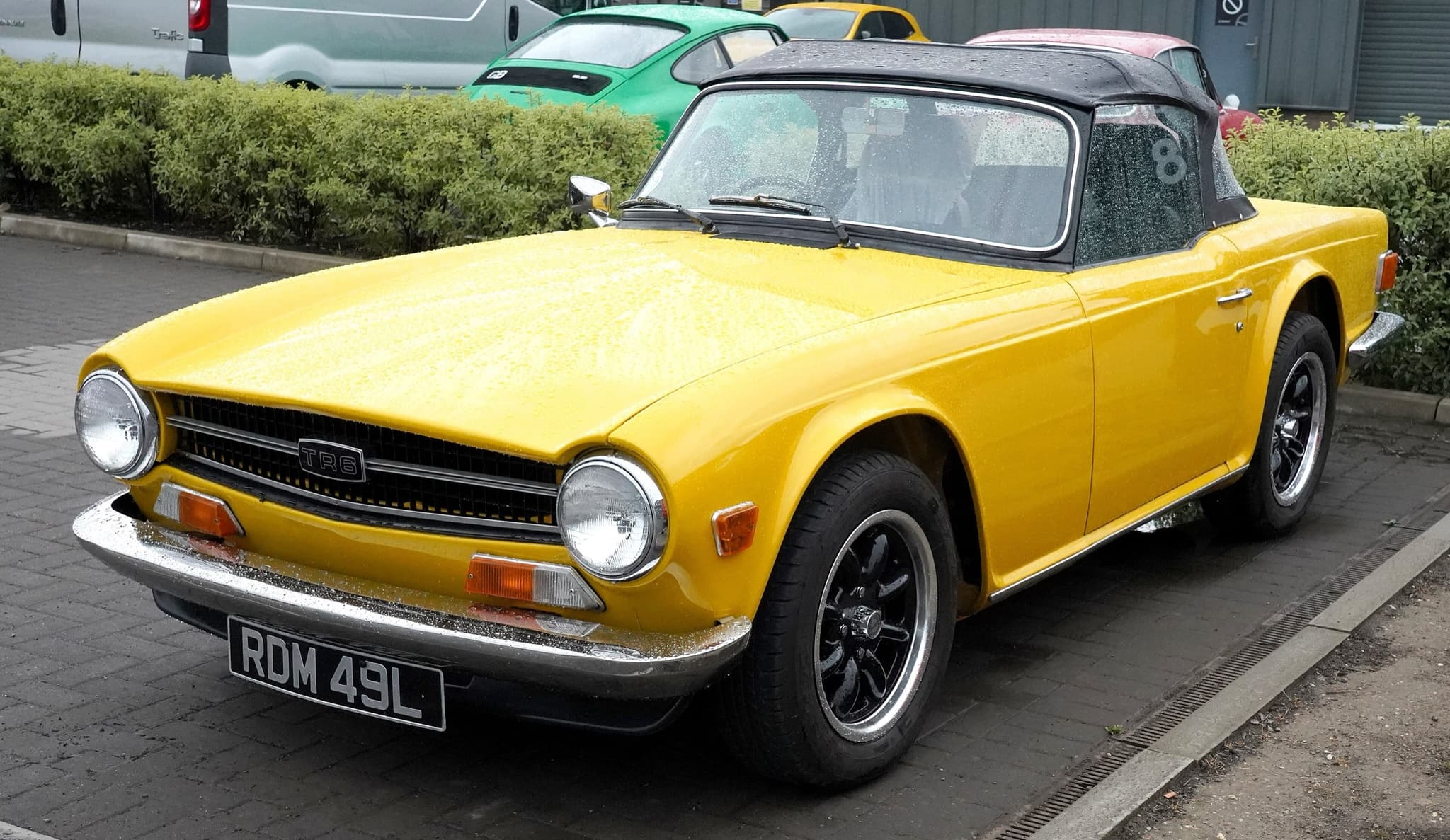
16 Yellow, hood up and beaded with rain, in North Yorkshire in 2025, on alloy wheels that are not original.
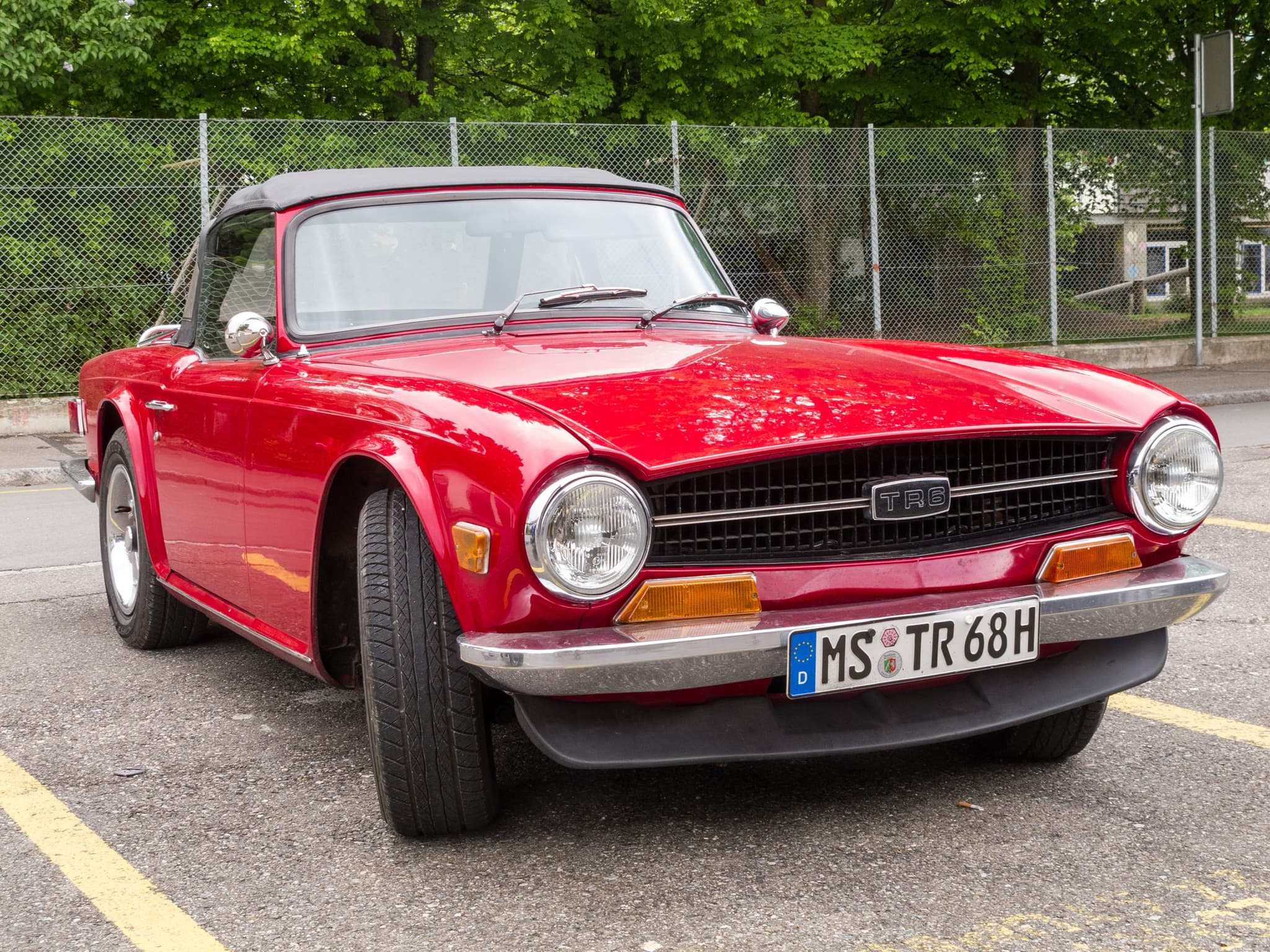
17 Red, with a black hood and spoiler, alone in a car park in Germany in May 2012.
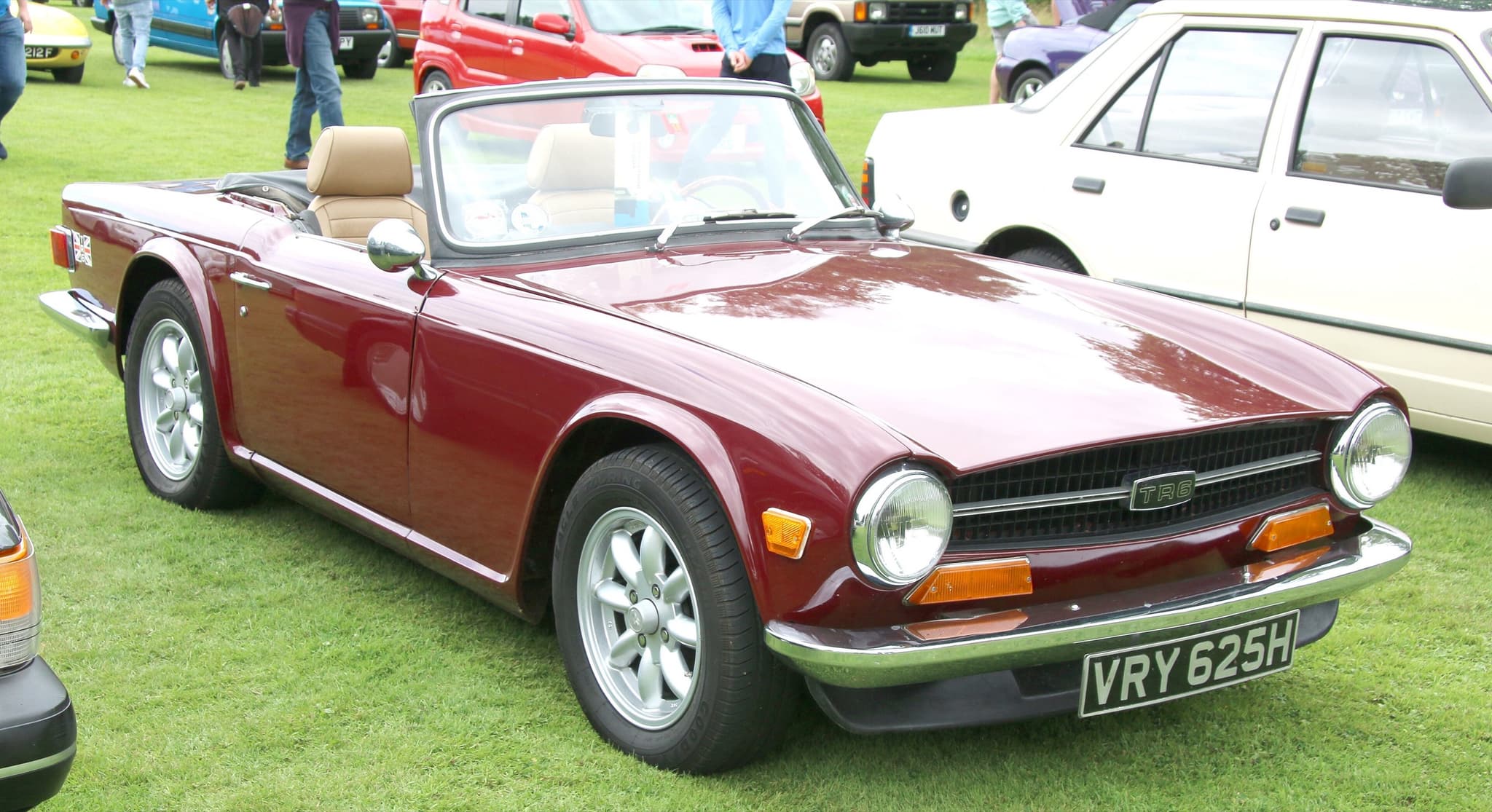
18 Maroon with tan seats, at the Festival of the Unexceptional at Grimsthorpe Castle in 2021: a TR6 with a front spoiler and later alloy wheels.
Picture credits (6)
- 13 Rutger van der Maar, CC BY 2.0
- 14 Thomas Bresson, CC BY 3.0
- 15 kitmasterbloke, CC BY 2.0
- 16 kitmasterbloke, CC BY 4.0
- 17 JoachimKohler-HB, CC BY-SA 4.0
- 18 kitmasterbloke, CC BY 2.0
The interior
The instruments date a cockpit, as the interior page explains. Those of the late cars, from late 1972, are restyled, with the small dials' needles now pointing up, and one of them is a battery-condition meter. American cars had head restraints on their seats from the start. Many cockpits have been retrimmed and their steering wheels changed since.source 1source 10
Interiors 4
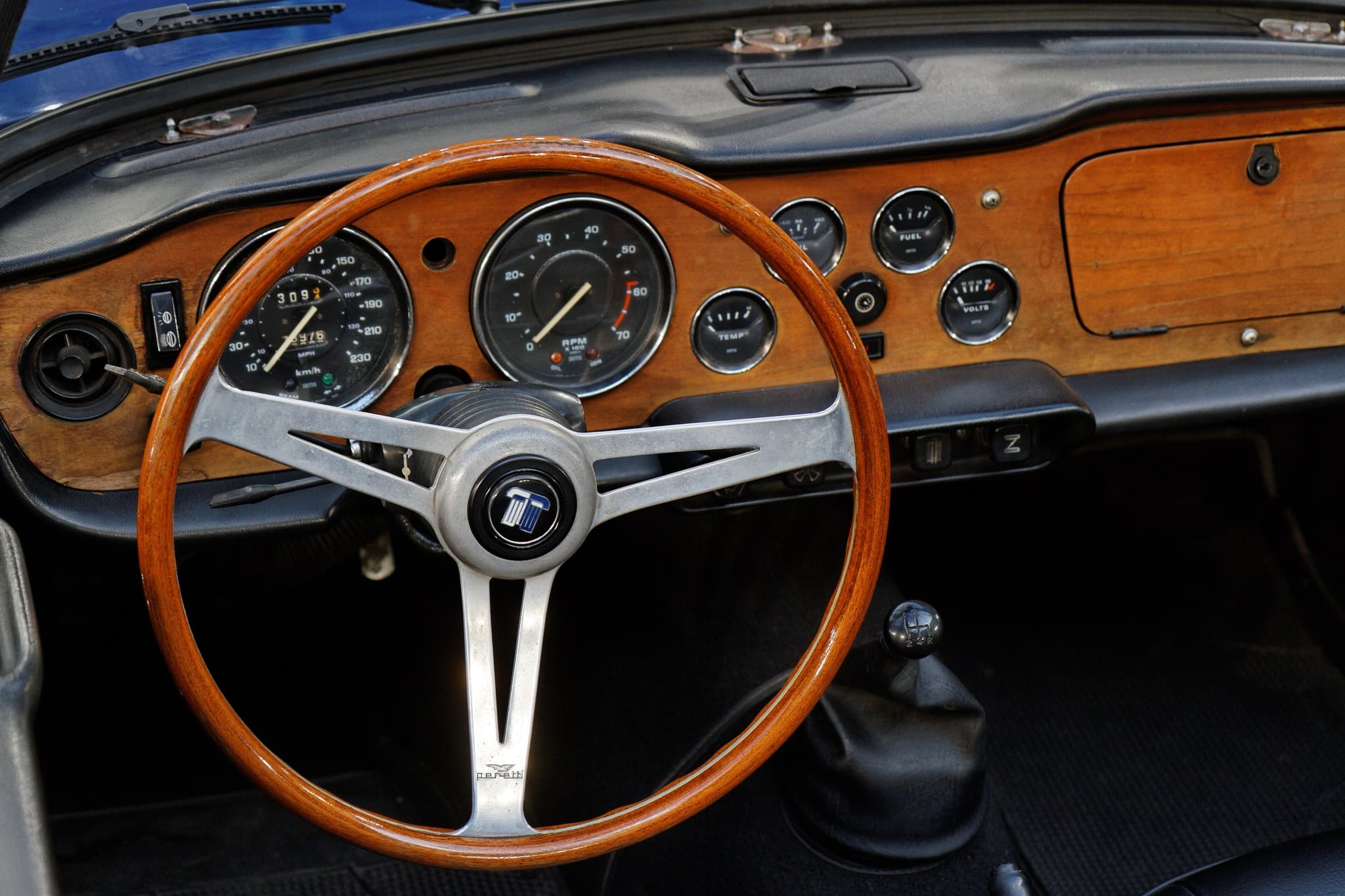
19 The late instruments, the battery meter among them, in a left-hand-drive TR6 with km/h on its speedometer, catalogued as a 1974 car at a Paris sale in 2014.
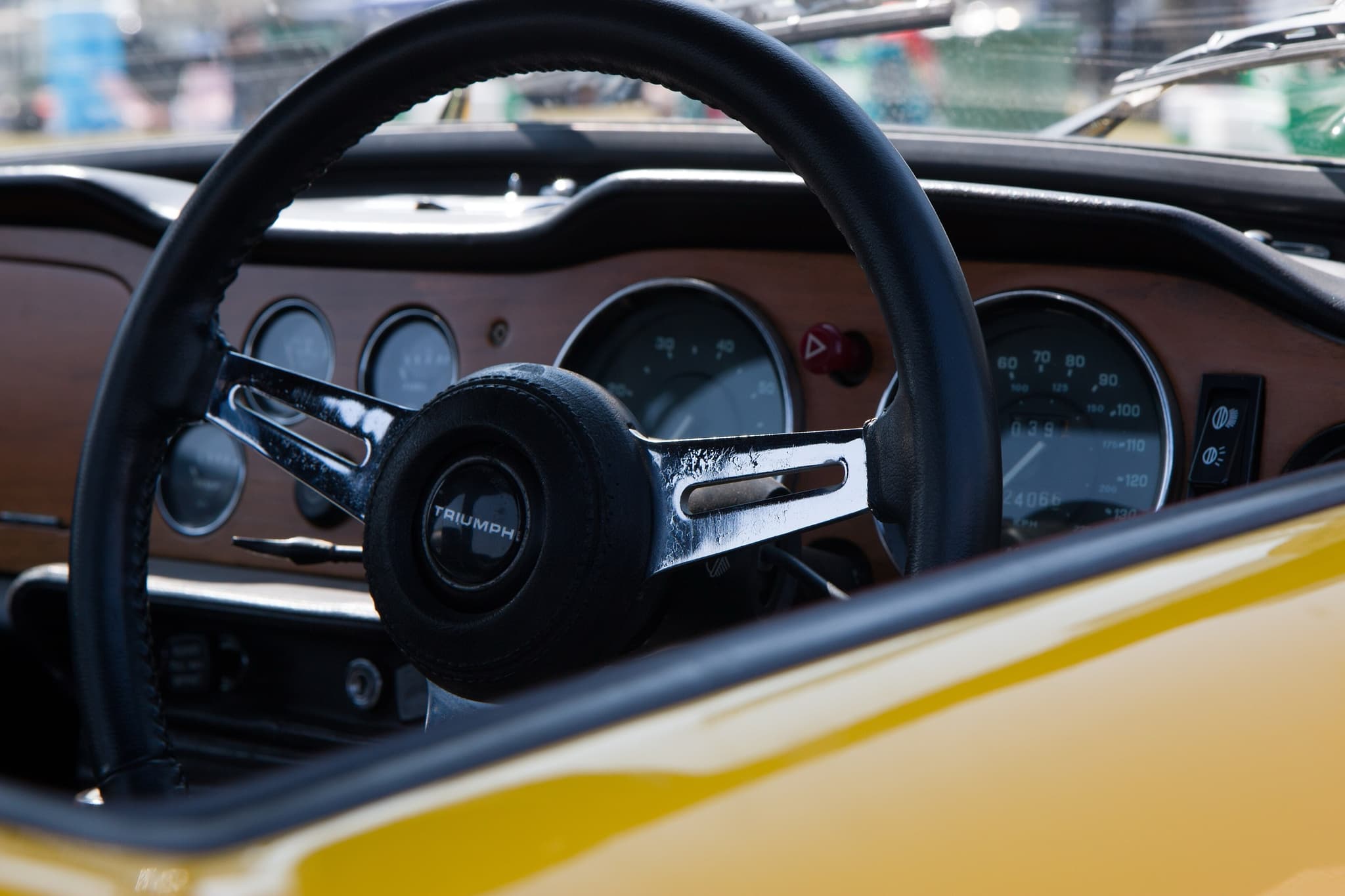
20 A leather-rimmed wheel with slotted chrome spokes, and the facia of a yellow TR6, at a classic car festival in Hong Kong in 2014.
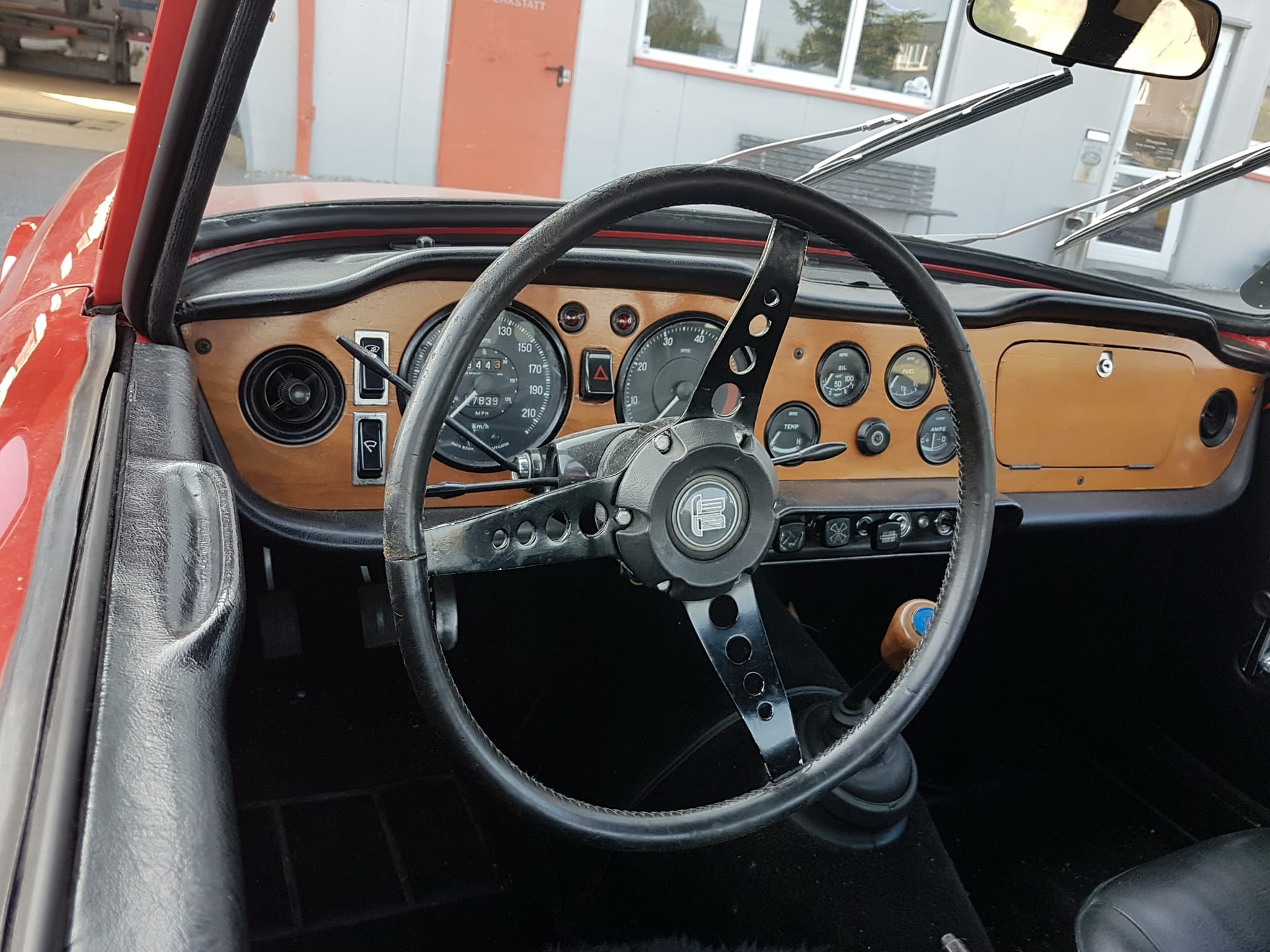
21 Through the open door of a red left-hand-drive TR6 at Hohenems, Austria, in 2019: the wood facia, two large dials and a black three-spoke wheel.
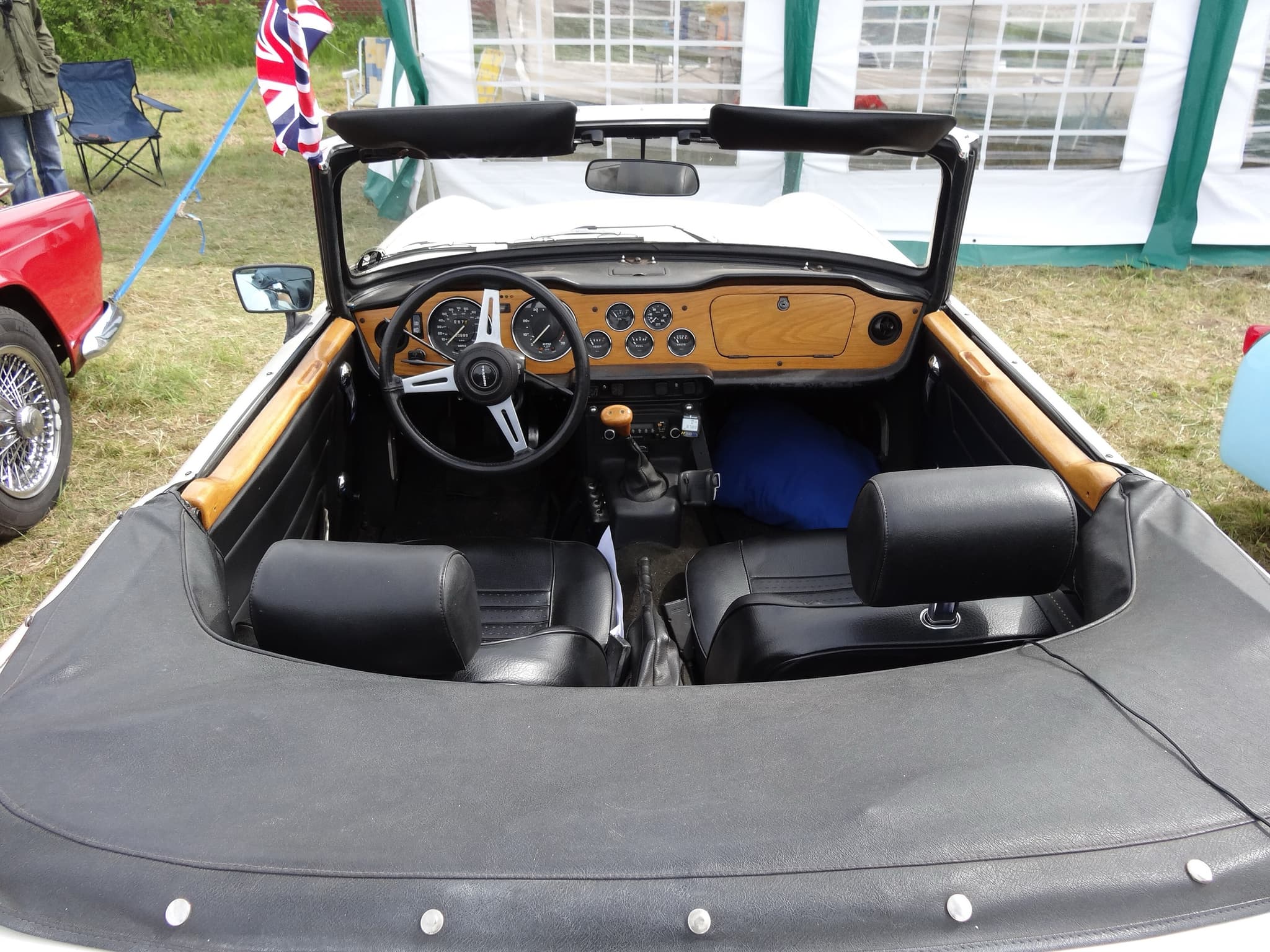
22 From behind a white TR6 at a classic car meeting in northern Germany in 2013: an American car's seats, their head restraints on stalks, and a tonneau over the rear.
Picture credits (4)
- 19 Thesupermat, CC BY-SA 3.0
- 20 km30192002, CC BY 2.0
- 21 Asurnipal, CC BY-SA 4.0
- 22 Nightflyer, CC BY 3.0
The engine bay
Lift the bonnet of a TR6 PI and its injection is plain: a throttle butterfly and an injector for each cylinder, fed by pipes from the metering unit. An American car has two Stromberg carburettors instead, with more emission equipment around them the later it is: exhaust-gas recirculation by the 1974 model year, and air injection for the 1975 model year.source 6source 11source 2
Engine bays 2
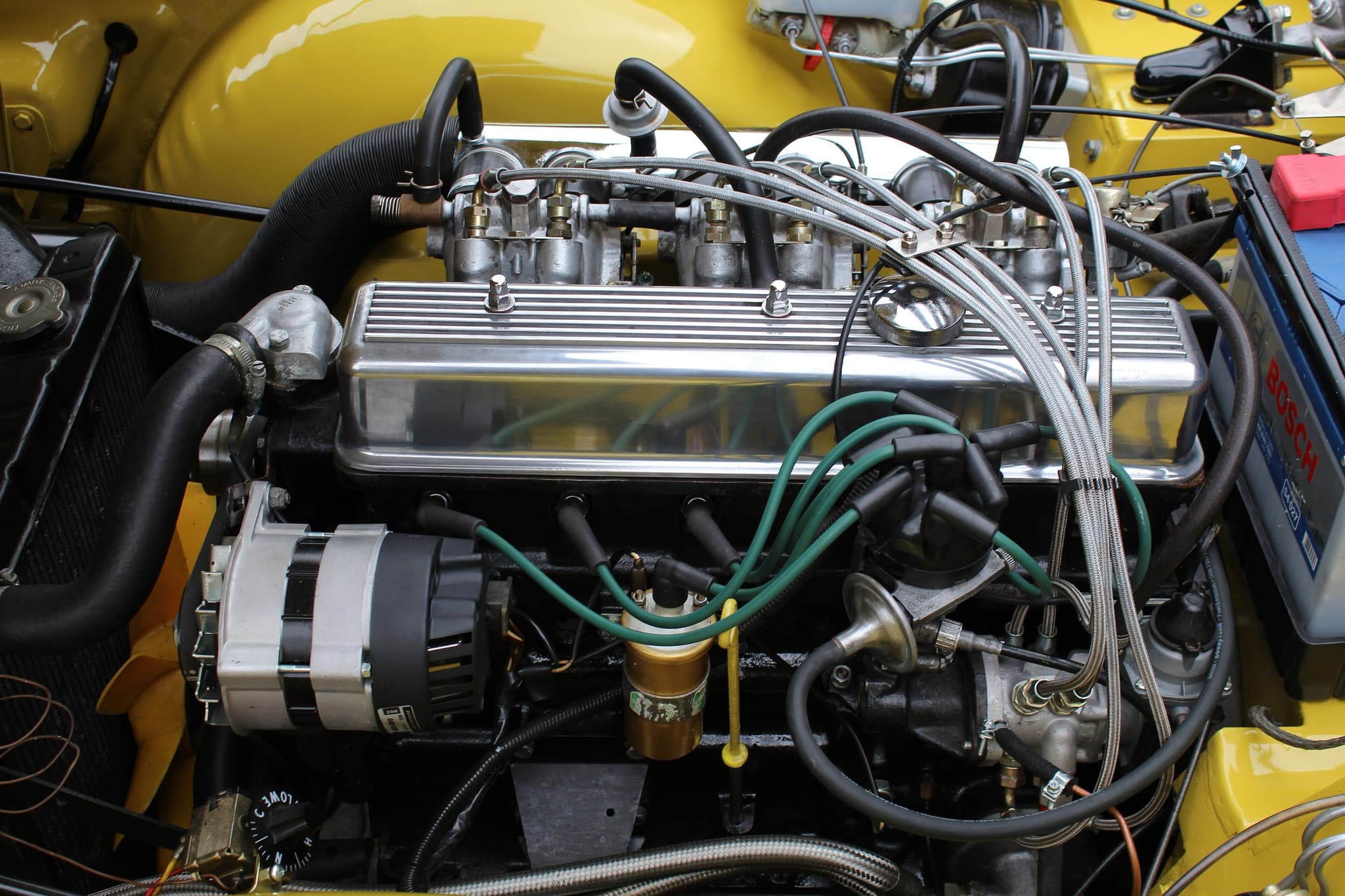
23 Lucas injection on the yellow TR6 PI shown earlier: throttle bodies in pairs, brass injectors and braided pipes from the metering unit; the finned rocker cover is not standard.
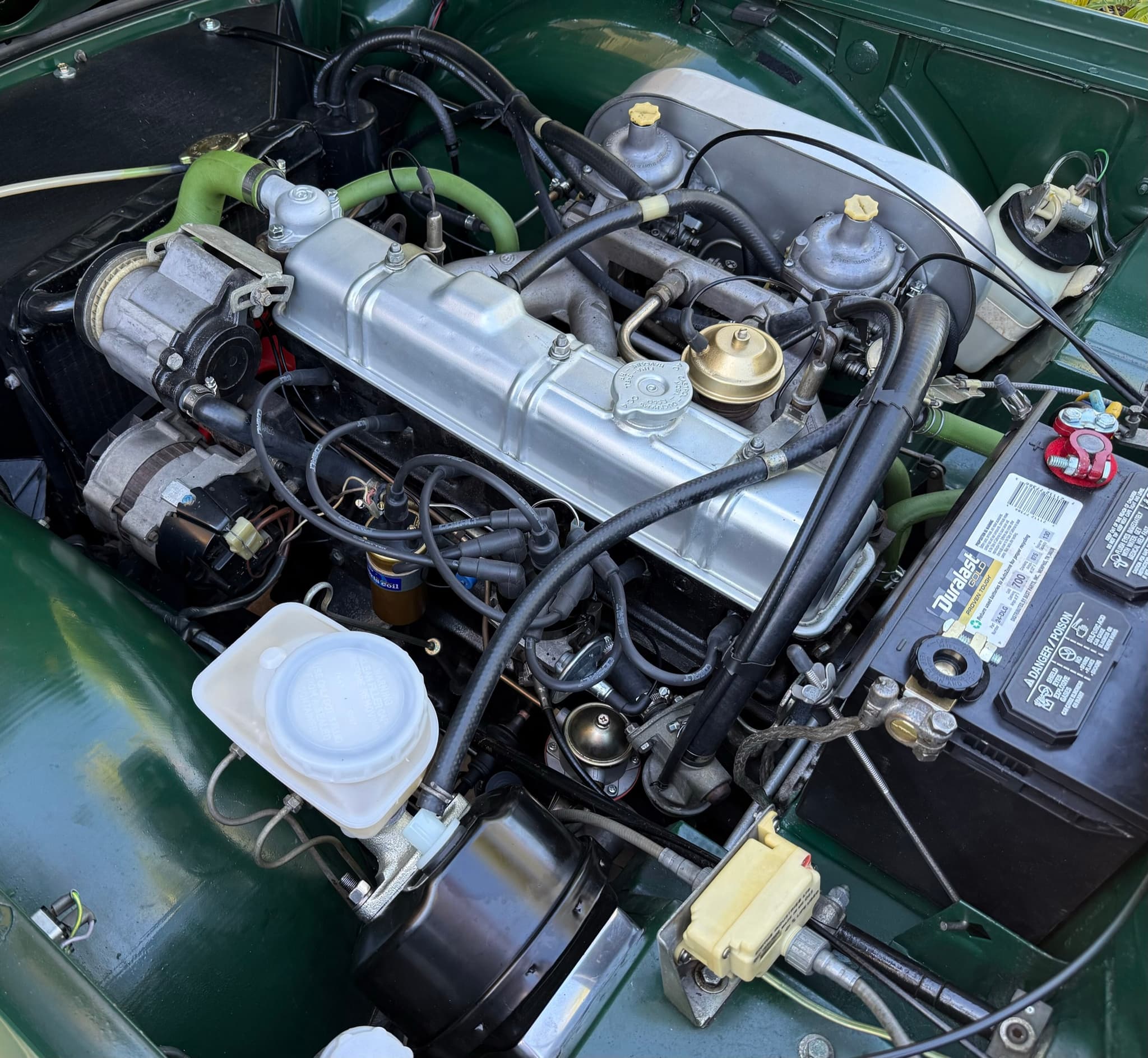
24 Looking down on twin Strombergs, an air pump and recirculation pipework in a dark green American TR6, whose owner dates the engine to the TR6's last week, July 1976.
Picture credits (2)
- 23 Thomas's Pics, CC BY 2.0
- 24 Transpoecon, CC BY-SA 4.0
The hardtop
Both cars wear the hardtop that Triumph designed for the TR6, made in one piece of steel; hardtop and options tells its story, and that of the older top that also fits.source 12
Hardtops 2
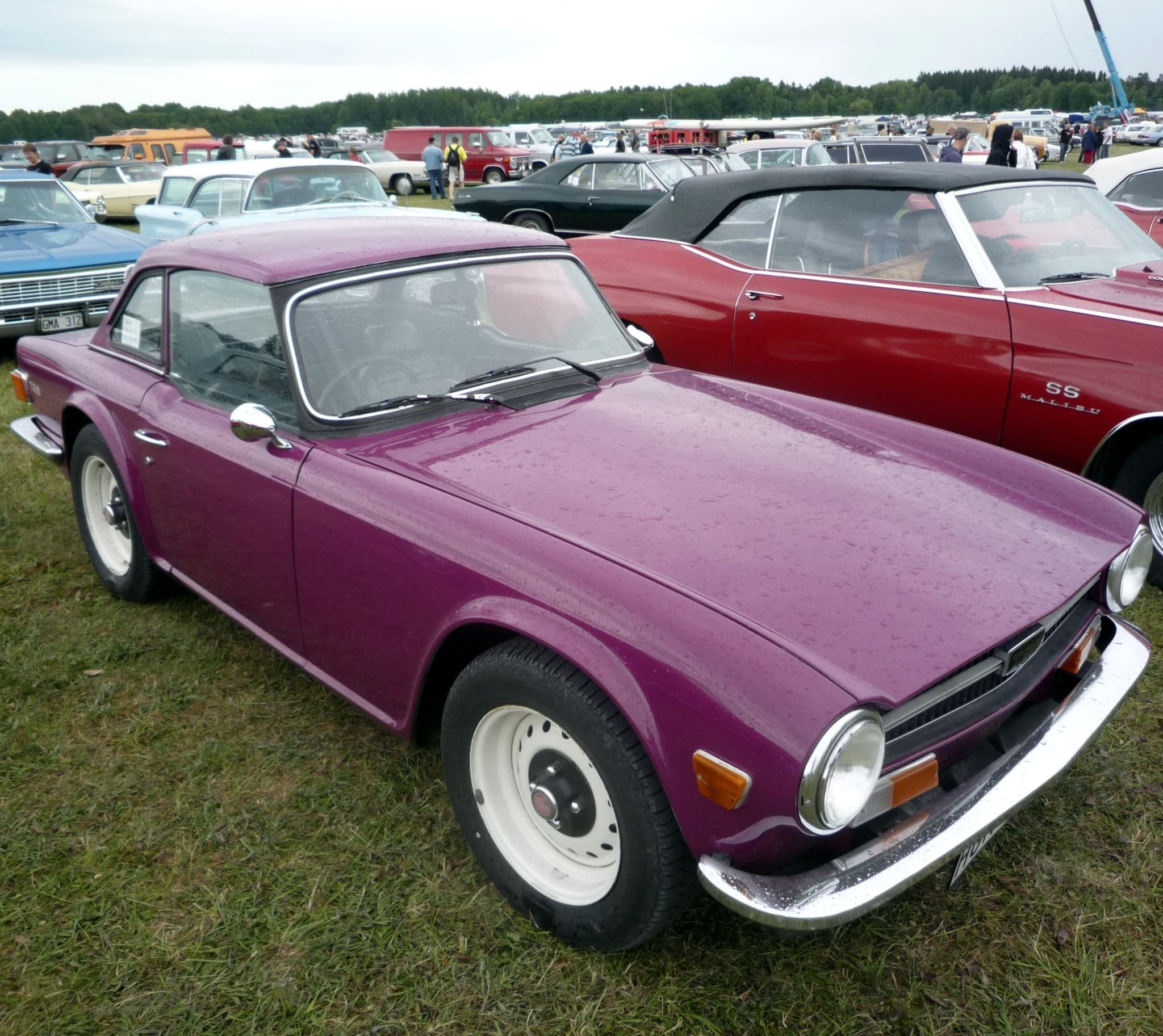
25 Purple from bumper to roof: a TR6 with its hardtop in the body's colour, in drizzle at a big car meeting in 2008; the white wheels are not original.
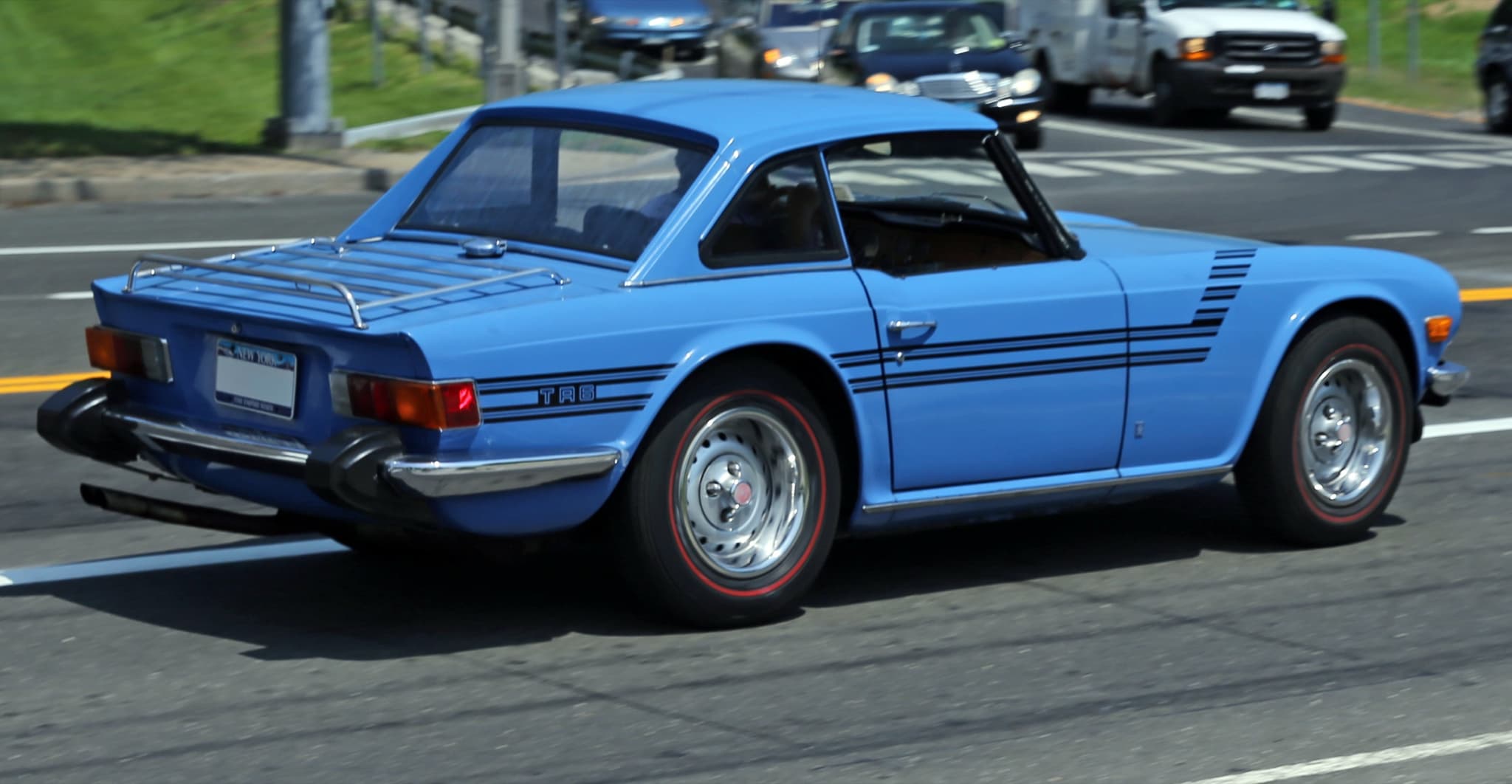
26 Blue, with a hardtop and a luggage rack, driving away through an American city in 2013; its rubber rear overriders belong to the 1974 to 1976 model years.
Picture credits (2)
- 25 Michael Spiller from Bradford, UK, CC BY-SA 2.0
- 26 Mr.choppers, CC BY-SA 3.0
Racing and rallying
Racing 3
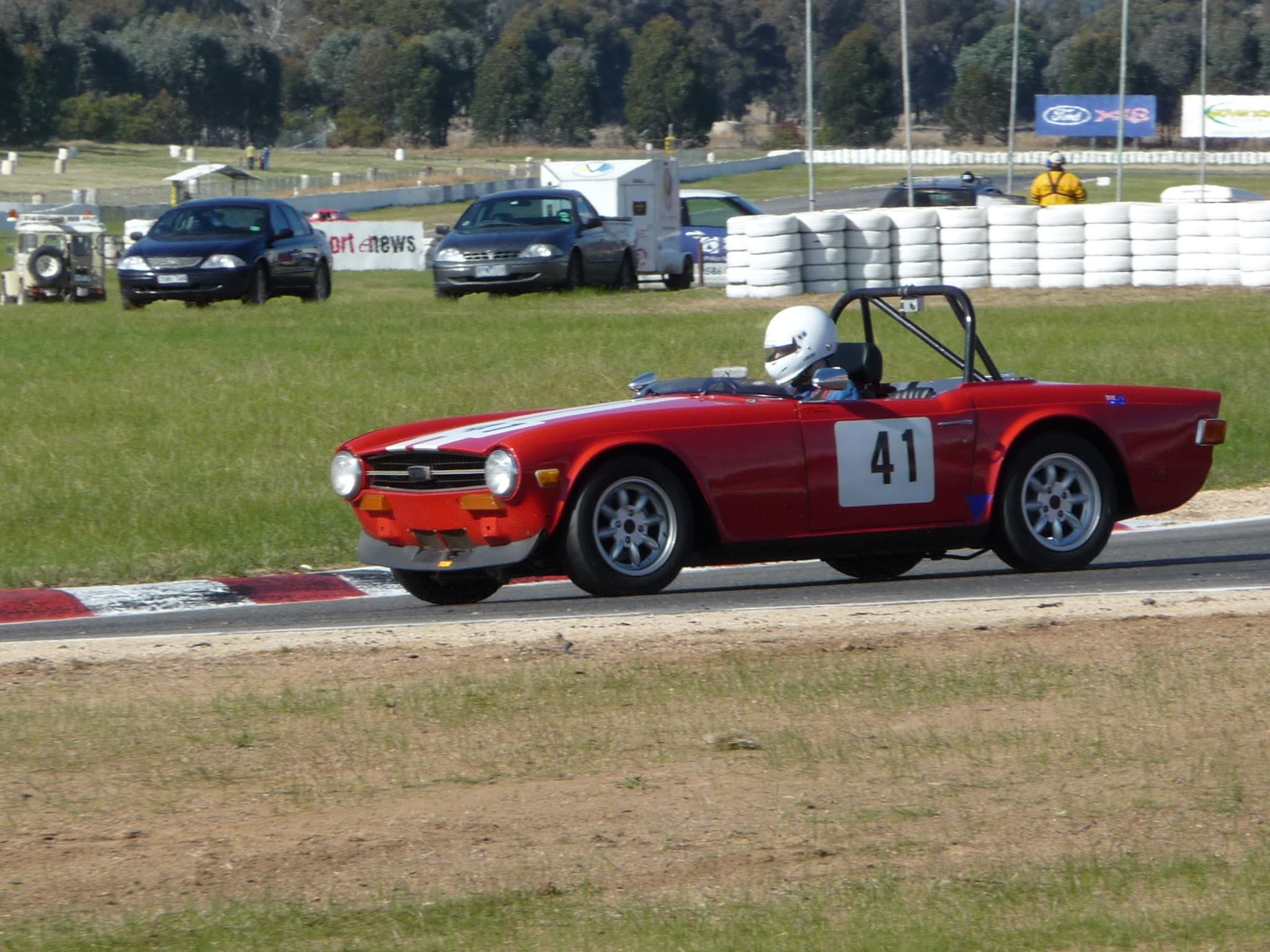
27 Red, number 41, with a roll cage and white stripes, on a kerb at the Winton circuit in Victoria, Australia, in 2011: a historic racer of today.
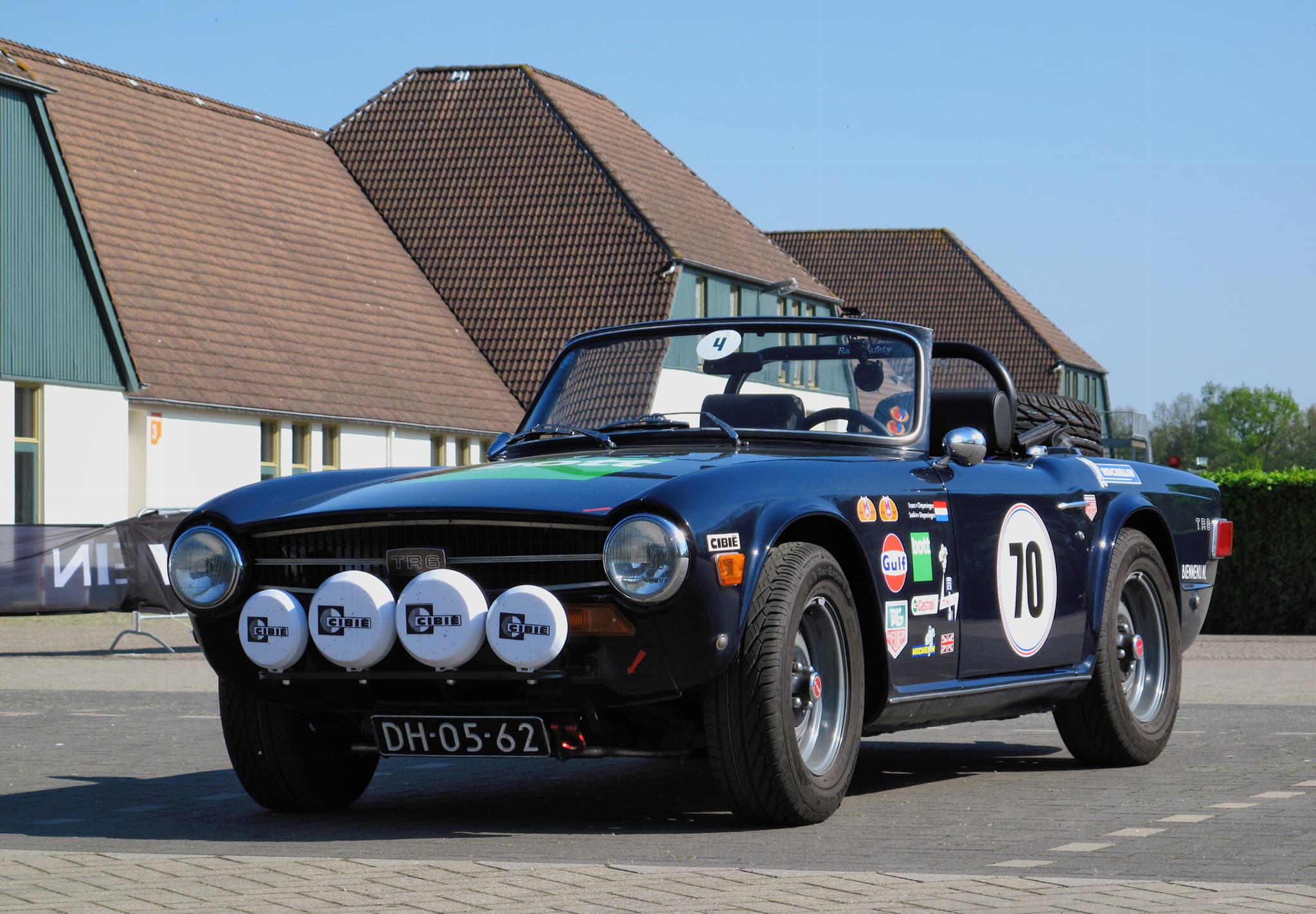
28 Number 70, an early TR6 dressed for historic rallying with spot lamps and rally plates, on brick paving in the Netherlands, 2019.
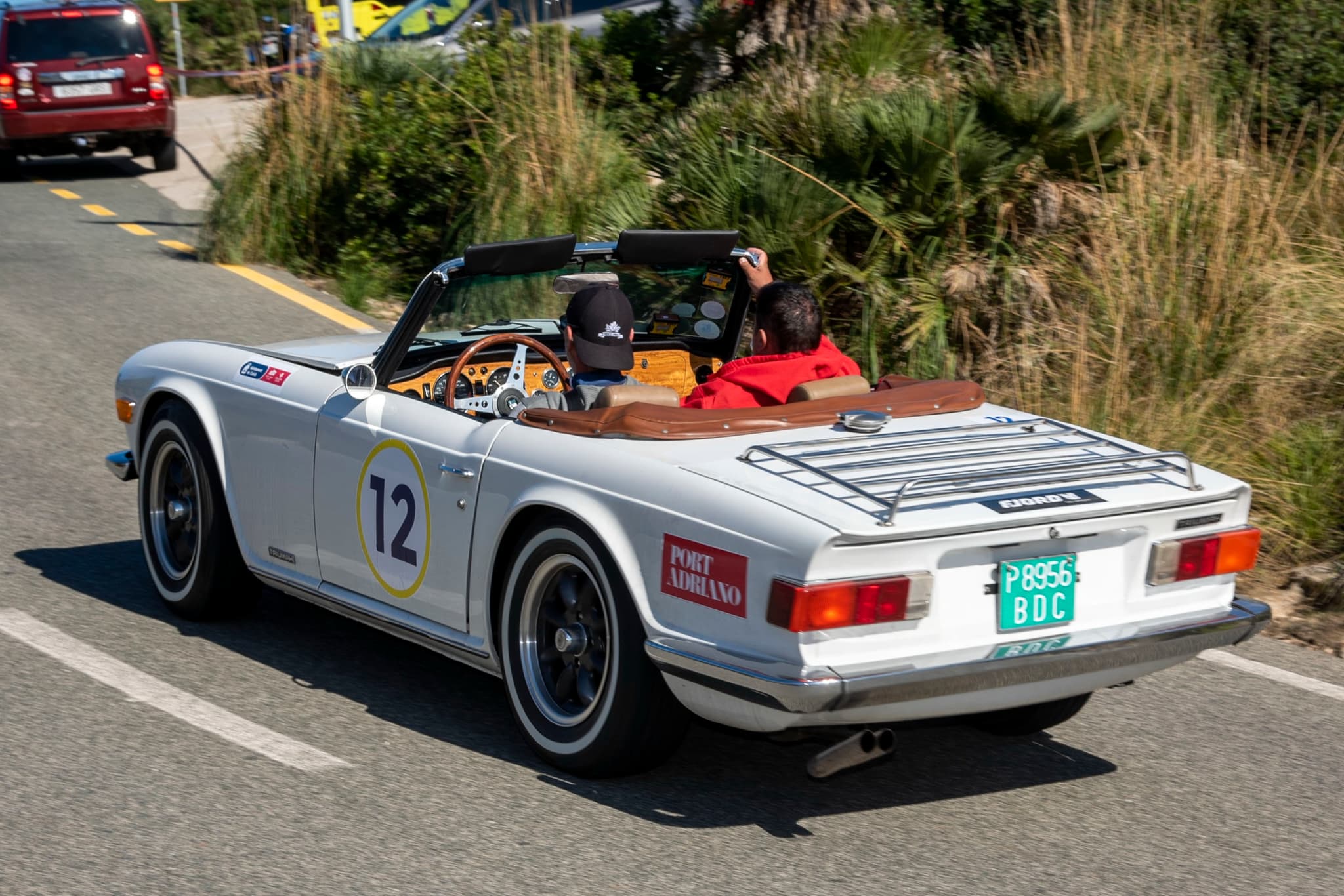
29 Start number 12, seen from behind on a mountain road, in a regularity rally on Mallorca in 2021.
Picture credits (3)
- 27 jason goulding, CC BY 2.0
- 28 Rutger van der Maar, CC BY 2.0
- 29 Koldo Zuazaga, CC0
Sources
Sources are given as plain text; their addresses are on the sources page.
- Primarymade at the time, by the maker or by people who were there
- Referenceserious later work: clubs, specialists, magazines, books
- Databaseresults and listings, entry by entry
- TR Register, "Buyer Beware: TR6" (2 pp. PDF leaflet), p. 1, the model years and the changes; p. 1, the 1969 and 1970 details; the 1974 overriders; p. 1, the CP and CR prefixes; re-imported cars converted to right-hand drive; p. 1, the 1973 instruments. Reference
- Vintage Triumph Register, "TR6" (history, year-by-year changes, US production table, buyer's guide), change list, '69 to '76; change list, '75: air injection. Reference
- Triumph Sports Owners Association, Triumph Sports Owners Association Newsletter, January 1973, Jan 1973 (vol. 19 no. 1), p. 2, the 1973 TR-6: spoiler, grille and Union Jack emblems. Primary
- Triumph Sports Owners Association, Triumph Sports Owners Association Newsletter, December 1973, Dec 1973, p. 2, the 1974 bumper guards. Primary
- Triumph Sports Owners Association, Triumph Sports Owners Association Newsletter, December 1974, Dec 1974, the 1975 TR-6: indicators below a raised front bumper. Primary
- Standard-Triumph, Triumph TR6 P.I. (sales brochure), UK, Dec 1970, publication 426/1270/ENG, the photographs: the INJECTION badge on the tail; the injection described. Primary
- Aaron Severson, "Grandfather's Ax: The Many Evolutions of the Triumph TR4, Part 2: TR5, TR250, and TR6", Ate Up With Motor, 7 Nov 2012, A new bottle: the injected engine never federalised. Reference
- Chris Cowin, "History: Exporting British cars to Canada – Part Two: The British Leyland Years", AROnline, 19 Aug 2025, Canadian TR6s kept carburettors. Reference
- Graham Robson (foreword), Triumph TR6 1969–1976 Parts & Accessories Catalogue, Rimmer Bros, edn 2.2 (source code TR600313), p. 207, "Paint & trim colours". Reference
- Triumph Sports Owners Association, Triumph Sports Owners Association Newsletter, January 1969, Jan 1969 (vol. 15 no. 1), p. 3, the US seats with head restraints. Primary
- Triumph Sports Owners Association, Triumph Sports Owners Association Newsletter, September 1974, Sep 1974, the 1974 emission systems. Primary
- Moss Motoring, "Triumph TR6: An Enduring Classic", 9 Jan 2009, "Triumph designed a new hardtop for the TR6". Reference
- racingsportscars.com, "Triumph TR6 – All Results", the TR6's races, 1969–77. Database
- Moss Motoring, "Bob Tullius, Group 44 Inc.", 5 Apr 2009, Group 44 and its Triumphs. Reference