Triumph TR6 Engine
One six-cylinder engine in two forms: with Lucas petrol (fuel) injection in the TR6 PI, and with two Zenith-Stromberg carburettors and a growing set of emission controls in the American car. How each worked, what went wrong with them, and how their power was rated.
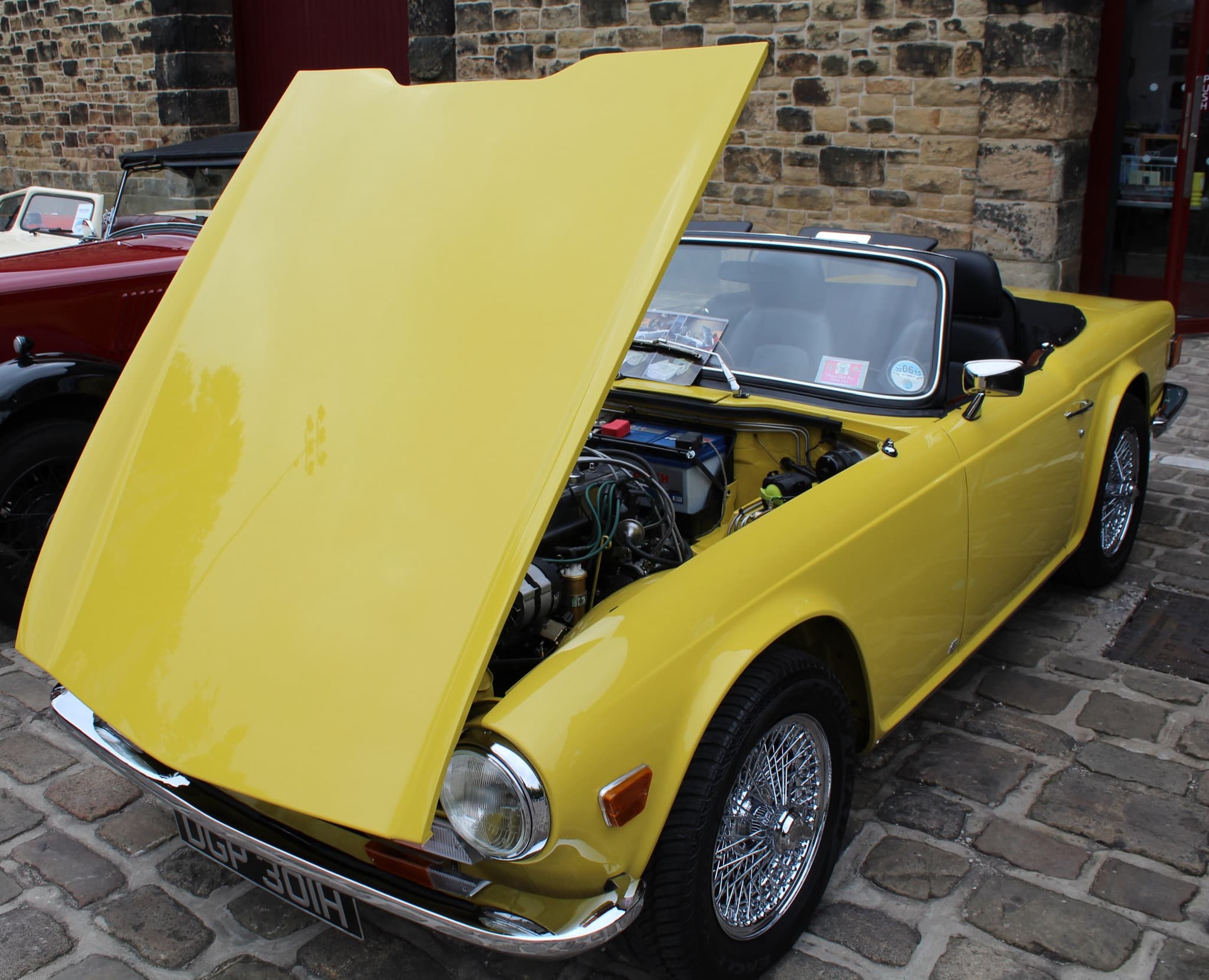
Every TR6 has the same engine: Triumph's six-cylinder in line, the engine of the TR5 and the TR250 before it and of the Triumph 2.5 PI saloon (sedan) beside it. Motor Sport, testing a TR6 PI in 1971, called it simply "the saloon's PI engine". What differed was how it was fed: in the TR6 PI by Lucas petrol (fuel) injection, and in the American car, the US TR6, by two Zenith-Stromberg carburettors with, as the years went on, more and more equipment to clean its exhaust. Their figures are in the specifications; this page explains them.source 1source 2source 3
The six
It is a long-stroke engine with pushrod-operated overhead valves, a chain-driven camshaft and four main bearings, and its block and head are of cast iron. Classic & Sports Car explains the long stroke: the bores were siamesed, so when the capacity grew, the stroke had to grow with it. The importer's launch description of 1969 listed chrome-plated top compression rings on aluminium-alloy pistons, exhaust valves faced with Stellite, lead-indium bearing shells, and an eccentric-lobe oil pump with a full-flow filter.
Its character is its torque. Motor Sport's tester in 1971 found the TR6's engine "all too willing to exceed" its peak revs; half a century later, Classic & Sports Car found that "It hunts and splutters as you prod at the throttle" while the driver works the choke for a steady idle, and that above 4,000 rpm it gave more noise, if an enjoyable one, rather than more pull. Each engine's number carries the same prefix as the car's commission number; identification shows where to find it, and the buyers guide gives the checks.source 4source 1source 5source 6source 3source 7source 8
Lucas petrol injection
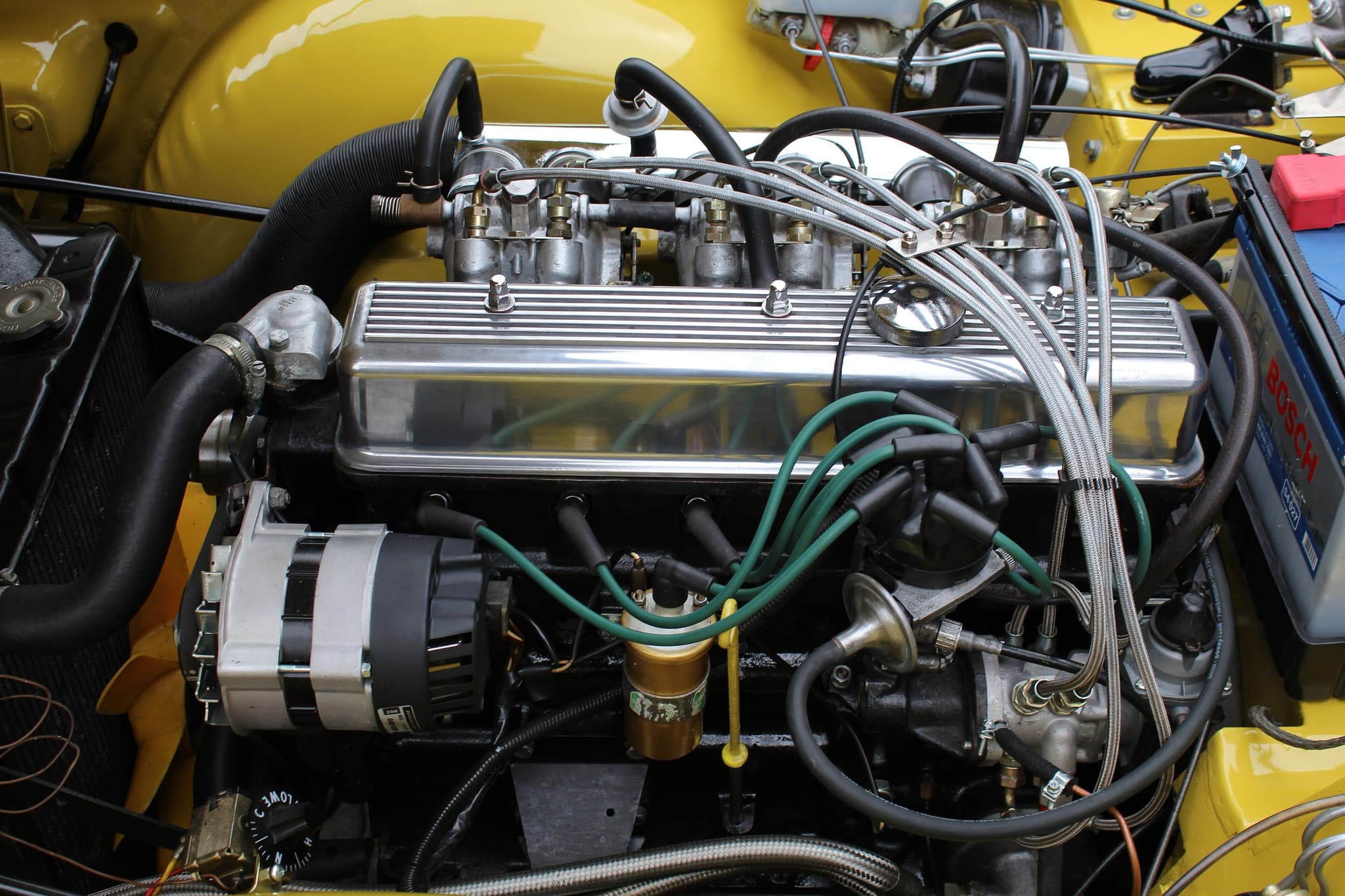
Triumph's brochure explained the injection in a sentence: "fuel is pumped from the tank, pressurised and accurately metered", and the measured charges are injected into each port in turn as a fine spray. An electric pump, in the boot (trunk) beside the tank and filter, raised the pressure; a metering unit, driven from the distributor drive, shared the fuel out; and each cylinder had its own injector and throttle butterfly. The brochure sold it on its pedigree, as "a product of international motor racing".
The pump was the first thing testers noticed. In 1971 Motor Sport found that "the fuel pump made an alarming whine", and in 1973 Clive Richardson wrote that his "would have drowned the noise of Concorde"; his car needed three pumps in its first year. A reader of Motor Sport reported in 1973 that a faltering pump could be revived with a tap, and cured with new brushes like a windscreen (windshield) wiper motor's. Richardson's misfire was a faulty metering unit, and starting needed thought: "Full-choke and a whiff of throttle does the trick when cold", he wrote, and full choke again after half an hour standing warm. Aaron Severson, of Ate Up With Motor, adds that the injected engine was known for a rough idle, and TR-Register Deutschland that the three throttle spindles wear and let in air.
Set up properly, it worked. After Triumph's engineers rebuilt the system on Richardson's car, he covered 25,700 km (16,000 miles) without trouble from it, and he wrote:
If every Lucas system worked as well as mine does now, doubtless we should all be praising the design to high heaven instead of damning it because of what would seem to be inconsistent engineering quality.
Practical Classics suggests fitting a Bosch pump in place of the Lucas one, and checking the injectors, metering unit and pressure regulator and replacing any that need it.source 1source 3source 9source 10source 11source 12source 13source 14
The ratings
Every power figure for the TR6 belongs to a rating, and the ratings are not all on the same basis. Triumph's figure for the first injected engine, in the 1970 brochure, names no standard. Later British brochures gave a lower figure for the same engine, and the German registration papers one in metric horsepower to the DIN standard. When the CR arrived, Richardson summed the figures up:
Original brochures claimed 150 b.h.p., later ones 142 and now 125.
The TR Register adds that the CR's figure was "measured to different standards" from the CP's, and so "not as big a de-tune as it looked", without saying which standards; Ate Up With Motor and Revington TR give the CR a figure a point lower, which Severson calls net and DIN, and TR-Register Deutschland a DIN figure lower still.
The American ratings are clearer. The launch figure of 1969 was printed with no standard, though Severson calls it net. The importer's specification for the 1972 model year gave a slightly higher figure rated to the SAE standard, with lower compression, and the January 1973 announcement called it SAE net; the same 1972 table had a second, higher row with no standard named. The specifications give each figure with its rating and source.
The carburetted engine and its emission controls
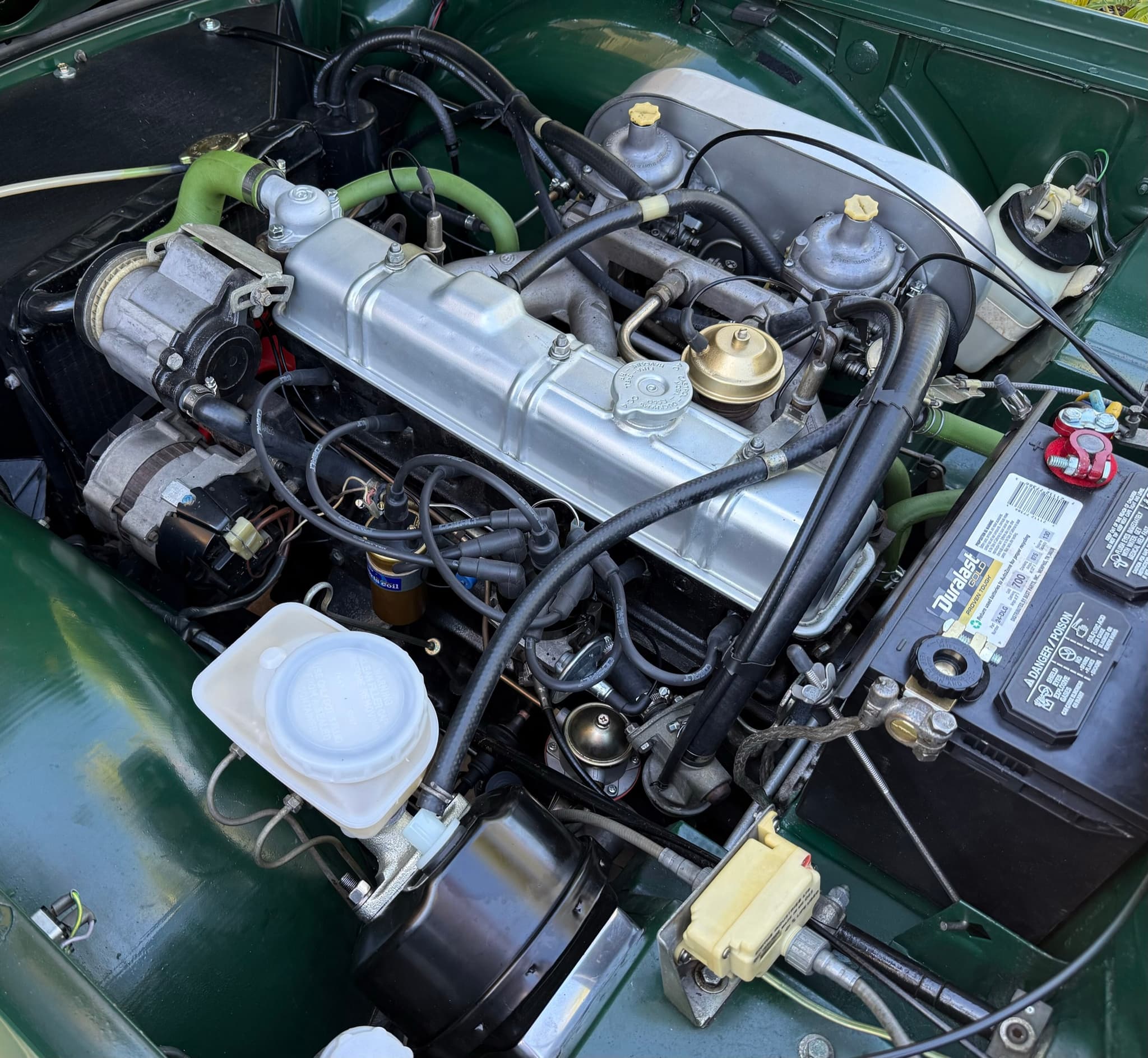
The American engine changed almost every year. In 1969 its two Strombergs already had smog controls, with a heated inlet manifold and a valve for positive crankcase ventilation. A new inlet manifold followed for the 1970 model year, and for the 1972 model year lower compression, which the importer said cost no power, and an exhaust with twin downpipes. The 1973 cars gained a valve to stop the engine running on after it was switched off.
By the 1974 model year, the importer's newsletter listed a closed crankcase; exhaust-gas recirculation, worked by a vacuum valve at higher road speeds, to cut oxides of nitrogen; evaporative-loss control, with a sealed filler cap and a carbon canister ahead of the engine; a thermostatic vacuum switch and vacuum retard at idle; and Strombergs with throttle by-pass valves and temperature compensators. The canister was to be renewed and the recirculation checked every 19,300 km (12,000 miles). Air injection followed for the 1975 model year. Even the cars for the 49 states outside California, Severson writes, "became increasingly festooned with emissions-control devices"; the US TR6 page explains the cars for California.source 5source 19source 17source 18source 20source 14
Sources
Sources are given as plain text; their addresses are on the sources page.
- Primarymade at the time, by the maker or by people who were there
- Referenceserious later work: clubs, specialists, magazines, books
- Standard-Triumph, Triumph TR6 P.I. (sales brochure), UK, Dec 1970, publication 426/1270/ENG, p. 11, the engine; p. 11, four main bearings; the injection described; "a product of international motor racing"; p. 11, the CP's rating, no basis printed. Primary
- Triumph Sports Owners Association, Triumph Sports Owners Association Newsletter, January 1969, Jan 1969 (vol. 15 no. 1), p. 3, the US engine; p. 3, the launch rating, no basis printed. Primary
- Bill Boddy, "Rumblings" (TR6 PI and 2.5 PI Mk II), Motor Sport, Mar 1971, p. 34, p. 34, "the saloon's PI engine"; p. 34, "all too willing to exceed"; p. 34, "an alarming whine". Primary
- Triumph Sports Owners Association, Triumph Sports Owners Association Newsletter, December 1973, Dec 1973, p. 3, pushrod overhead valves, chain-driven camshaft, chrome cast-iron block and head. Primary
- Triumph Sports Owners Association, Triumph Sports Owners Association Newsletter, February 1969, Feb 1969, the engine described: rings, valves, bearings, oil pump and filter; the engine-bay caption: smog control, heated inlet manifold, PCV valve. Primary
- Charlie Calderwood, "Datsun 240Z vs Triumph TR6: the battle for America", Classic & Sports Car, 1 Feb 2023, the long stroke; "It hunts and splutters". Reference
- TR Register, "Buyer Beware: TR6" (2 pp. PDF leaflet), p. 1, the engine prefix matches the commission prefix. Reference
- Graham Robson (foreword), Triumph TR6 1969–1976 Parts & Accessories Catalogue, Rimmer Bros, edn 2.2 (source code TR600313), p. 5, where the engine number is stamped. Reference
- Clive Richardson, "The Tale of a TR6", Motor Sport, Nov 1973, p. 54, p. 54, the pump in the boot, Concorde, three pumps, the metering unit, starting; p. 54, "Original brochures claimed …". Primary
- Clive Richardson, "The continuing tale of a TR6", Motor Sport, Dec 1974, p. 53, p. 53, the system rebuilt; "If every Lucas system worked as well as mine does now …"; the running-in block. Primary
- Motor Sport, Readers' letters on the TR6 (group), Feb 1970, p. 54; Jun 1973, p. 94; Aug 1973, p. 77; Jan 1974, p. 57, 1973: the pump revived with a tap; its brushes. Primary
- Bruno Dwinger, "Geschichte, Typenkunde und Kaufberatung: British Leyland Triumph TR 6PI und TR 6 (Vergaser) – Die Karmann Autos", TR-Register Deutschland, c. 2010, 13 pp. (PDF), p. 5, three throttle spindles; pp. 2, 5, the DIN ratings. Reference
- Practical Classics, "Buyer's Brief: Triumph TR6", updated 29 Jan 2025, injection faults and the modern cures. Reference
- Aaron Severson, "Grandfather's Ax: The Many Evolutions of the Triumph TR4, Part 2: TR5, TR250, and TR6", Ate Up With Motor, 7 Nov 2012, TR in twilight: the rough idle; the US ratings, net; the CR, "net … DIN"; TR in twilight: "festooned with emissions-control devices"; California. Reference
- TR Register, "Triumph TR6 Buyers Guide" (facts sheet), Engine details: ratings by series; "measured to different standards". Reference
- Revington TR, "Technical Specification Change Points" (TR6), the CR's rating. Reference
- Triumph Sports Owners Association, Triumph Sports Owners Association Newsletter, November–December 1971, Nov–Dec 1971 (vol. 17 nos. 11–12), p. 2, the 1972 specification table; the 1972 compression, "no loss in brake horsepower". Primary
- Triumph Sports Owners Association, Triumph Sports Owners Association Newsletter, January 1973, Jan 1973 (vol. 19 no. 1), p. 2, SAE net; p. 2, the anti-run-on valve. Primary
- Vintage Triumph Register, "TR6" (history, year-by-year changes, US production table, buyer's guide), change list: '70 inlet manifold; '72 downpipes; '75 air injection. Reference
- Triumph Sports Owners Association, Triumph Sports Owners Association Newsletter, September 1974, Sep 1974, the 1974 emission systems and their service. Primary