Triumph TR6 Hardtop
The TR6's factory hardtop, a one-piece steel top drawn by Triumph's own stylists, and the options that went with it: Laycock overdrive, A-type then J-type, wire wheels until 1973, the tonneau, and America's dealer-fitted air conditioning. Also written hard top.
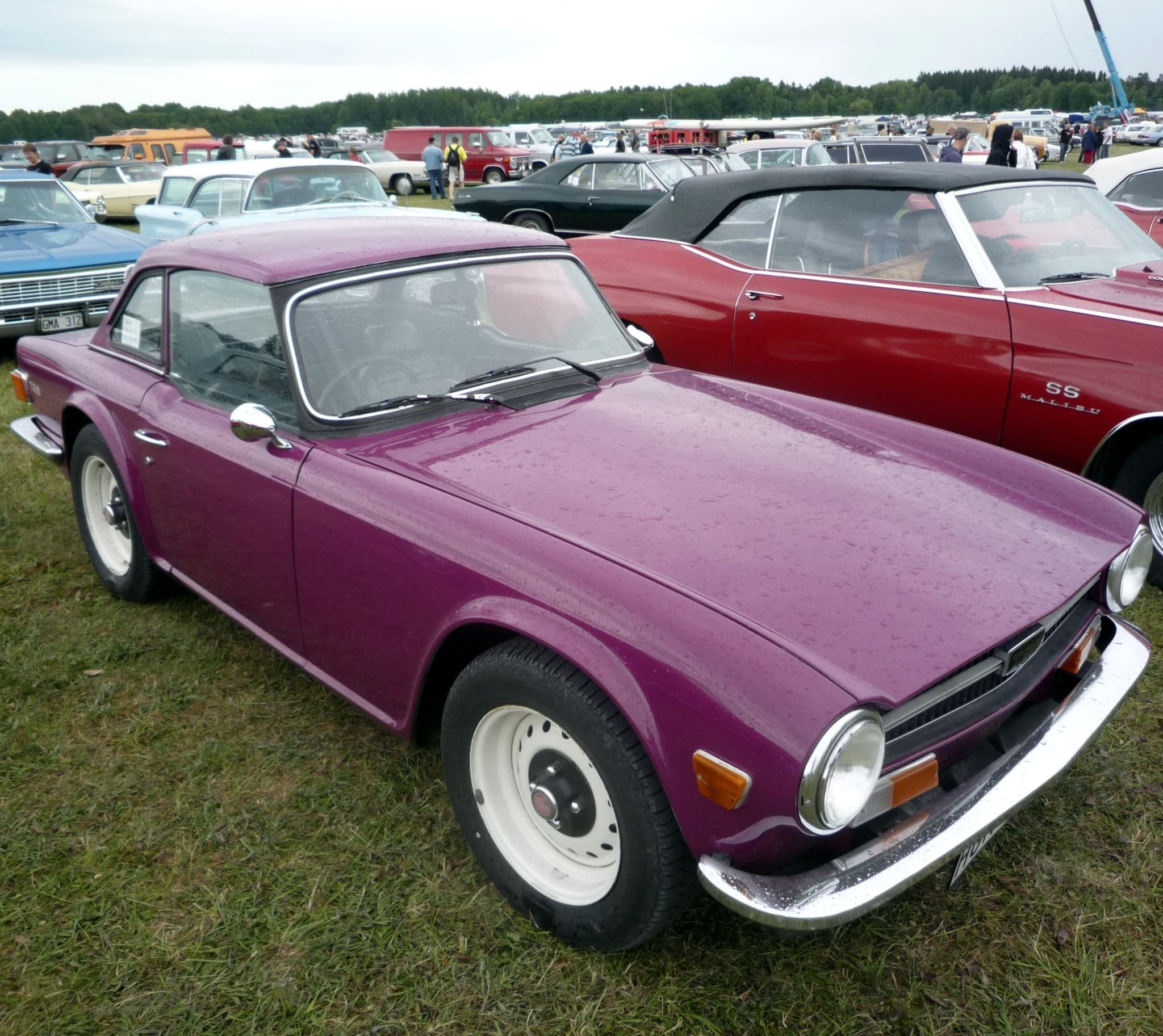
In Britain the TR6 PI was sold in two forms, a soft-top model and a hardtop model, and the hardtop car came with its hood (soft top) only as an extra. On the US TR6 the factory hardtop was an option, and the Vintage Triumph Register notes that it went on selling well to the end of production. With it came the usual extras of a British sports car of the time: overdrive, wire wheels, a tonneau cover, and for America a list of dealers' accessories.source 1source 2source 3
The hardtop
The TR6's hardtop was new: one piece, of steel, with its own rear window, lifted on and off the car whole. Karmann had restyled the car's nose and tail, but the hardtop was Triumph's own work, by its stylists in Coventry, Aaron Severson writes, and Moss Motoring agrees that Triumph designed it for the TR6. It replaced the two-piece hardtop of the TR4 family, which Severson says had been expensive to make and hard to sell. The Vintage Triumph Register liked the result:
A useful option on the TR6 was the one piece detachable steel hardtop which easily converted the car to a neat sports coupe.
It made the car stiffer, too. Clive Richardson's TR6 was delivered in hardtop form in 1973, and he found the scuttle shake much worse with the soft top, the rigid steel hardtop "creating a much tauter unit"; his also arrived with rust on the hardtop's headlining and its fixing nuts, and sealer oozing from its windows. In America the hardtop listed for the 1974 model year had rear quarter windows that opened.
The older two-piece top survived all the same: Moss Motoring notes that the earlier TR4 hardtop still fits a TR6, though its profile is more rounded, so a two-piece top on a TR6 came from an earlier car.
Overdrive
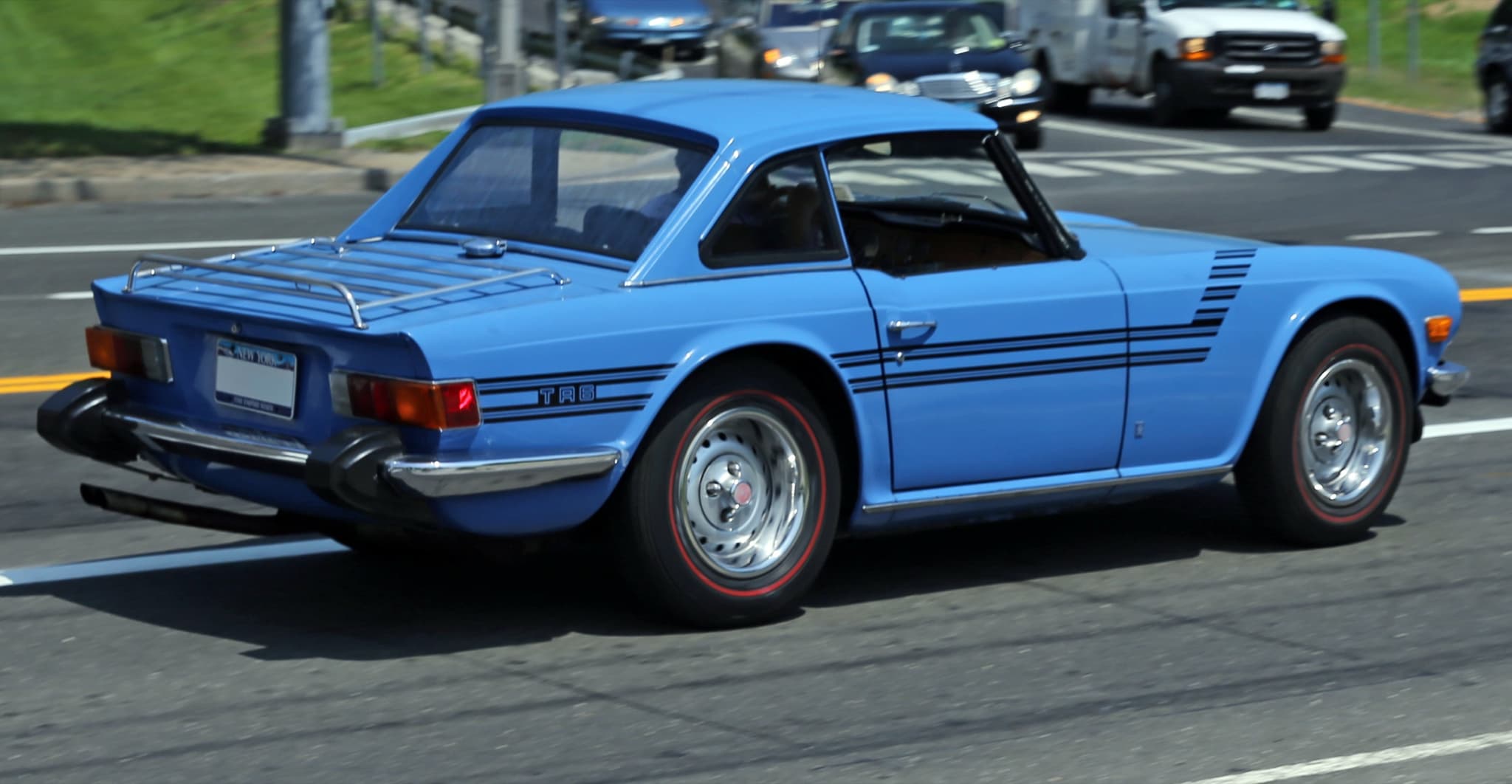
Overdrive, made by Laycock de Normanville, was an option from the start, and a car built with it carries the letter O after its commission number. The early cars had the A-type of the TR250, working on second, third and top; Motor Sport's test car of 1971 worked it with "a rather loose r.h. stalk-lever", and in overdrive top it covered more than 42 km/h (26 mph) for every 1,000 rpm. The late cars, from late 1972, had the J-type, which the importer called "a more rugged optional overdrive" and which worked on third and top alone. Richardson explained what had happened to the second-gear overdrive:
That delightful 2nd-gear overdrive ratio had to be deleted (merely a matter of a switchgear modification) because a combination of torque and heavy-footed drivers was creating far too many service problems.
A specialist rewired Richardson's car to work in second again in 1974, and he found overdrive top worth having: at 113 to 129 km/h (70 to 80 mph) his car used 10.9 litres per 100 km (26 miles per imperial gallon).
Other factory and dealer options
Wire wheels, with 72 spokes and centre-lock spinners, were offered until May 1973. The tonneau cover was an extra on soft-top cars until it became standard in 1974, and British buyers of the 1971 model year could order a laminated windscreen (windshield); from 1973 the seats had provision for head restraints, which were extra.
The American lists were longer. At the launch in 1969 the importer offered radios, a console with a clock, luggage and ski racks, overriders (bumper guards), eight-spoke racing wheels in magnesium or aluminium, a cigarette lighter and parts for racing, and from that April a preparation manual. For the 1973 model year it added air conditioning, installed by dealers. For the 1974 model year the accessories included radios, a luggage rack, Koni adjustable dampers, rubber mats and side stripe kits in black or silver.source 2source 8source 12source 1source 6source 13source 14source 10source 7
Wheels and racks 3
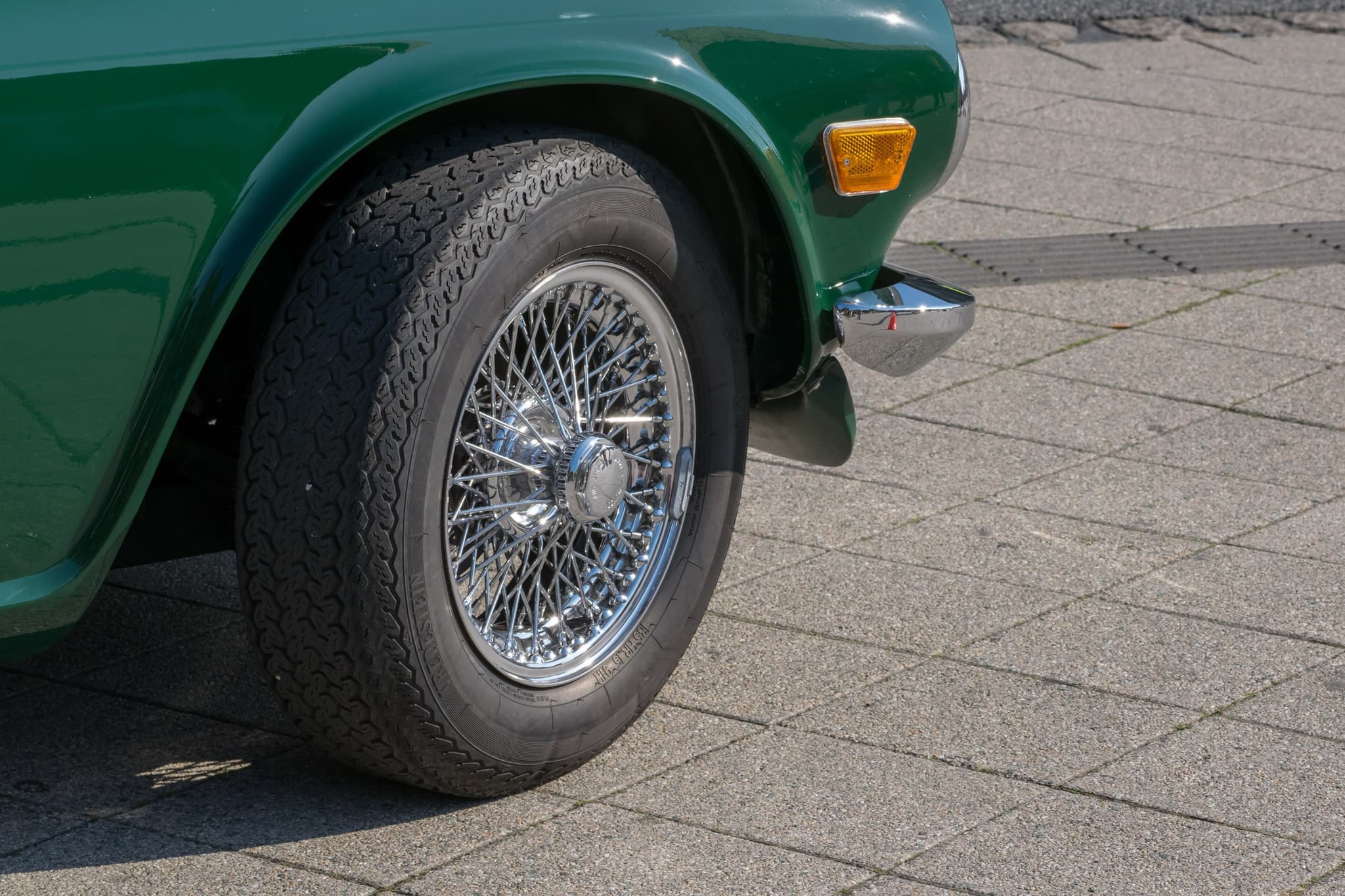
1 A 72-spoke wire wheel with its knock-off spinner, on a dark green TR6 that its photographer dates to 1970, at Detmold, Germany, in 2016.
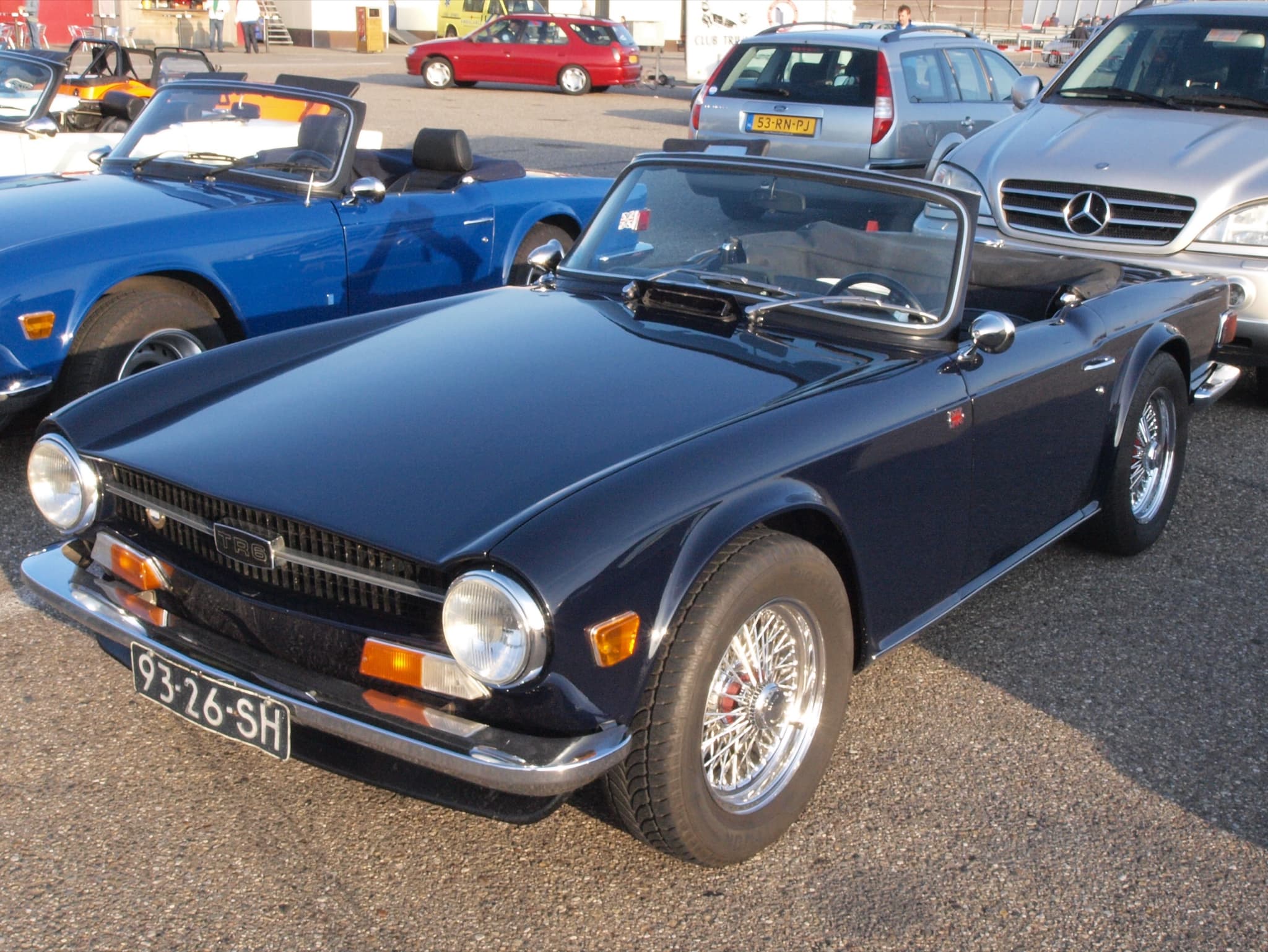
2 An early TR6 on wire wheels in the paddock at Zandvoort, the Netherlands, in September 2009.
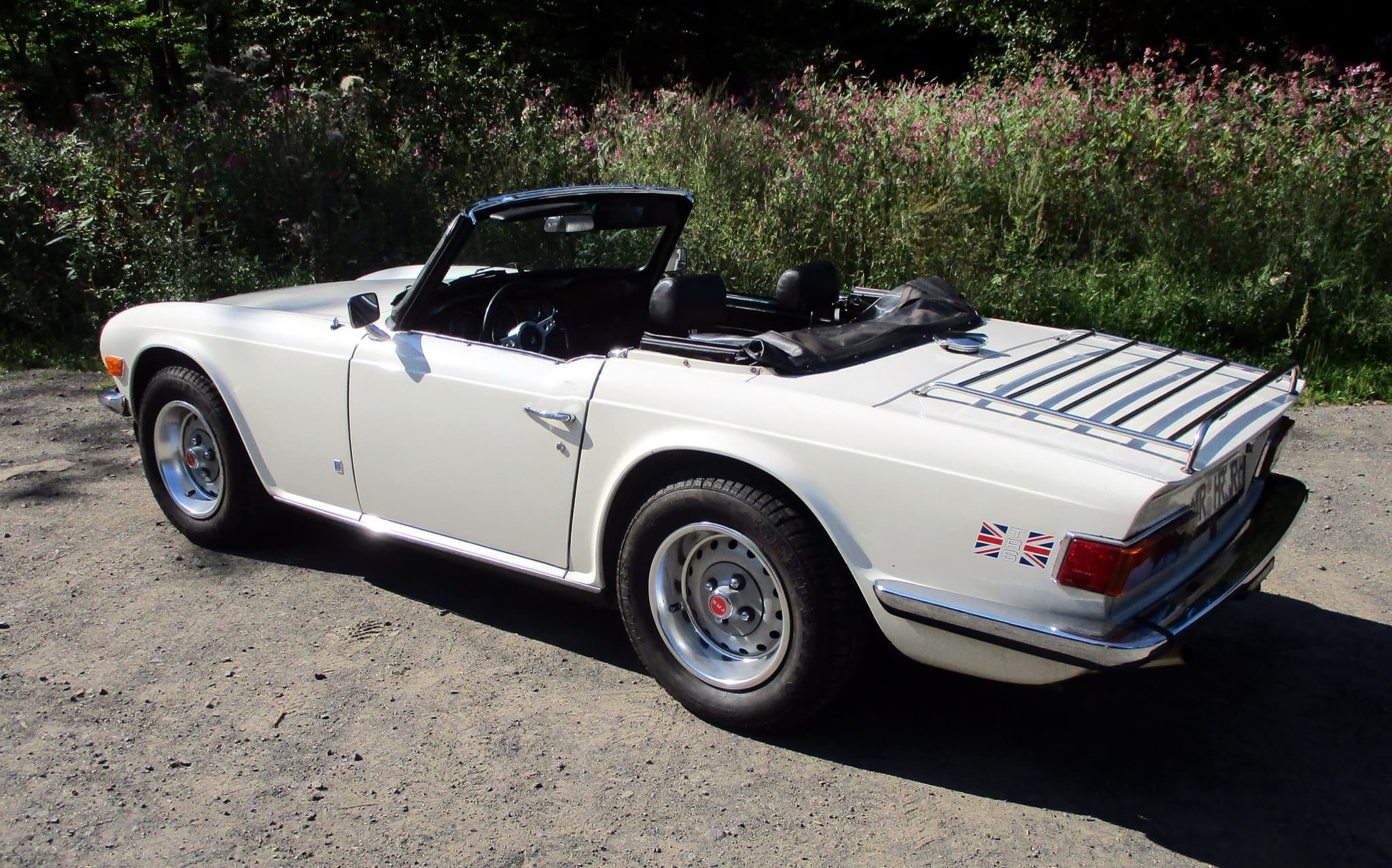
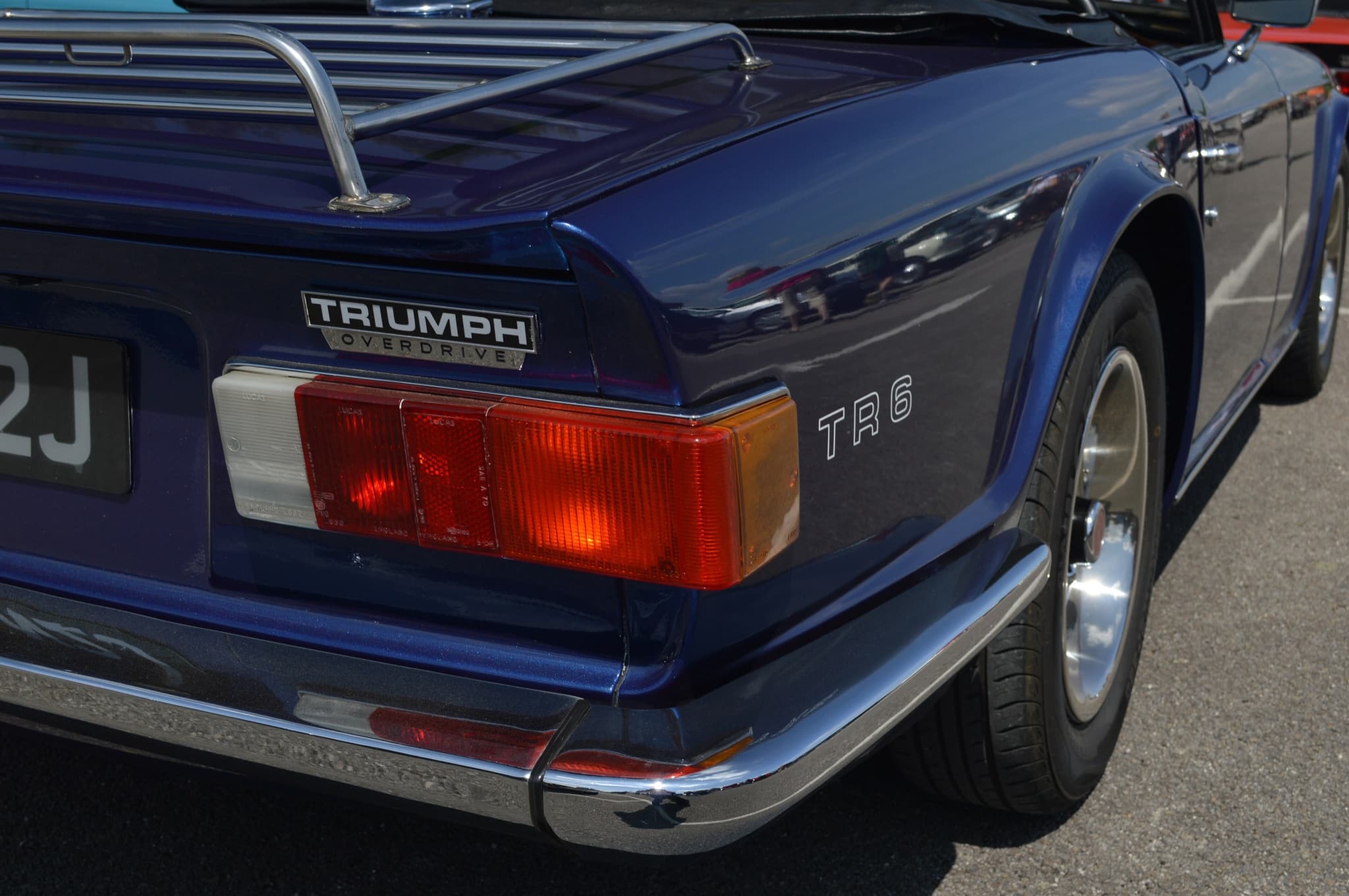
3 A luggage rack on the boot (trunk) lid of a white American TR6, on a forest track in Germany in August 2019.
Picture credits (3)
- 1 Tsungam, CC BY-SA 4.0
- 2 Alf van Beem, CC0
- 3 Corvesprit, CC BY-SA 4.0
Sources
Sources are given as plain text; their addresses are on the sources page.
- Primarymade at the time, by the maker or by people who were there
- Referenceserious later work: clubs, specialists, magazines, books
- Standard-Triumph, Triumph TR6 P.I. (sales brochure), UK, Dec 1970, publication 426/1270/ENG, Optional extras (soft top and hard top models); soft-top and hardtop models; optional extras: laminated windscreen, tonneau. Primary
- Vintage Triumph Register, "TR6" (history, year-by-year changes, US production table, buyer's guide), history: the hardtop; change list; history: "A useful option on the TR6 …"; change list: the hardtop sold well; change list: the A-type from the TR250; the J-type; change list: "Wire wheel option ends in May" (1973); 72-spoke wheels; the tonneau standard. Reference
- Clive Richardson, "The continuing tale of a TR6", Motor Sport, Dec 1974, p. 53, p. 53, the hardtop model and its soft top; p. 53, the hardtop model; p. 53, standard since the beginning of 1974; rewired for second; consumption. Primary
- Aaron Severson, "Grandfather's Ax: The Many Evolutions of the Triumph TR4, Part 2: TR5, TR250, and TR6", Ate Up With Motor, 7 Nov 2012, A new bottle: the one-piece hardtop by Triumph's in-house stylists; the two-piece top expensive and hard to sell; TR in twilight: "standard on all TR6s in 1974". Reference
- Moss Motoring, "Triumph TR6: An Enduring Classic", 9 Jan 2009, "Triumph designed a new hardtop for the TR6"; the earlier TR4 top fits, "a more rounded profile". Reference
- Clive Richardson, "The Tale of a TR6", Motor Sport, Nov 1973, p. 54, p. 54, delivered in hard-top form; scuttle shake; the faults; p. 54, "That delightful 2nd-gear overdrive ratio …"; p. 54, head restraints. Primary
- Triumph Sports Owners Association, Triumph Sports Owners Association Newsletter, December 1973, Dec 1973, p. 3, opening rear quarter windows; p. 2, overdrive an option for 1974; p. 3, the US options of 1974. Primary
- TR Register, "Buyer Beware: TR6" (2 pp. PDF leaflet), p. 1, A-type and J-type; the O suffix; standard from CR5000; p. 1, wire wheels to the 1973 model. Reference
- Bill Boddy, "Rumblings" (TR6 PI and 2.5 PI Mk II), Motor Sport, Mar 1971, p. 34, p. 34, the stalk; overdrive top. Primary
- Triumph Sports Owners Association, Triumph Sports Owners Association Newsletter, January 1973, Jan 1973 (vol. 19 no. 1), p. 2, "a more rugged optional overdrive"; p. 2, air conditioning. Primary
- Triumph Sports Owners Association, Triumph Sports Owners Association Newsletter, December 1974, Dec 1974, the 1975 announcement: overdrive optional. Primary
- Rob Sass, "Buyers Guide: Triumph TR6", Hagerty UK, 12 Nov 2014, "72 spoke wires were available on the early cars". Reference
- Triumph Sports Owners Association, Triumph Sports Owners Association Newsletter, January 1969, Jan 1969 (vol. 15 no. 1), pp. 2–3, the US options of 1969. Primary
- Triumph Sports Owners Association, Triumph Sports Owners Association Newsletter, April 1969, Apr 1969 (vol. 15 no. 4), p. 4, the TR-250/TR-6 preparation manual ready. Primary