Triumph TR6 History
From the new face Standard-Triumph ordered for the TR5 in 1967 to the last car built at Canley in July 1976: how Karmann restyled it, why Britain and America got different TR6s, and why it stayed in production for almost eight years.
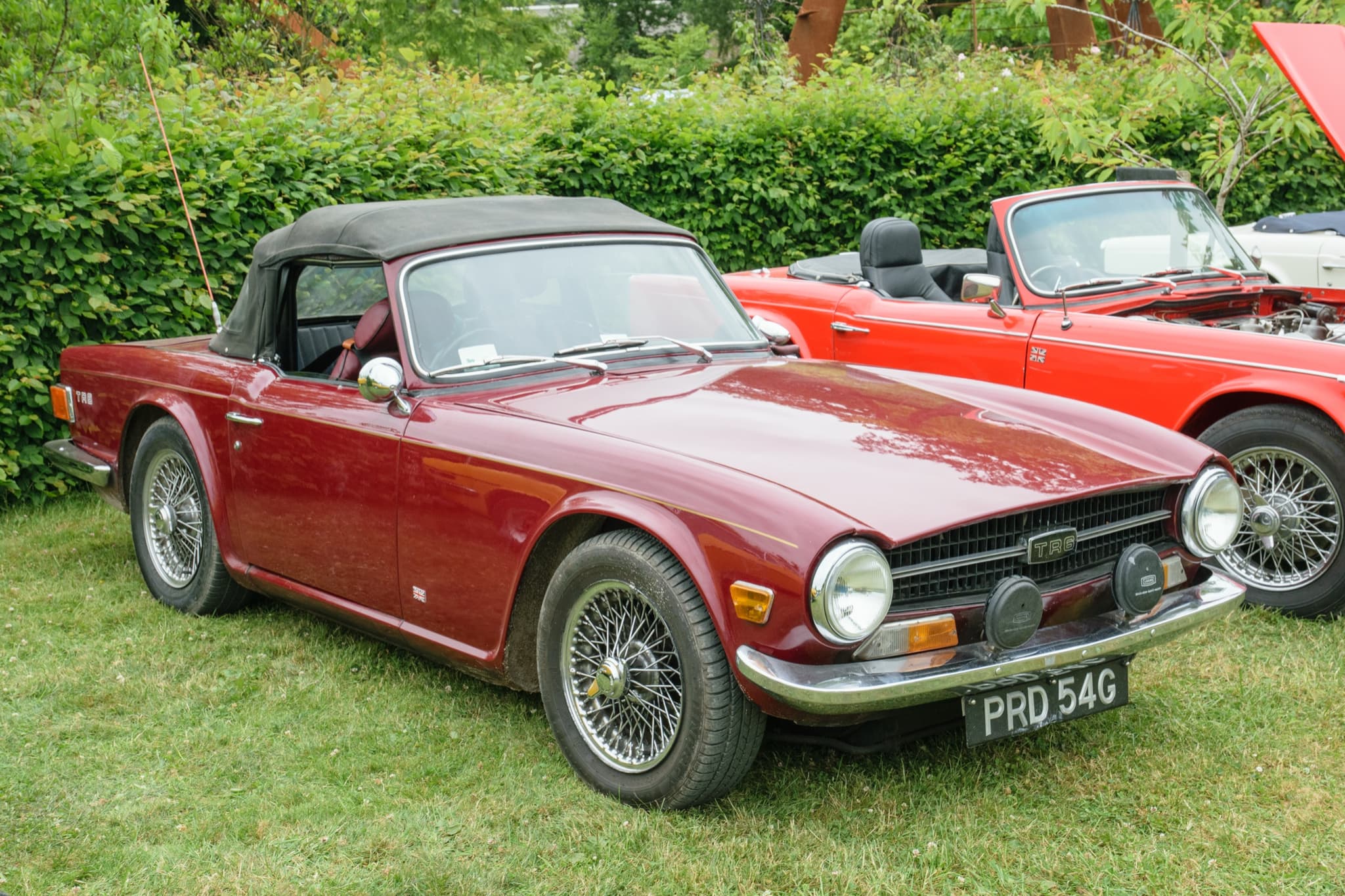
On 19 September 1968 the works at Canley, in Coventry, built its last TR5 and its last TR250, and its first TR6, a carburetted car, CC25003L. The new car was the old one under a new nose and tail, drawn in West Germany. Its successor was meant to arrive in time for the 1973 model year; it was late, and the TR6 stayed in production for almost eight years.source 1source 2source 3
The brief: a new face, 1967
In the middle of 1967, Aaron Severson writes, before the TR250 and the TR5 had even gone on sale, Standard-Triumph decided that its sports car needed updating, and quickly. The body was Giovanni Michelotti's, from the TR4, and Bruce McWilliams, who ran marketing for the company's American organisation, had been arguing that it no longer looked new. There was no money for a new car, and Michelotti, Triumph's usual stylist, had no time: he was occupied with other Triumph models, TR-Register Deutschland writes, and Severson adds that Leyland needed him to restyle the 2000 and 2.5 PI saloons (sedans).
So the job went to Karmann of Osnabrück, a coachbuilder that Moss Motoring describes as well known for its work for Volkswagen, Porsche and BMW. Karmann accepted Triumph's deadline and quoted a low price for both the restyle and the tooling. Severson names the stylist as Gerhard Giesecke, and writes that the design was reportedly developed with a good deal of input from Triumph's North American organisation. TR-Register Deutschland dates the clay model to September 1967; from that to production took about a year, and Karmann made the press tools for the new panels as well.
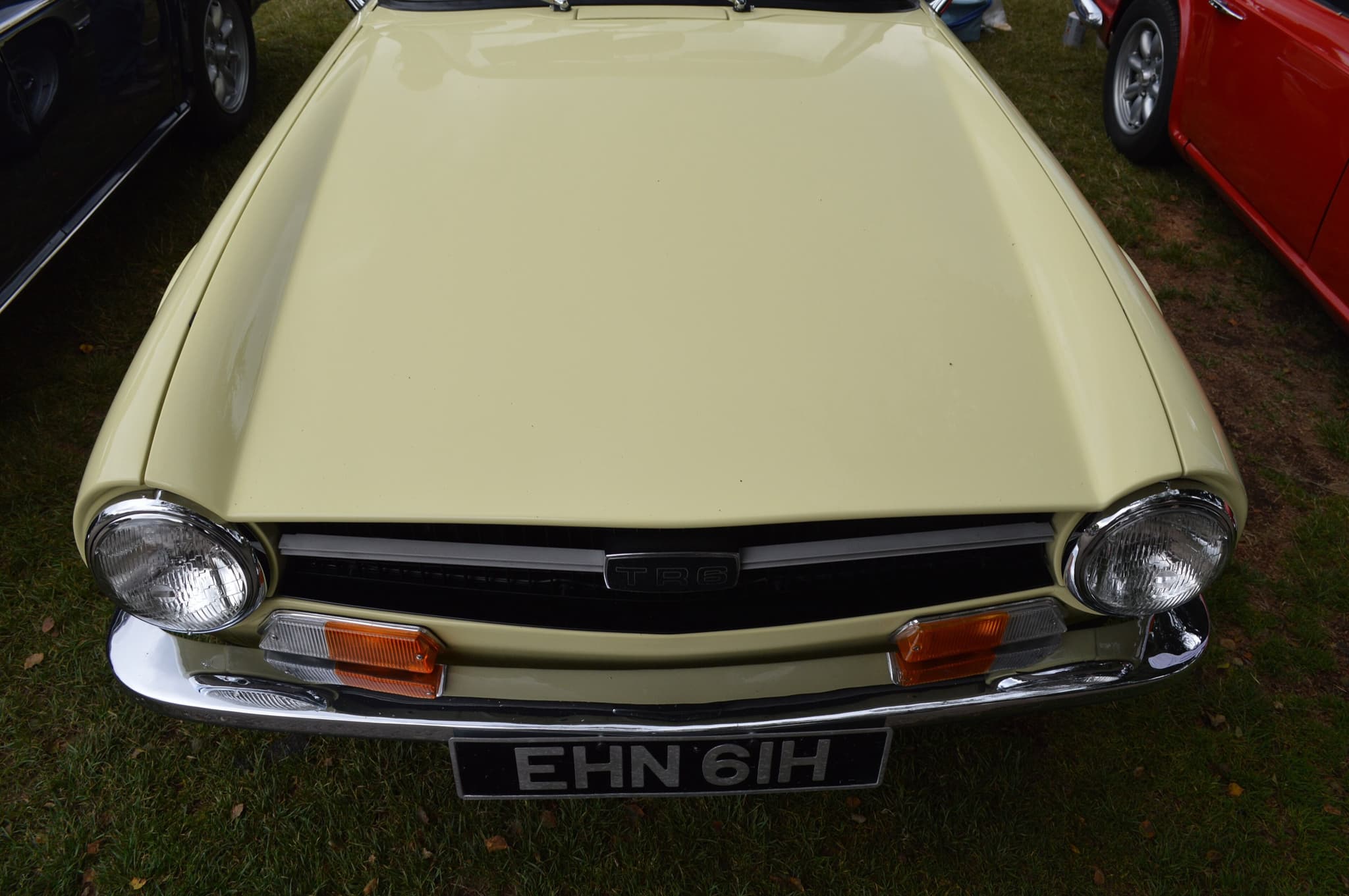
Karmann redrew the car's two ends: a flatter bonnet (hood), new front and rear wings (fenders), a full-width grille with the headlamps at its ends, and a tail cut off square, with wrap-round lamps and a bigger boot (trunk). The middle of the car, Michelotti's, stayed as it was. Leyland was pleased enough with the work, Severson writes, to give Karmann the tooling for the Mk 2 versions of the 2000 and 2.5 PI saloons, and Classic & Sports Car writes that it is "widely regarded as one of the most successful examples of reheated bodywork in automotive history".source 3source 4source 5source 6source 7source 8source 9
Building it, 1968
The frame, the engines and the running gear came from the TR5 and the TR250, with wider wheel rims, revised spring and damper rates and a front anti-roll bar. The bodies were made at Speke, near Liverpool, TR-Register Deutschland says, and the cars were assembled at Canley.
The first TR6 commission number, CP25001, was "probably a prototype", in the words of Rimmer's parts catalogue, which takes its dates from the factory's build records; the Vintage Triumph Register calls it the first prototype TR6, built on 19 September 1968. The numbers after it went to kits for assembly abroad, and the first production TR6 PI, CP25156, followed on 28 November 1968. Before the launch, Graham Robson, then Autocar's man in Coventry, was called to Canley to see the new car, so soon after the TR5, and decades later he recalled what he found:
I was astonished by what I saw, and was immediately convinced that the new car would be a success. Without spending a huge budget, between them, Michelotti and Karmann had transformed the looks of the classic TR.
Introduction, January 1969
The TR6 was shown to the public in January 1969. No source read says where. In America the importer's owners' newsletter opened its January issue with the news:
If you've only just recovered from the 1967 arrival of the TR-250, be prepared for another shock. . . the TR-6 is here.
Few Americans on the east coast could buy one at first. A dock strike held the first shipments in harbours from Baltimore to Houston, one ship in New York harbour carrying more than 1,600 British Leyland cars, and the February newsletter reported that only dealers in the western states had cars to sell. Even so, Triumph's competition department in California, under Kas Kastner, had a racing TR-6 ready for the first national race of the season, at Las Vegas on 22 and 23 February.
In Britain the TR6 PI cost a little more than the TR5 PI had; in America, thanks to the recent devaluation of sterling, the TR6 started a little cheaper than the TR250, Severson writes. The launch prices are in the specifications.
The first magazine tests followed within months, Car and Driver's in February 1969 and Autocar's of the TR6 PI on 17 April; what the testers found is on road tests.source 11source 4source 7source 12source 3source 13
Assembly in Belgium
Not every TR6 was finished in Coventry. In 1973 Motor Sport reported that the TR6s sold on the Continent were assembled at British Leyland's plant at Malines (Mechelen), in Belgium, and a British owner living in Belgium wrote to the magazine that year that his own had been assembled there. The Belgian cars were built from kits and were all injected cars with left-hand drive, the TR Register says, and TR-Register Deutschland gives customs advantages as the reason for building them there. Motor Sport noted that they ran on Dunlop tyres made in France.
Rimmer's catalogue lists five ranges of commission numbers for the kits, which together hold at most 807 numbers by our arithmetic; numbers are not cars, and no source read gives a count of the cars built. The Belgian cars' numbers carry an extra 1 before the prefix and a P after the serial, which identification explains. No source read records a TR6 assembled anywhere else.source 10source 14source 11source 4source 1
The British Leyland years, 1969–72
The TR6 arrived soon after Leyland and British Motor Holdings had merged into the British Leyland Motor Corporation, chaired by Donald Stokes, later Lord Stokes. Triumph's general manager, George Turnbull, and its technical director, Harry Webster, left for Austin-Morris; Cliff Swindle and Rover's Spencer King took their places. With a replacement planned, Severson writes, the TR6 got little further development, and most of its changes answered new regulations or made it cheaper to build.
For the 1970 model year it gained a black windscreen (windshield) surround whatever the colour of the car, new wheel trims, reclining seats and a new steering wheel, and American cars a steering-column lock, with the ignition switch moved from the facia to the column; British cars had the lock for the 1971 model year. In the middle of 1971 came a stronger gearbox (transmission), with internals of the Triumph Stag's type and new ratios. American cars for the 1972 model year had their compression lowered, with, the importer said, no loss of power.
At the London Motor Show of October 1972, British Leyland marked the TR's 20th anniversary with Group 44's racing TR6, brought over from the United States for its stand, and Lord Stokes was taken enough with it, Motor Sport reported, to mention it on late-night television.source 3source 8source 11source 15source 16source 4source 17source 18source 19
The late cars, 1973–76
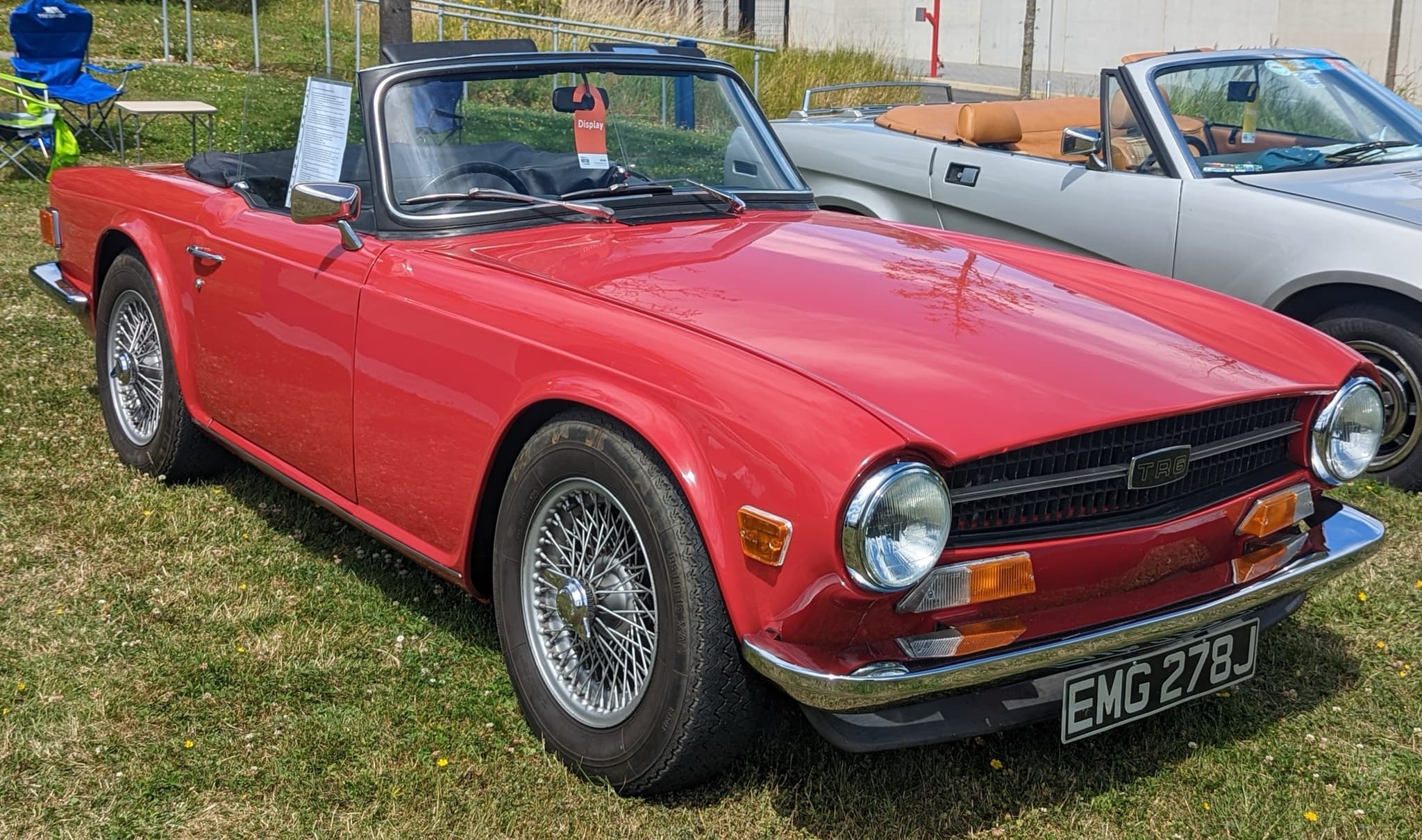
Late in 1972 the commission numbers changed from CP and CC to CR and CF, and the cars changed with them. A spoiler appeared under the front bumper and chrome beading at the edges of the grille; inside there were restyled instruments, the small dials' needles now pointing upwards, a battery-condition meter in place of the ammeter, a dip switch on the column and flame-resistant trim, and a grille replaced the flap in front of the windscreen. American cars of the 1973 model year gained Union flag decals on their rear wings, and the front bumper was mounted more strongly for America's new bumper rule. The injected engine got a milder camshaft and revised metering, which lowered its rated power; the TR6 PI page gives the three reasons that have been offered for it.
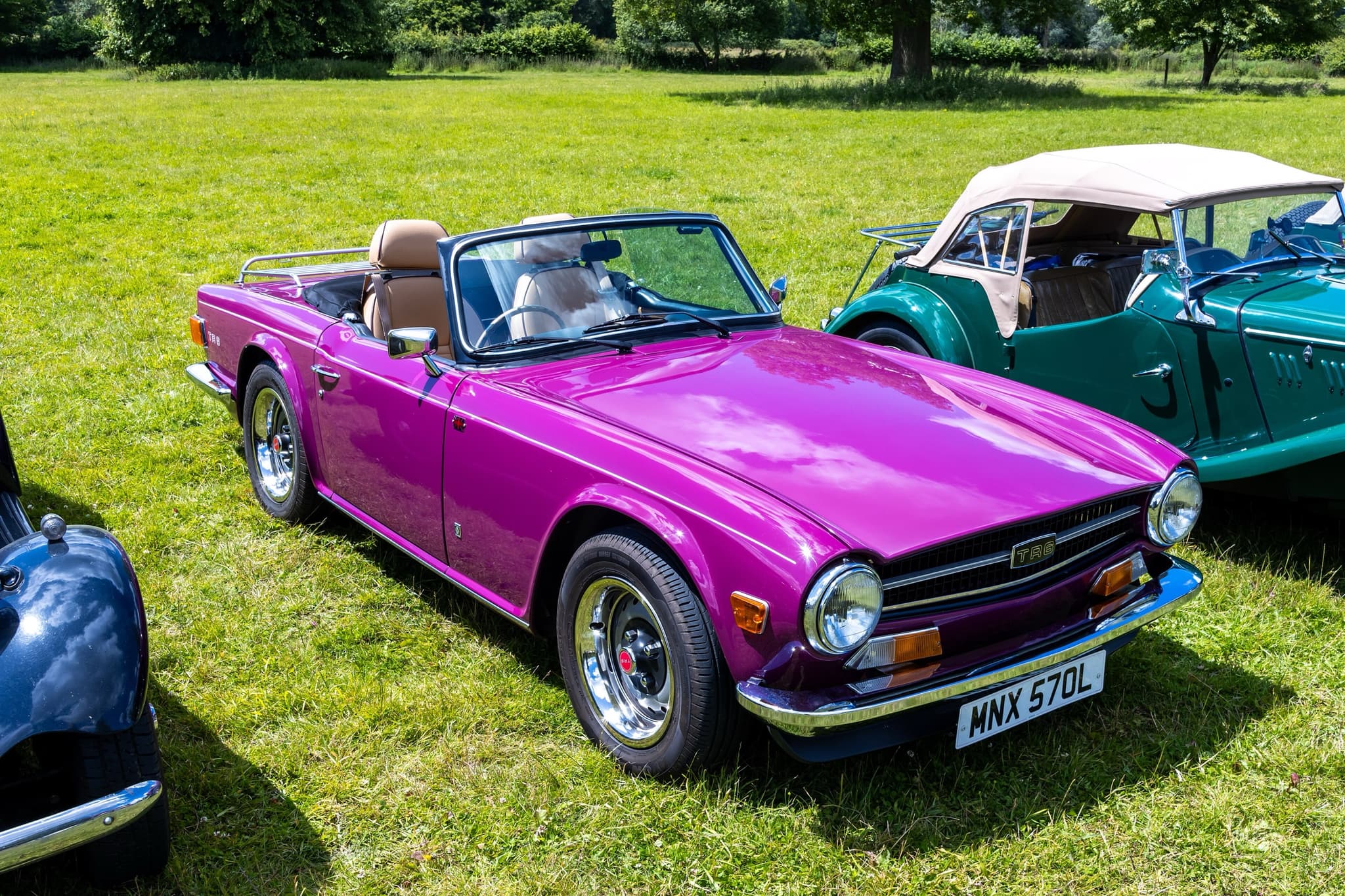
Laycock's J-type overdrive, working on third and top only, replaced the earlier A-type. On British cars overdrive became standard from commission number CR5000, the TR Register says, but American buyers still paid extra for it. For the 1974 model year the US TR6 gained black rubber overriders (bumper guards) front and rear, and for the 1975 model year a raised front bumper, with the indicators moved beneath it.
The quality of the cars did not keep pace. Clive Richardson, Motor Sport's assistant editor, bought a new TR6 in 1973 and found its finish "appalling", and when he said so, several hundred readers wrote in with stories of their own. A warranty assessor who joined British Leyland's San Francisco office in April 1975 later recalled "the absolute nadir of British Leyland product quality". The cars still sold: in 1974, the importer reported, supply could not keep up with demand, and Severson calls it the TR6's best year in America.source 10source 8source 20source 11source 21source 22source 23source 24source 3
Rivals
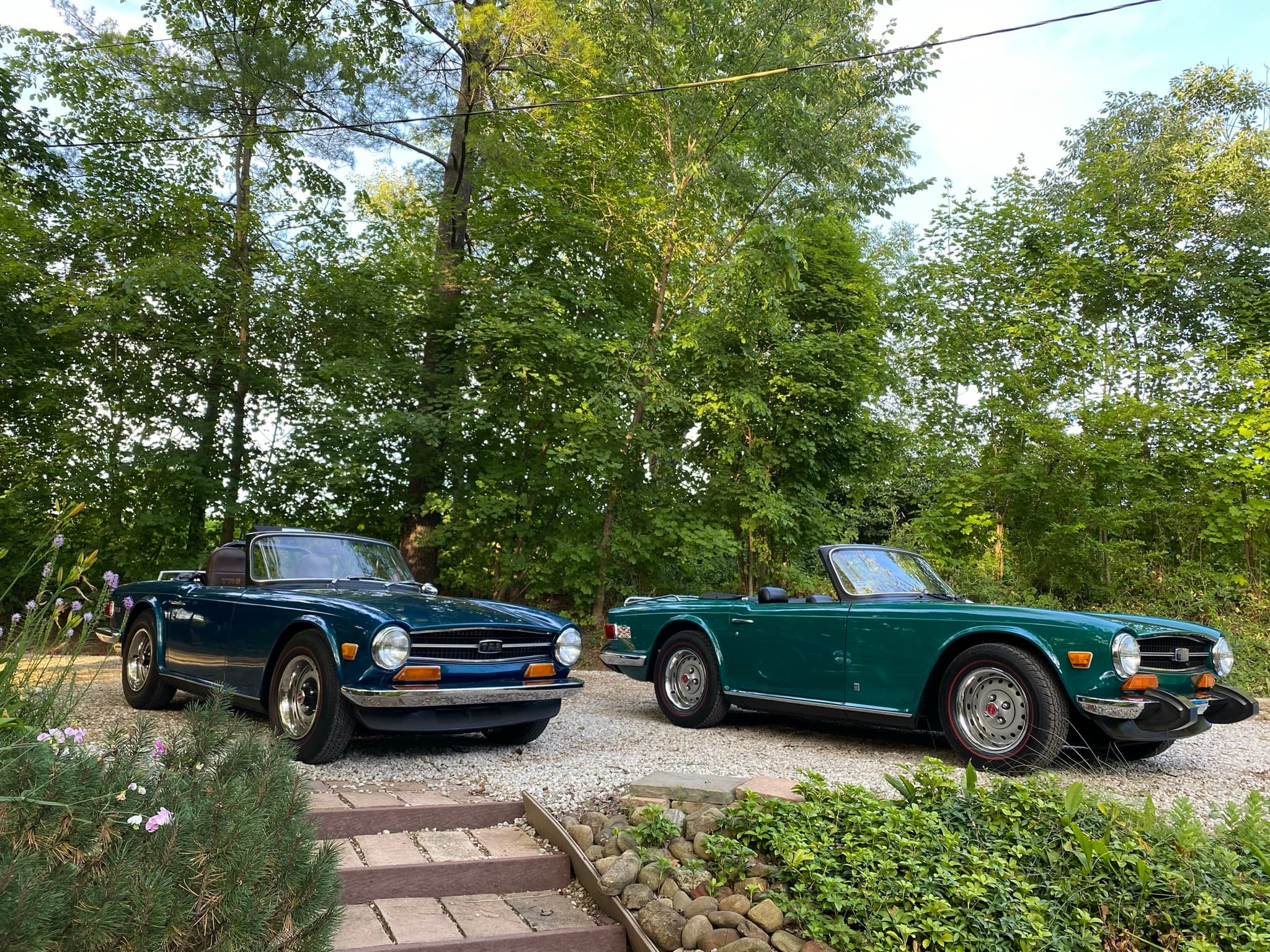
In America the rival that mattered was the Datsun 240Z, launched in 1969 like the TR6, with a six-cylinder engine of its own. Classic & Sports Car calls the contest the battle for America: it writes that the 240Z set a new benchmark, and sees the two cars as the handing over of America's sports-car market from Britain to Japan. On the track, 240Zs took all three places in C Production at the 1970 American Road Race of Champions, and a 240Z won the class in 1972, when Group 44's TR6 was second. From 1973 the Jensen-Healey was the TR6's nearest open rival in America, Moss Motoring writes, and both had gone from the showrooms by early 1977.
In Britain, Clive Richardson set out the choice as he saw it when he bought his TR6 in 1973:
The open sports-car market is severely restricted, particularly in the middle price bracket, under £2,000, restricted virtually to the TR6, Jensen-Healey and the Morgan Plus 8.
Of those, he saw the Jensen-Healey as an overgrown Spitfire whose reliability was still in doubt, and the Morgan as a car whose wait was reputed to run to years, and he thought a Lotus Europa handled better. Severson adds that a Ford Capri 3000 GT cost about the same as a TR6 PI and was more practical. The MGB, cheaper, outsold every TR of the period: Severson writes that TR production from the TR4 to the TR6 was "a fraction of the MGB's tally".
| Rival | Market | What the sources give |
|---|---|---|
| Datsun 240Z | America and Britain | £2,288 new in Britain in 1971, basis not stated; 156,078 built, 1969–73 (Classic & Sports Car) |
| MGB | America | $2,875 on AROnline's March 1971 list |
| Triumph Spitfire | America | $2,649 on the same list |
| Triumph Stag | America | $5,773 with hardtop, on the same list |
| Jaguar E-type V12 convertible | America | $6,950 on the same list |
| Fiat 124 Spider | America | Dearer than the TR-6 in Road & Track's 1974 price order |
| Jensen-Healey and Morgan Plus 8 | Britain | Under £2,000 in 1973 (Motor Sport) |
| Ford Capri 3000 GT | Britain | About a TR6 PI's price (Severson) |
Road & Track ranked 11 cars it had tested in 1972 and 1973 in approximate order of price, and the TR-6 came 8th, cheaper only than the Fiat 124 Spider, the BMW 2002 and the Saab 99EMS. The rivals page sets them out in more detail.source 10source 3source 9source 25source 26source 27source 28source 29source 30
Before and after the TR6
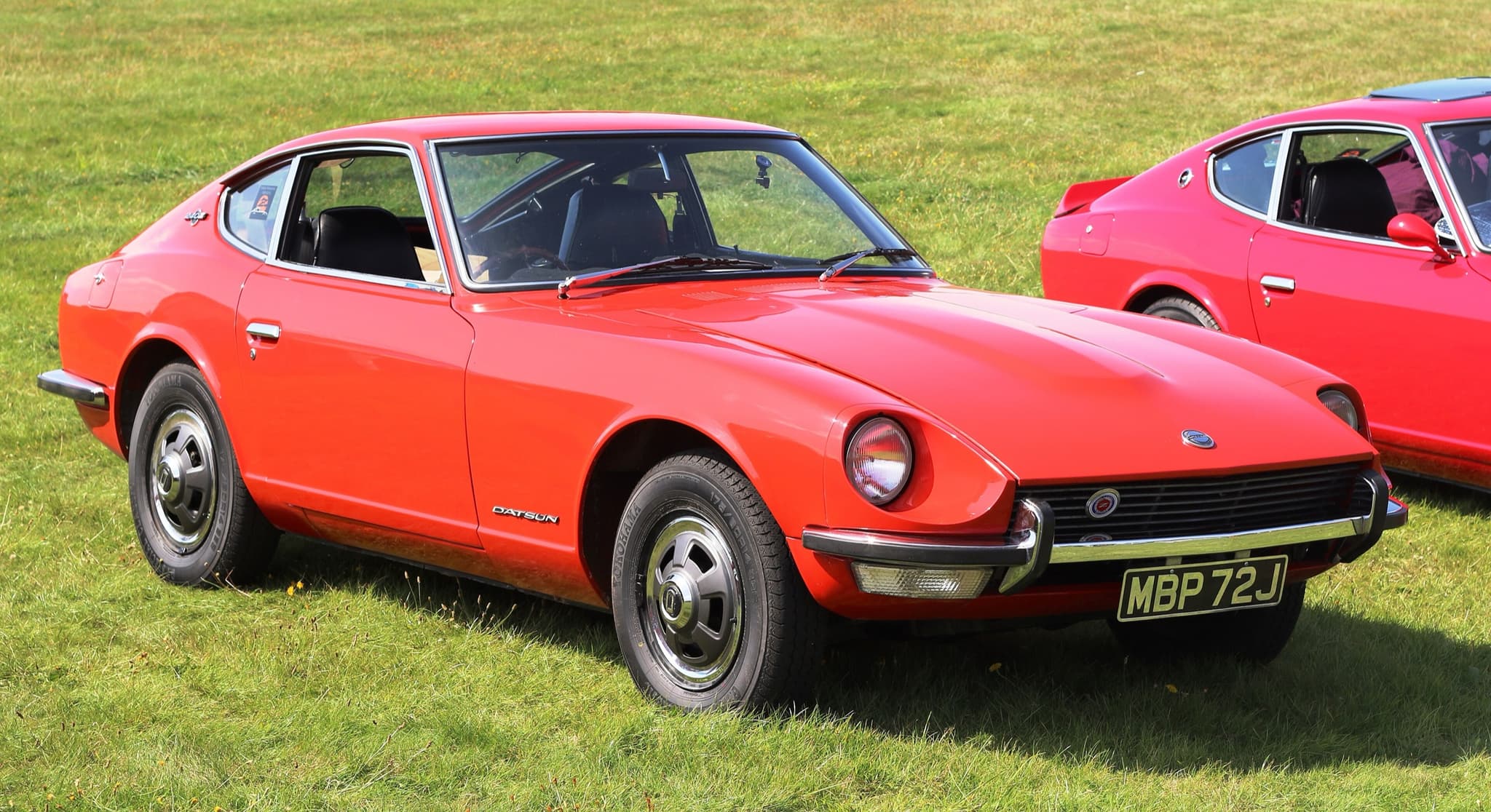
The TR5 PI and the TR250 that came before it were built from the summer of 1967 to 19 September 1968, and the TR6 kept their frame, engines and running gear and the middle of their body: Revington TR lists the doors, the windscreen frame, the floor, the sills (rocker panels) and the bulkhead. In America the TR6 also filled the place of the Austin-Healey 3000 in the market, though no source read says that British Leyland planned it so: Classic & Sports Car writes that it made the most of the big Healey's demise, and Moss Motoring has paired the two six-cylinder cars as the nearest Britain came to a muscle car.
Its successor, code-named Bullet, was in hand from about 1969, according to AROnline, as a replacement for both the GT6 and the TR6, and under way by 1971, TR-Register Deutschland says. Built at Speke from September 1974, the TR7 was, in the TR Register's words, "completely different in body shape, engineering and mechanics". Most critics and many buyers, Severson writes, missed the old car's torque, its overdrive and its "wind-in-the-hair joie de vivre".
The end, 1975–76
By the end of 1974 there were rumours that the TR6 was finished, and Clive Richardson of Motor Sport passed on what the factory told him:
I understand from Triumph that contrary to rumour it will continue in production for some time.
The injected car went first. The last TR6 PI, CR6701, was built on 7 February 1975. Severson writes that Rover-Triumph wanted to be rid of the injected engine, and dates its end, with the 2.5 PI saloon's, to the summer of 1975; the TR6's own build record stops earlier. The TR7 did not go on sale in Britain until 19 May 1976, 15 months after the last TR6 PI.
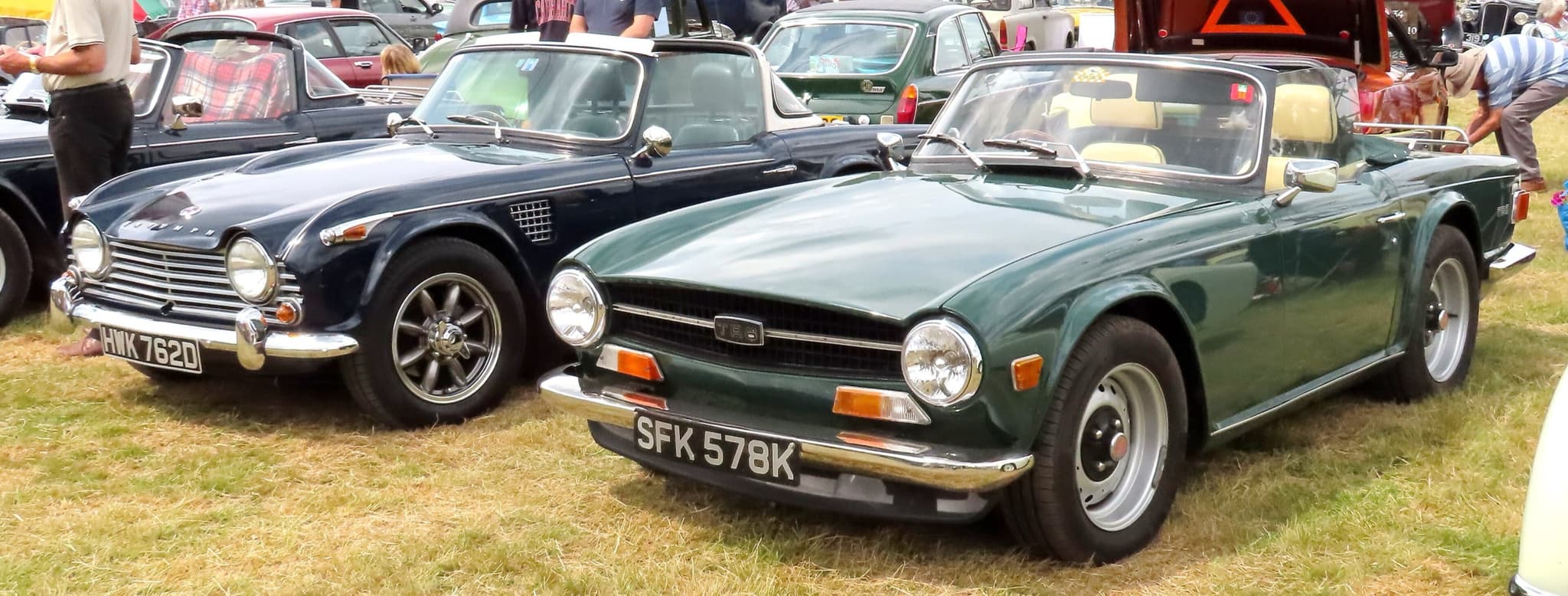
In America the TR6 went on. When the TR7 was launched there in January 1975, Motor Sport reported that it "will not replace the TR6, for the time being at least". At the London Motor Show that October a Leyland official on the stand said that TR6 production had ceased; Tony Spalding, the company's director of public relations, then confirmed that it would carry on at 150 a week until the following June, Motor Sport reported. American dealers, Severson writes, found the TR6 "an easier sale than the controversial new TR7", and in June 1976 they delivered 639 of them, by the importer's figures.
The last TR6, CF58328U, was built on 15 July 1976. Some 1976 cars were not sold until 1977, which gave them 1977 papers, but none was built that year. The last car off the line, Severson writes, went to Bob Tullius, whose Group 44 had raced TR6s since 1969, and Moss Motoring said in 1994 that Bob Tullius Racing owned it.source 1source 8source 3source 33source 31source 34source 21source 35source 36source 37source 38
Sources
Sources are given as plain text; their addresses are on the sources page.
- Primarymade at the time, by the maker or by people who were there
- Referenceserious later work: clubs, specialists, magazines, books
- Databaseresults and listings, entry by entry
- Graham Robson (foreword), Triumph TR6 1969–1976 Parts & Accessories Catalogue, Rimmer Bros, edn 2.2 (source code TR600313), p. 5, Vehicle identification: CC25003L, built 19 September 1968; p. 2, Robson's foreword; p. 5, CP25001, the CKD kits, CP25156; p. 5, the five CKD ranges; p. 5, CR6701 (7 February 1975) and CF58328U (15 July 1976). Reference
- Drew Holliday, "Triumph TR250 Production Information" (8 pp. PDF), Vintage Triumph Register, p. 1, the last TR5 (CP3101) and TR250 (CD8594L), 19 September 1968; p. 1, first and last TR250s and TR5s. Reference
- Aaron Severson, "Grandfather's Ax: The Many Evolutions of the Triumph TR4, Part 2: TR5, TR250, and TR6", Ate Up With Motor, 7 Nov 2012, TR in twilight: the TR7's lateness and almost eight years; A new bottle: the Triumph TR6 (the mid-1967 decision; McWilliams; the saloons; Karmann's price and deadline; Giesecke; the tooling contract for the Mk 2 saloons); A new bottle: the anti-roll bar, the first on a production TR; spring and damper rates; A new bottle: the launch prices against the TR5 PI and TR250; devaluation; notes on sources: Car and Driver, February 1969; The BMC-Leyland merger: Stokes, Turnbull, Webster, Swindle, King; little additional development; TR in twilight: 1974, the peak year; TR in twilight: the Capri 3000 GT; the MGB's tally; A new bottle; TR in twilight: Bullet's timing; the TR7's reception; TR in twilight: the injected engine's end; "an easier sale". Reference
- Bruno Dwinger, "Geschichte, Typenkunde und Kaufberatung: British Leyland Triumph TR 6PI und TR 6 (Vergaser) – Die Karmann Autos", TR-Register Deutschland, c. 2010, 13 pp. (PDF), p. 1, not enough money for a new car; Michelotti without time; the clay model, September 1967; the presses; p. 1, the bodies made at Speke; p. 1, shown to the public in January 1969; p. 2, the customs advantages; the CKD ranges; the Stag-type gearbox internals; p. 1, the successor under way by 1971. Reference
- Revington TR, "Technical Specification Change Points" (TR6), "Michelotti being busy"; the parts carried over; the itemised parts carried over. Reference
- Moss Motoring, "Britain's Big Iron", Dec 2002, TR6 section: Karmann's work for VW, Porsche and BMW; the TR6 beside the big Healeys; "the best-selling TR in history when production ended in 1976". Reference
- Triumph Sports Owners Association, Triumph Sports Owners Association Newsletter, January 1969, Jan 1969 (vol. 15 no. 1), p. 1, the new body described; p. 1, "there is now a front anti-roll bar"; the rims; p. 1, "the TR-6 is here". Primary
- Vintage Triumph Register, "TR6" (history, year-by-year changes, US production table, buyer's guide), history and change list: the body; history: the wider rims; Spotter's Guide, '68: CP25001; change list, '70 to '72; change list, '73 to '75; production page: more TR6s than any earlier TR; Spotter's Guide, '76: the last PI and the last TR6; cars titled in 1977. Reference
- Charlie Calderwood, "Datsun 240Z vs Triumph TR6: the battle for America", Classic & Sports Car, 1 Feb 2023, "reheated bodywork"; the battle for America; the factfiles (240Z price, 1971; units 1969–73); the Healey's demise. Reference
- Clive Richardson, "The Tale of a TR6", Motor Sport, Nov 1973, p. 54, p. 54, Spen King and the anti-roll bar; p. 54, Malines and the French-made Dunlops; p. 54, the 1973 changes; the camshaft; the finish; p. 54, the open-car market under £2,000; the Lotus Europa. Primary
- TR Register, "Buyer Beware: TR6" (2 pp. PDF leaflet), p. 1, introduced January 1969; p. 1, the Belgian cars: PI, left-hand drive, the numbers; p. 1, the 1970 model-year changes; p. 1, overdrive standard from CR5000; the 1974 overriders; p. 2, the TR7 "completely different". Reference
- Triumph Sports Owners Association, Triumph Sports Owners Association Newsletter, February 1969, Feb 1969, p. 1, the dock strike; the competition TR-6 for Las Vegas. Primary
- TR Register, "Triumph TR6 Buyers Guide" (facts sheet), the performance table: Autocar, 17 April 1969. Reference
- Motor Sport, Readers' letters on the TR6 (group), Feb 1970, p. 54; Jun 1973, p. 94; Aug 1973, p. 77; Jan 1974, p. 57, Jun 1973, p. 94: a TR6 assembled at Mechelen. Primary
- Triumph Sports Owners Association, Triumph Sports Owners Association Newsletter, March 1970, Mar 1970, the steering column lock. Primary
- Standard-Triumph, Triumph TR6 P.I. (sales brochure), UK, Dec 1970, publication 426/1270/ENG, specification note: the steering lock for 1971. Primary
- Triumph Sports Owners Association, Triumph Sports Owners Association Newsletter, November–December 1971, Nov–Dec 1971 (vol. 17 nos. 11–12), the 1972 model year: compression lowered, no loss of power. Primary
- Bill Boddy, "Matters of Moment", Motor Sport, Nov 1972, p. 19, p. 19, the Group 44 TR6 at Earls Court; Lord Stokes. Primary
- Triumph Sports Owners Association, Triumph Sports Owners Association Newsletter, November 1972, Nov 1972 (vol. 18 no. 11), the 20th anniversary exhibit. Primary
- Triumph Sports Owners Association, Triumph Sports Owners Association Newsletter, January 1973, Jan 1973 (vol. 19 no. 1), p. 2, the 1973 model year. Primary
- Clive Richardson, "The continuing tale of a TR6", Motor Sport, Dec 1974, p. 53, p. 53, overdrive standard since the beginning of 1974; the readers' letters; p. 53, "contrary to rumour". Primary
- Triumph Sports Owners Association, Triumph Sports Owners Association Newsletter, December 1973, Dec 1973, p. 2, the 1974 model year: bumper guards; overdrive an option. Primary
- Triumph Sports Owners Association, Triumph Sports Owners Association Newsletter, December 1974, Dec 1974, the 1975 model year; supply short of demand. Primary
- Moss Motoring, "John F. Quilter, Warranty Claims Assessor", 19 May 2021, the San Francisco zone office, April 1975. Reference
- Triumph Sports Owners Association, Triumph Sports Owners Association Newsletter, December 1970, Dec 1970 (vol. 16 no. 12), the 1970 ARRC, C Production. Primary
- Triumph Sports Owners Association, Triumph Sports Owners Association Newsletter, December 1972, Dec 1972 (vol. 18 no. 12), p. 2, the 1972 ARRC. Primary
- racingsportscars.com, "Triumph TR6 – All Results", ARRC 1972, C Production. Database
- Moss Motoring, "Triumph in America", 1 Mar 2001, the Jensen-Healey from 1973; both gone in early 1977. Reference
- Road & Track, Road & Track, June 1974, Jun 1974, the introductory table of 1972–73 test figures, in ascending order of price. Primary
- Chris Cowin, "History: Exporting British cars to the USA – Part Two", AROnline, 31 May 2025, updated 21 Oct 2025, US list prices, March 1971. Reference
- Keith Adams, "The Cars: Triumph TR7/TR8 development story", AROnline, updated 8 Feb 2024, Bullet from 1969; Speke, September 1974; the US launch; timeline: January 1975 (US); 19 May 1976 (UK). Reference
- Malcolm Paris (compiler), "Triumph TR7 / TR7 V8 and TR8 Buyers Guide", TR Register, the TR7's total. Reference
- Clive Richardson ("C.R."), "The TR7 makes a quiet British bow", Motor Sport, Feb 1975, p. 30, p. 30, the TR7 sold alongside the TR6. Primary
- Clive Richardson ("C.R."), "Triumph TR7: sports car or two-seater saloon?", Motor Sport, Jun 1976, p. 63, on sale in Britain from 19 May 1976. Primary
- Motor Sport, News, editorials and short items on the TR7 (group), Jul 1975 – Aug 1981; Apr 2002, Nov 1975, p. 30: TR6 production at 150 a week until June. Primary
- Triumph Sports Owners Association, Triumph Sports Owners Association Newsletter, May–June 1976, May–Jun 1976, June 1976 deliveries. Primary
- Moss Motoring, "Twenty-Five years of the TR6: A Nostalgic Profile", Oct 1994, cars on dealers' lots into the 1977 model year; the last TR6 owned by Bob Tullius Racing, 1994. Reference
- Moss Motoring, "Bob Tullius, Group 44 Inc.", 5 Apr 2009, Group 44's TR6s, 1969–75. Reference