Triumph TR6 Designer
Who designed the TR6? Karmann of Osnabrück, in West Germany, redrew its nose and tail in about a year, on the middle of the body Giovanni Michelotti had styled for the TR4. What each of them did, and the stories that give the car to someone else.
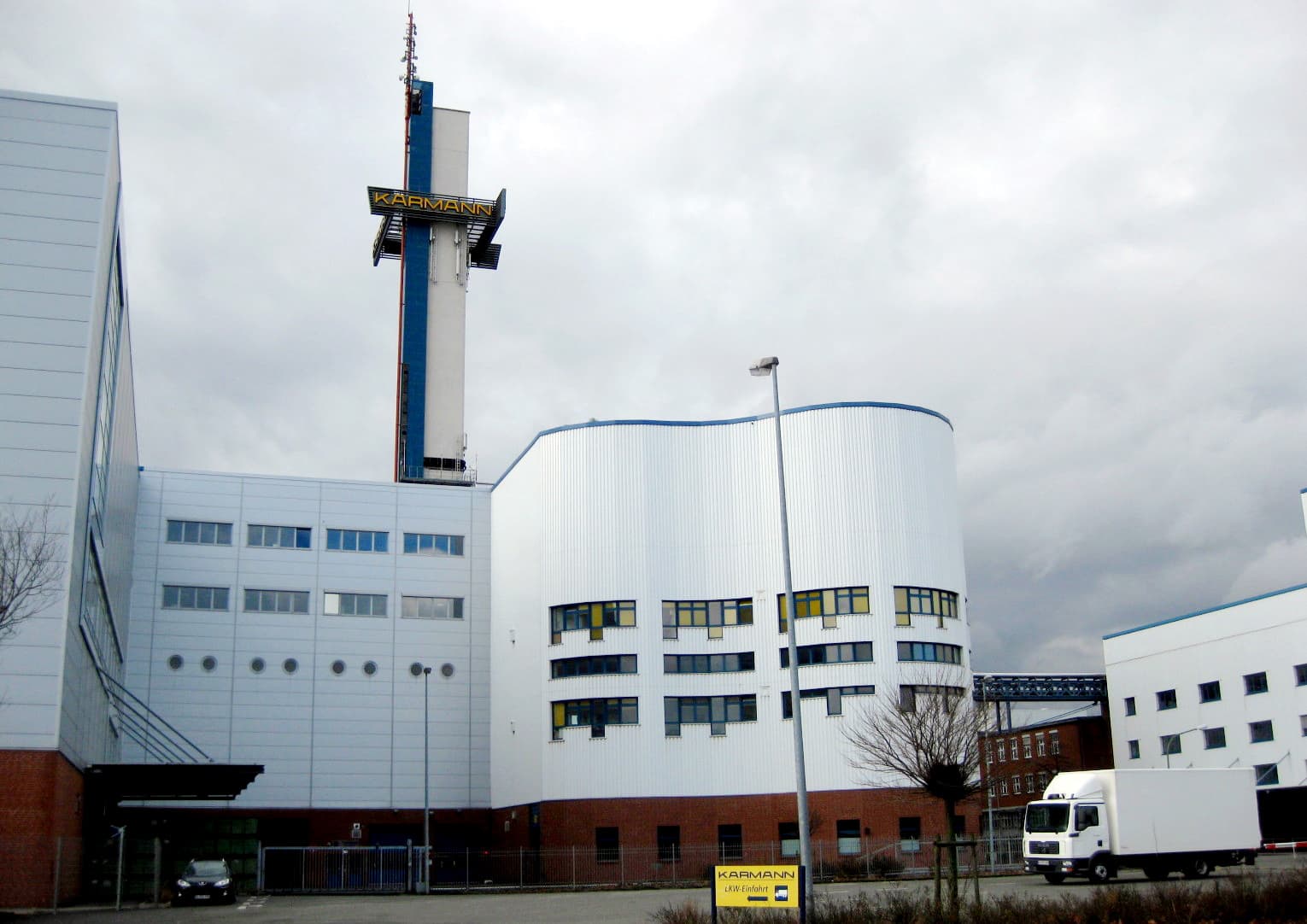
The TR6 has two designers, and neither of them drew all of it. The middle of the car, its doors, windscreen (windshield) and floor, was the TR4's, whose body Giovanni Michelotti had styled. Its new nose and tail came from Germany. When Standard-Triumph wanted a new look for the TR5 in 1967, TR-Register Deutschland explains, its usual stylist could not take the job:
Da der Vertragsdesigner Giovanni Michelotti keine Zeit für einen Neuentwurf hatte … suchte man in Europa einen anderen Partner für das Vorhaben und fand in Deutschland die Firma Karmann.
In English, our translation: since the contract designer Giovanni Michelotti had no time for a new design, a different partner for the project was sought in Europe, and found in Germany, in the firm of Karmann. Revington TR gives the same reason, and Aaron Severson writes that Leyland had more pressing work for him, among it a restyle for its saloons (sedans), the 2000 and the 2.5 PI.source 1source 2source 3
What Karmann was
Wilhelm Karmann GmbH was a coachbuilder and contract manufacturer at Osnabrück, in West Germany, whose other clients, Moss Motoring notes, included Volkswagen, Porsche and BMW. Severson writes that it quoted a competitive price for the restyle and its tooling together. He is the only source read that names the man who drew it:
The TR facelift was done instead by Gerhard Giesecke of the West German coachbuilder Karmann, which didn't flinch at Triumph's daunting deadline …
Severson adds that the design was reportedly shaped with much input from Triumph's North American organisation, and that the result won Karmann the tooling contract for the saloons' Mk 2 versions as well. By TR-Register Deutschland's dating the clay model was accepted in September 1967; it says that Karmann supplied the presses for the new panels and that the bodies were then made at Speke, near Liverpool, for the cars to be built at Canley.
The restyle, panel by panel
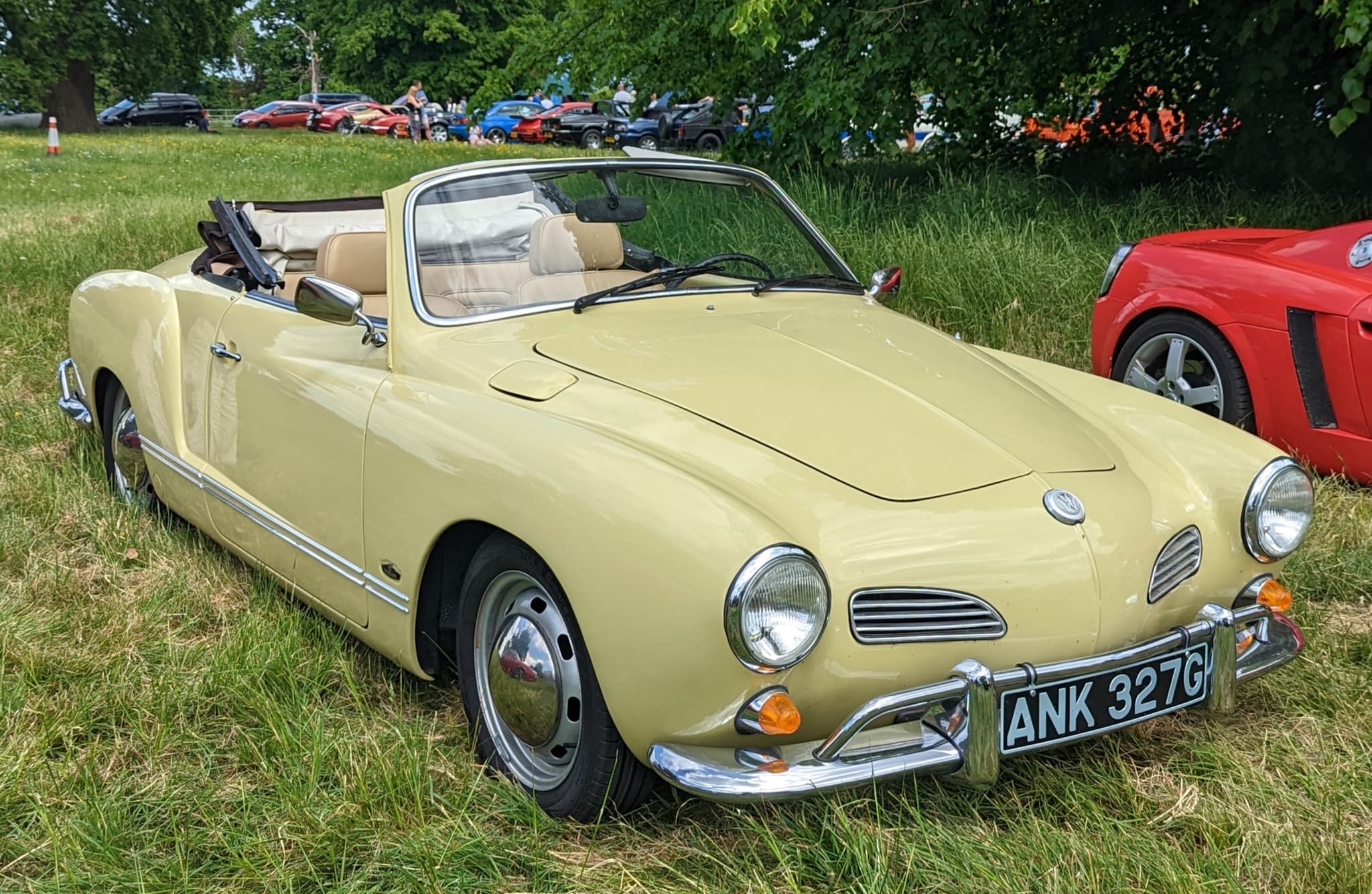
Karmann redrew everything at the ends of the car and nothing in between. The bonnet (hood) lost the TR5's bulges: "No more eyebrows in the hood for lights or bulges for carburetors!", the American importer told owners, describing "a smoothly sloping expanse of metal". The headlamps moved out to the ends of a full-width grille, which the British brochure called "the long, low, black grille", and the front wings (fenders) were new; "All four wings are bolted on", the brochure added. At the back, new wings ran to a squared-off tail, with lamps that wrapped round its corners and a flat panel painted black between them, over a somewhat bigger boot (trunk), though Moss Motoring noted in 1994 that it was a little more awkward to reach into.
What stayed was the structure. The Vintage Triumph Register describes the TR6 as using the main substructure of the TR4 and TR250, and Severson calls it largely carried over; Revington TR names the parts kept: doors, windscreen frame, floor pans, sills (rocker panels) and bulkhead. Graham Robson, who saw the new car at Canley before its launch, gave the credit to both, which is fair, so long as each is credited with its own part.
Karmann's ends 4
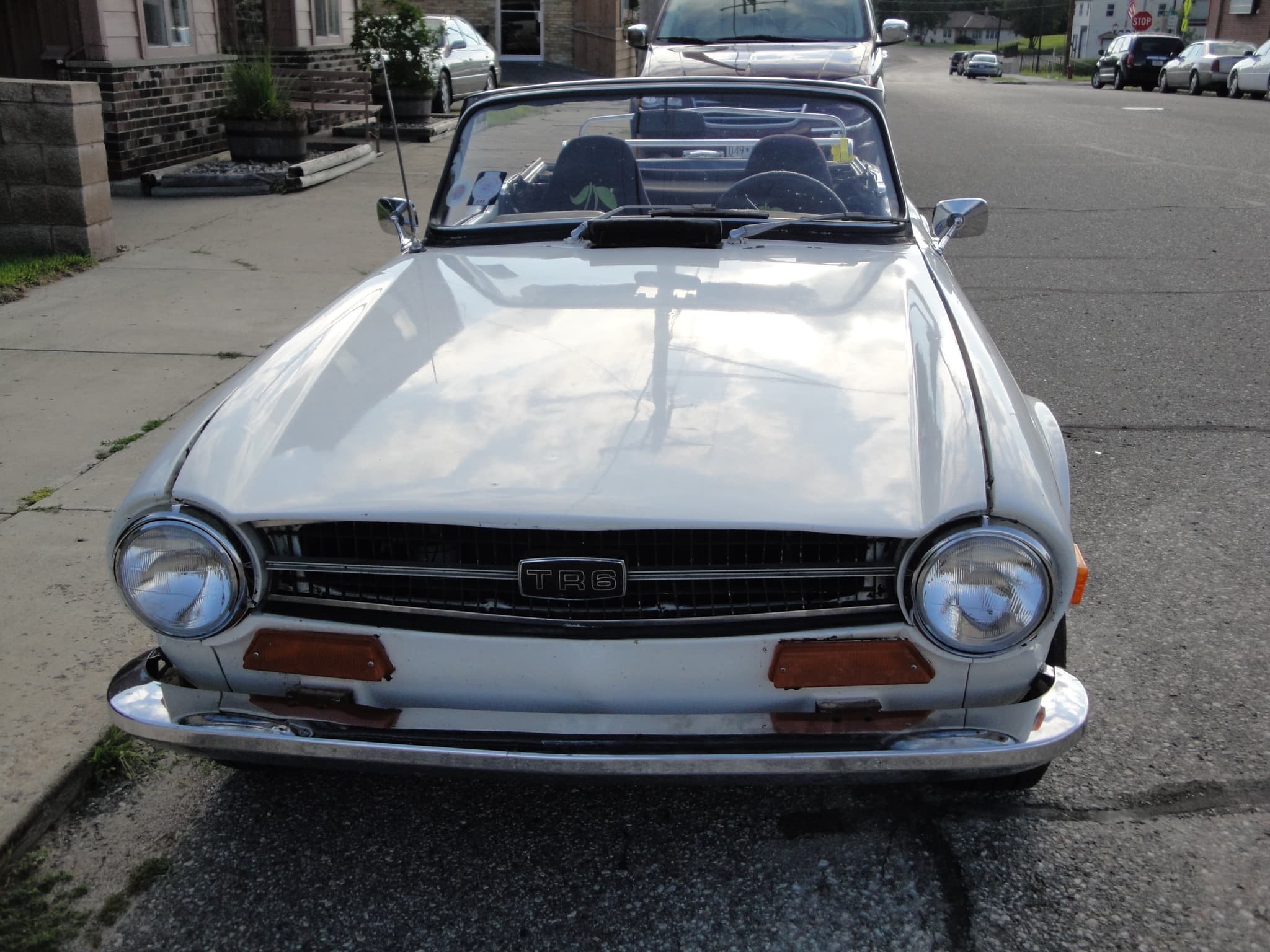
1 Karmann's nose, head-on: the headlamps set at the two ends of the grille, on an early left-hand-drive TR6 photographed in Minnesota.
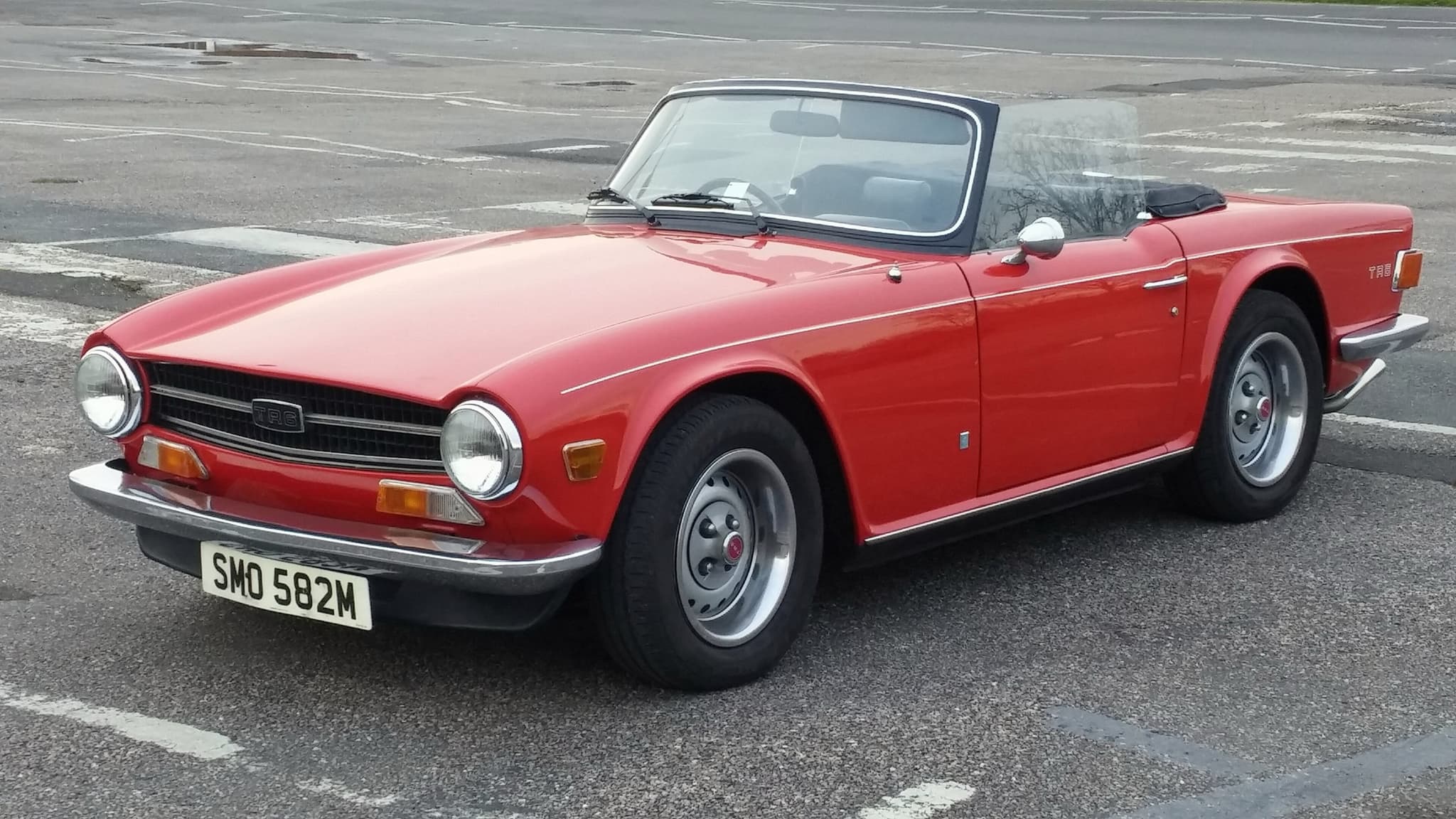
2 The flat bonnet and bolt-on front wings of a late right-hand-drive TR6, in February 2017.
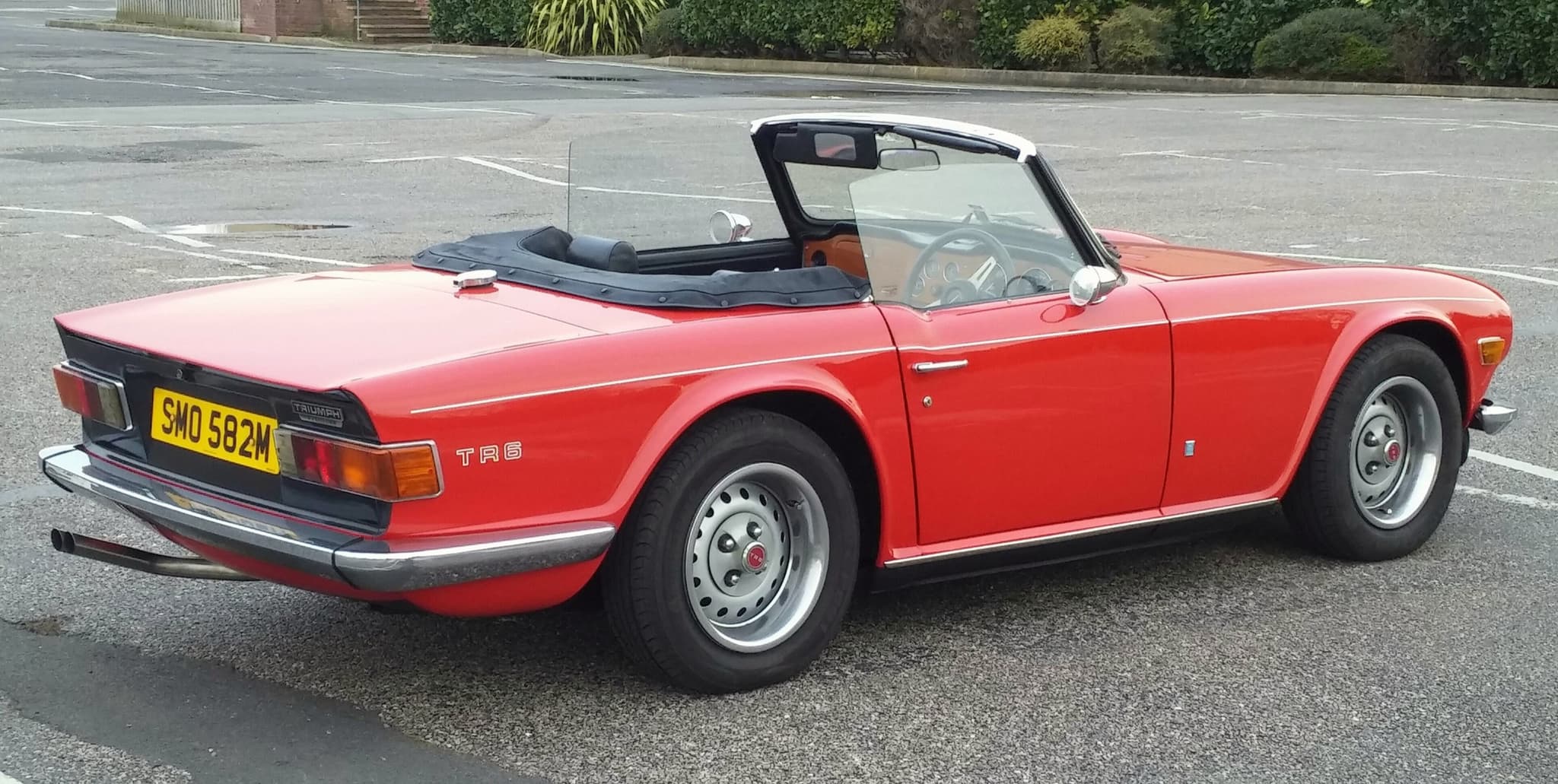
3 The same car's tail: squared off, its wrap-round lamps either side of a flat black panel.
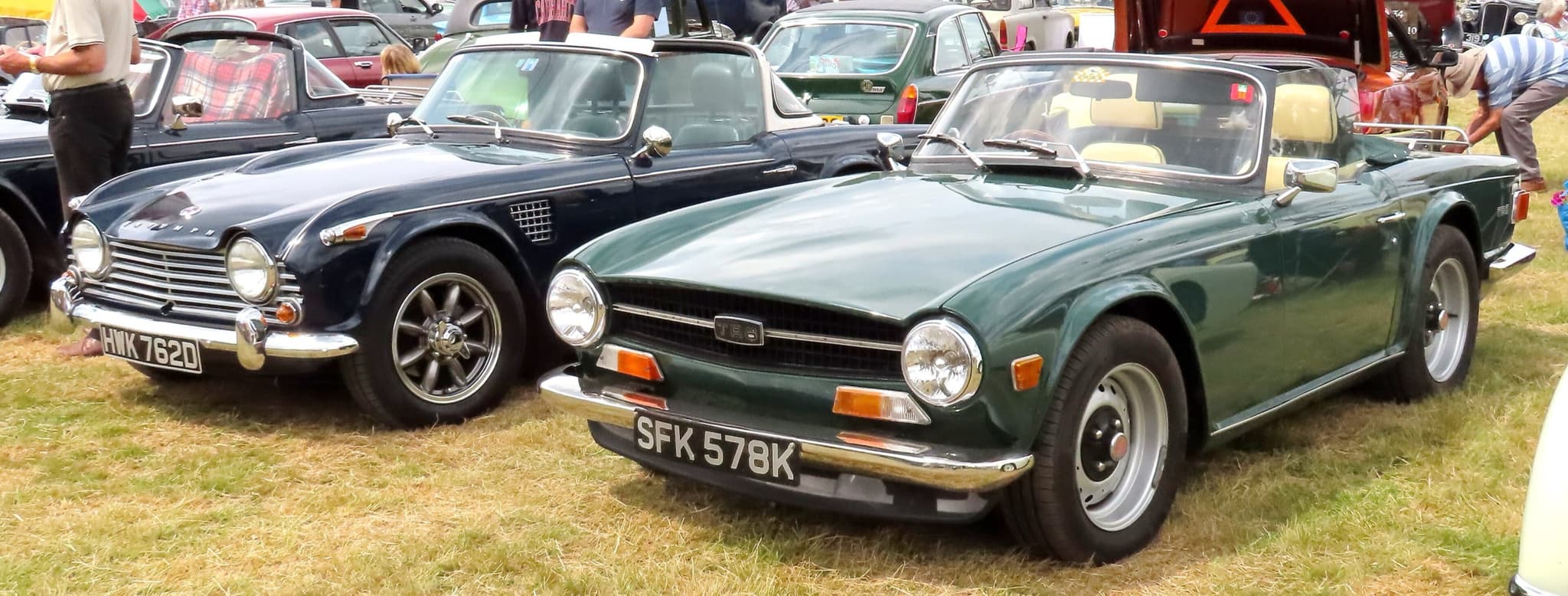
4 Old ends and new: on the left the body Michelotti drew, as the TR4A, TR5 and TR250 wore it, and on the right a TR6 (Aldham, 2019).
Picture credits (4)
- 1 Greg Gjerdingen from Willmar, USA, CC BY 2.0
- 2 Andrew Bone from Weymouth, England, CC BY 2.0
- 3 Andrew Bone from Weymouth, England, CC BY 2.0
- 4 kitmasterbloke, CC BY 2.0
How long did Karmann take?
Fact check
About a year
TR-Register Deutschland ("innerhalb eines Jahres", within a year) and Severson ("a little over a year", from clay to production)
14 months
Moss Motoring, in 2002 and again in 2009
Our reading. TR-Register Deutschland's and Severson's figures fit the dates: the clay model was accepted in September 1967 and the first TR6 was built in September 1968, so about a year it was. Moss Motoring's 14 months, twice from the same publisher, does not say from when it counts. A figure of six months, sometimes repeated, has no source that we have found.source 1source 3source 10source 4
Sources
Sources are given as plain text; their addresses are on the sources page.
- Primarymade at the time, by the maker or by people who were there
- Referenceserious later work: clubs, specialists, magazines, books
- Bruno Dwinger, "Geschichte, Typenkunde und Kaufberatung: British Leyland Triumph TR 6PI und TR 6 (Vergaser) – Die Karmann Autos", TR-Register Deutschland, c. 2010, 13 pp. (PDF), p. 1, "Da der Vertragsdesigner Giovanni Michelotti keine Zeit …"; p. 1, the clay model, September 1967; the presses; Speke; p. 1, "innerhalb eines Jahres". Reference
- Revington TR, "Technical Specification Change Points" (TR6), Michelotti busy; the restyle front and rear; doors, windscreen frame, floor pans, sills and bulkhead kept. Reference
- Aaron Severson, "Grandfather's Ax: The Many Evolutions of the Triumph TR4, Part 2: TR5, TR250, and TR6", Ate Up With Motor, 7 Nov 2012, A new bottle: Michelotti and the saloons; A new bottle: "The TR facelift was done instead by Gerhard Giesecke …"; the price and the deadline; North American input; the Mk 2 tooling; A new bottle: structurally largely carryover; the tail; A new bottle: "a little over a year". Reference
- Moss Motoring, "Britain's Big Iron", Dec 2002, Karmann "well known for its work for VW, Porsche, and BMW"; "Given only 14 months". Reference
- Triumph Sports Owners Association, Triumph Sports Owners Association Newsletter, January 1969, Jan 1969 (vol. 15 no. 1), p. 1, "styled by Karmann-Ghia"; p. 1, the new body described: "No more eyebrows in the hood …"; "a smoothly sloping expanse of metal". Primary
- Graham Robson (foreword), Triumph TR6 1969–1976 Parts & Accessories Catalogue, Rimmer Bros, edn 2.2 (source code TR600313), p. 208, "Kharman Ghia"; p. 2, Robson's foreword: Michelotti and Karmann together. Reference
- Standard-Triumph, Triumph TR6 P.I. (sales brochure), UK, Dec 1970, publication 426/1270/ENG, "All four wings are bolted on"; "the long, low, black grille". Primary
- Vintage Triumph Register, "TR6" (history, year-by-year changes, US production table, buyer's guide), change list: the body; "using main substructure of the TR4/250". Reference
- Moss Motoring, "Twenty-Five years of the TR6: A Nostalgic Profile", Oct 1994, the boot hard to reach. Reference
- Moss Motoring, "Triumph TR6: An Enduring Classic", 9 Jan 2009, "Triumph requested tooling 14 months later". Reference